Ukraine goes to polls after vitriolic campaign
Nationalist heroine or Russian favourite? Five years on from the Orange Revolution, the former Soviet state must choose – and it's set to be close

For free real time breaking news alerts sent straight to your inbox sign up to our breaking news emails
Sign up to our free breaking news emails
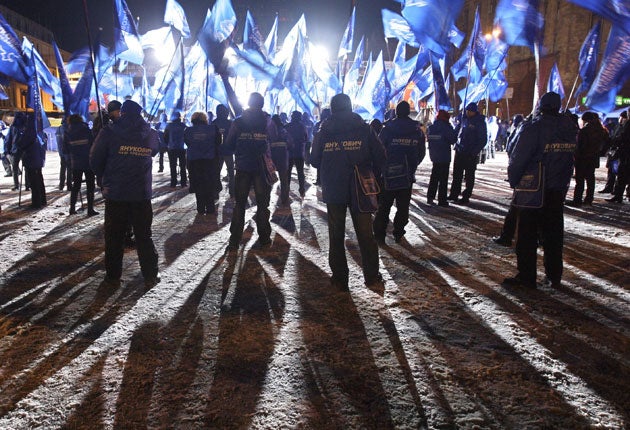
Ukrainians go to the polls to elect a new president today in the second round of an election that has been marked by vitriol and personal insults between the two candidates. If, as many analysts predict, Viktor Yanukovych gets a narrow victory, it will be a remarkable turnaround in his personal fortunes, and the country will have come full circle since the Orange Revolution five years ago.
But whatever happens, the country is likely to see a shift back towards Russia, whether the vote is won by the dour Mr Yanukovych, who draws his main support from the Russian-speaking south and east of Ukraine, or his bitter rival, the fiery nationalist Yulia Tymoshenko, heroine of the Orange Revolution.
The two candidates have radically different bases, which reflect the east-west divide in Ukraine. Mr Yanukovich is most popular in the grimy eastern mining towns and gets his financial support and political backing from the oligarchs who control the mines and factories. Ms Tymoshenko appeals mostly to those in the Ukrainian-speaking west of the country.
But while one of the promises of the Orange Revolution was to bring Ukraine closer to Europe and disengage from the suffocating Russian embrace, this no longer seems viable. In August, Russian President Dmitry Medvedev sent Viktor Yushchenko, the Ukrainian President, a letter, criticising him for the "anti-Russian course" on which he had led the country. "In Russia, we hope that the new political leadership of Ukraine will be prepared to build relations between our countries that will, in practice, correspond to the genuine hopes of our nations, and the interests of European security," wrote Mr Medvedev in his letter, which essentially ended all co-operation between Mr Yushchenko's government and Moscow.
While Ms Tymoshenko still advocates integration with the EU, she is too astute not to realise that much depends on Moscow. There are the near-annual disputes over gas, and vast trade links between the two countries, all far too important to risk Moscow's ire.
She was once a hate figure in Russia on a par with Georgian president Mikheil Saakashvili. With her charismatic speeches and aggressive nationalism, she represented everything that the Russian authorities despised about the Orange Revolution. One Russian MP even made a pornographic film, in which lookalikes of Ms Tymoshenko and Mr Saakashvili plotted against Russia while frolicking in a sauna.
But Ms Tymoshenko has begun to mend fences. She has built up a rapport with Vladimir Putin, and is likely to embark on a rapprochement with Russia if elected. But there is still no doubt that Moscow would like Mr Yanukovych in charge. He is more likely to promote its language, and be less driven towards Nato and the EU.
The candidates took a breather from mudslinging yesterday in an official "day of silence" before the election. Many analysts expect Mr Yanukovych to edge to victory, but the result is likely to be close.
Ms Tymoshenko has promised to bring her followers out into the streets if she believes Mr Yanukovych has tried to falsify the poll. Her supporters say Mr Yanukovych has brought 2,000 former police and security officials to Kiev, as a physical presence if things turn nasty.
Meanwhile, earlier in the week, Ukrainian special services said they had arrested five Russian secret agents near the city of Odessa, who were part of a plot to steal state secrets.
The story so far
The 2004 Orange Revolution was hailed in the West as part of a chain of "coloured revolutions" in former Soviet states that would kick out the old guard and bring in new, modernising democrats.
When Leonid Kuchma stepped down as president, Viktor Yanukovych was his chosen successor and the Kremlin's shoo-in. But thousands of Ukrainians, disillusioned with the rigged election, came out on to the streets, demanding a rerun – a rerun that saw Viktor Yushchenko, his face disfigured by a poisoning attempt, sweeping to victory with Yulia Tymoshenko at his side.
But, since then, it has been downhill for the Orange revolutionaries. Tymoshenko soon fell out with Yushchenko, leading to a three-way power struggle between the two of them and a revamped Yanukovych. Promised reforms were stalled, corruption flourished, and annual disputes over gas with Russia threatened to bring the country to its knees.
Subscribe to Independent Premium to bookmark this article
Want to bookmark your favourite articles and stories to read or reference later? Start your Independent Premium subscription today.
Join our commenting forum
Join thought-provoking conversations, follow other Independent readers and see their replies