US warns of 'implosion' of Nato alliance in Afghanistan

For free real time breaking news alerts sent straight to your inbox sign up to our breaking news emails
Sign up to our free breaking news emails
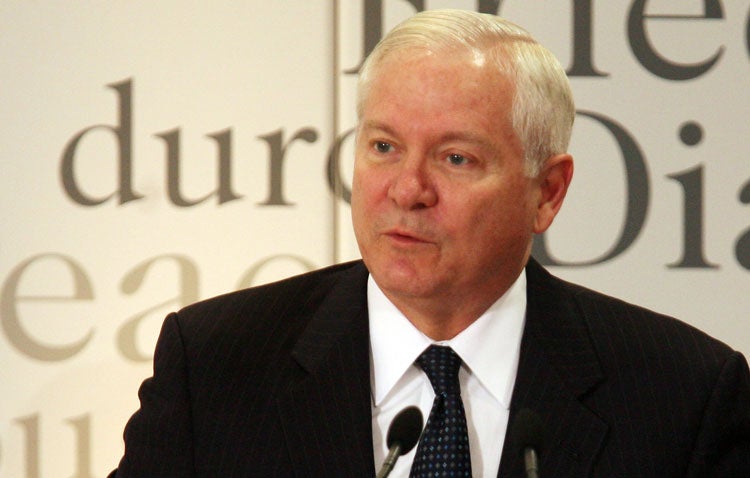
The US Defence Secretary, Robert Gates, appealed directly to Europeans yesterday to support the war in Afghanistan, warning that violence and terrorism would increase if Nato was defeated there.
Mr Gates said that the transatlantic alliance was under such stress over operations in Afghanistan that it risked imploding. Speaking in Munich to an audience that included presidents, foreign and defence ministers of many EU countries, Mr Gates acknowledged serious shortcomings in Nato operations in Afghanistan.
This was because the alliance was not working properly together to share the burden, he said.
"I am concerned that many people on this continent may not comprehend the magnitude of the direct threat to European security," he said. "We must not – we cannot – become a two-tiered alliance of those who are willing to fight and those who are not. Such a development, with all its implications for collective security, would in effect destroy the alliance."
Mr Gates's words took to a new, and far more acute, level arguments that have become ever sharper in recent months and culminated at an ill-tempered Nato summit in Lithuania last week. While the disputes at the Vilnius summit remained mostly behind closed doors, however, Mr Gates brought them loudly into the open at Munich.
Mr Gates was careful to name no names, but suggestions that some allies were less willing than others to sustain casualties have become a sensitive matter in Germany, where politicians are fending off calls from the Nato command either to contribute more troops to the international force as a whole, or to divert some of the troops serving under German command in northern Afghanistan to the more hostile terrain in the south.
Both the German Foreign minister, Frank-Walter Steinmeier, and the Defence minister, Franz Josef Jung, who had already addressed the Munich conference, had been at pains to set the record straight from their perspective. They insisted that the total number of German troops had been limited by the Bundestag, and there was little chance of an increase. They insisted, too, that northern Afghanistan was a dangerous place and Germany has taken casualties. They also argued that if, as Nato has proposed, some German troops were redeployed in the south, this would put at risk the continued success of the operation in the north.
German ministers recognise that their unwillingness to redeploy troops or increase the number is seen in some quarters as evidence of something akin to national cowardice.
While it is possible that France will send an additional 1,000 troops to help out in the south, this will not end the argument, which is partly about the whole performance of the alliance in Afghanistan, and partly about broader issues, such as the Nato command structure and commitment of individual members. As other speakers also noted, there was a deep gulf in public support for the operation between the US and many European countries, where it was doubted that success was even possible.
Mr Gates went out of his way to defend the Afghanistan operation as all of a piece with Nato's "core" purpose: "To defend the security interests and values of the transatlantic community". He presented Afghanistan as the epitome, in practice, of the threats that had been discussed by the alliance in theory during the 1990s – with the combination of an unstable state, terrorists linked by new technology; the nexus between drugs, terrorism and organised crime, as well as a "safe haven" that would allow "Islamic extremists to turn a poisonous ideology into a global movement".
Subscribe to Independent Premium to bookmark this article
Want to bookmark your favourite articles and stories to read or reference later? Start your Independent Premium subscription today.
Join our commenting forum
Join thought-provoking conversations, follow other Independent readers and see their replies