Ambushes and air strikes as Syrian regime fight rebels street-by-street to gain possession of Aleppo
Violence and expectation of more destructive strife to come, added to the sense of fear and the growing stream of refugees fleeing their home.

For free real time breaking news alerts sent straight to your inbox sign up to our breaking news emails
Sign up to our free breaking news emails
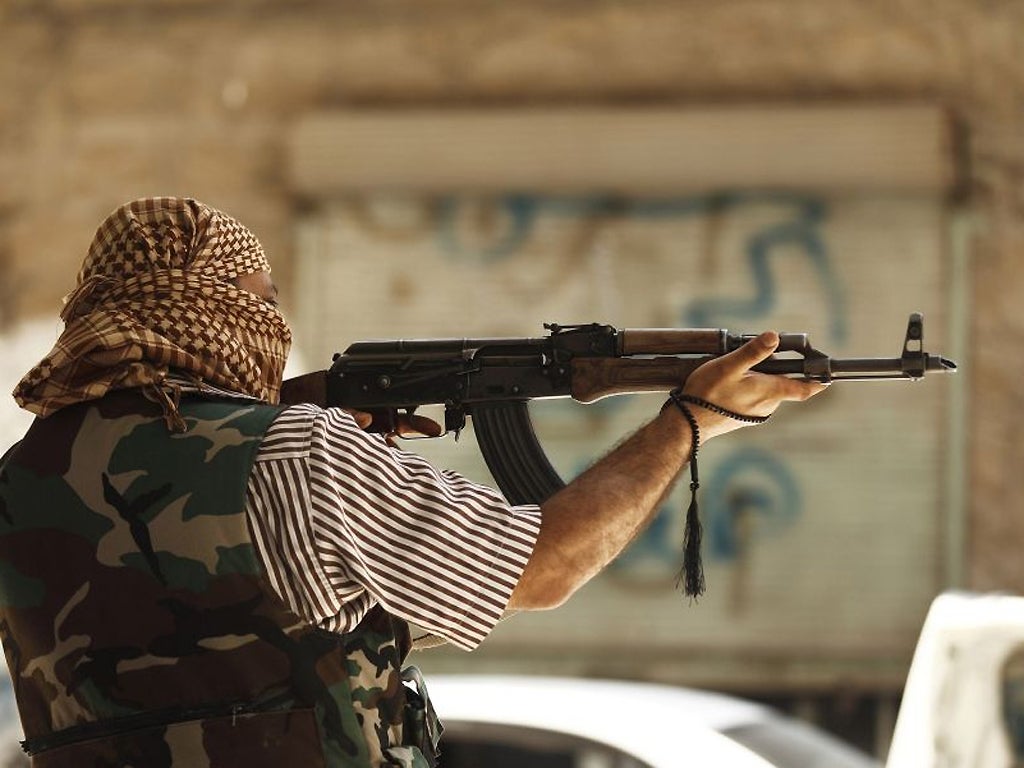
Ambushes and air strikes, sieges and executions were the bloody order of the day in Aleppo today as rebel and regime forces fought street by street to gain possession of Syria’s largest city.
The violence, and expectation of more destructive strife to come, added to the sense of fear and the growing stream of refugees fleeing their home.
While continuing resistance against armour and artillery in the districts of Salheddine and Hamdaniyeh, opposition fighters took the offensive in other areas; a series of police stations and posts were overrun with the defenders captured in some cases, but also a large number shot dead, with sizeable amounts of arms and ammunition seized.
The rebels, too, were in the gunsight of the enemy with regime troops sending salvos of mortar rounds and missile strikes from helicopter-gunships and, on at least two occasions, from a warplane. A new dynamic was also introduced into a conflict already deeply divisive and sectarian with a militia from the Al-Barre tribe, chanting their loyalty to Basher al-Assad, carrying out an assault near the city’s airport which killed 16 revolutionary fighters and cleared, for the time being, a road through which soldiers and supplies can be brought in from Damascus.
However, the capture of the security stations at Bab Al-Nerab, Al-Miersa and Salhain and, with that, the control of the adjoining neighbourhoods meant that the rebels were making incremental territorial gains. On each occasion helicopter-gunships appeared later to carry out strafing, but there was no sign of a ground forces coming in to retake the positions.
None of the bases were taken easily, with the defenders fighting hard. They were not just police officers, but members of the Mukhabarat — the secret police — and also the Shabiha, the paramilitary drawn from regime loyalists. Both groups had been accused of carrying out abuses, including torture and rape, in the campaign to suppress the uprising, and summary justice appeared to have been meted out in some instances with corpses showing bullet wounds to the backs of their heads.
Asked at Bab Al-Nerab whether any of the officials had been shot after surrendering, a young rebel grinned: “They did not surrender, they were caught”. This was disputed by an annoyed older fighter, Syed Abdul-Qadar, who insisted that all the deaths had taken place in the course of combat. “But at the airport the Barre killed people who had their hands tied behind their back” he added.
The bodies of the 20 officials lay at various parts of one police station which had caught fire when Kalashnikov shots set alight flammable liquid inside. The head of the rebel unit which had carried out the attack, Omar Abdel Aziz Hatteh, said: “We offered them the chance many times to surrender. But the Colonel in charge here refused to let any of his men come out and stay alive. He kept screaming at us on the telephone, using disgusting language.”
The body of Lieutenant Colonel Maklesh El-Ali was later put on the back of a pick-up truck and taken for a little tour around the city. “He was an evil man, he treated us like we were dogs” said Nouri Hassan al-Batme. Apartments in the building where he lived with his family, facing the station, had been commandeered by the security officials to position snipers during the shoot-out.
“They didn’t care what could have happened to us” said Mr Batme, a 47 year old contractor. “This regime does not care for its people. I have a brother, Faisal, who was arrested 32 years ago, we haven’t seen him since. This Colonel was a brutal man, he arrested me over a family matter 10 days ago and beat me on the feet with a stick. He also hit me so hard on the head that I cannot hear properly in one of my ears.”
Mr Batme and his family of six are moving out of their apartment for the time being because his wife was terrified of a helicopter attack. But he was apprehensive: “With no one here the thieves could come in and take things. We haven’t got a police station any longer, who is supposed to be doing their job?”
The storming of the station at al-Marju in Salhein was carried out by over 700 fighters; the 45 strong security detachment inside resisted before a bomb made out of a water storage container and TNT was bodily flung over the sandbags by two volunteers. Fifteen of the regime officials were killed, the rest arrested, except four who got away. “They were snipers, three of them were Iranians, the other was a Russian,” maintained Abdel Rahman Moussa, one of the rebels. “The Russian must have been valuable, right at the end they sent 200 soldiers to get him out. We keep on hearing about Russians and Iranians, also we think come Hezballah people are here as well.”
Rumours of foreign mercenaries in the pay of Assad, as well as the imminent launch of chemical weapons, were rife in the city, with no detectable for either. Also absent were the hundreds of foreign Islamists who, according to some Western media reports, have descended to raise the flag of al-Qa’ida and jihad in Aleppo.
“Where are they? The Chechens, the Africans and the Pakistanis, all with so many weapons?” Asked Abu Suleiman, a rebel officer, crouching down in an alley as an attack on a fourth security post, near Sher Osman, predominantly manned by the Shabiha, was faltering due to ammunition running out and what appeared to be a Mig-23 dropping ordnance. “We can do with them. No, not them, their weapons. That is going to be a problem very soon unless we start getting fresh supplies coming through. That may happen, the routes in the east have opened up.”
The rebels spent some of their last Kalashnikov ammunition providing covering fire as families fled from the street, a little girl crying until she was reunited with her pet Myna bird in a cage. As they made their way out an elderly man hobbled over to the fighters to offer his thanks. Or so they thought: “You people are destroying this country, have you no shame? I am 83 years old and I have seen nothing like it, even when we were fighting the French. Basher al-Assad is a great man, he is the President”, with that Mohammed Ibadullah Seif, leaning on his stick, rejoined his family.
“Can you believe that! Here we are risking our lives to free the country and that’s what the man says,” Abu Suleiman spread his hands as the fighters around him laughed. He shouted: “Go with Basher then if you love him so much, old man. But you would not wish to go the place where we are sending him.”
Subscribe to Independent Premium to bookmark this article
Want to bookmark your favourite articles and stories to read or reference later? Start your Independent Premium subscription today.
Join our commenting forum
Join thought-provoking conversations, follow other Independent readers and see their replies