
For free real time breaking news alerts sent straight to your inbox sign up to our breaking news emails
Sign up to our free breaking news emails
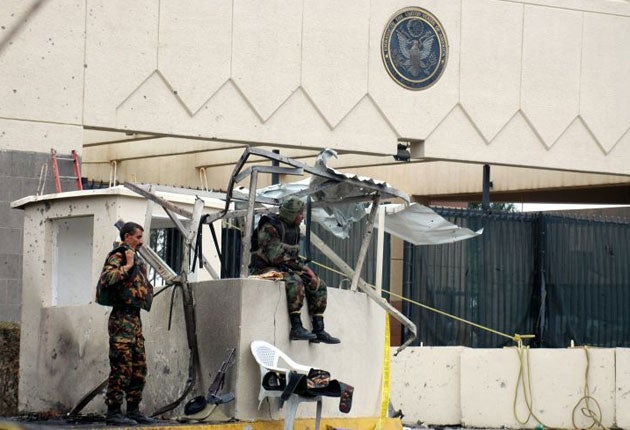
Citing the "ongoing threat" of another terrorist attack, and saying it was "not going to take any chances with the lives of staff", the United States has closed its embassy in Yemen, in a move that adds to a rising sense of urgency about the threat from Islamic extremists in that country.
Britain and Spain swiftly followed suit, urging foreign nationals there to be especially vigilant. Militants linked to al-Qa'ida, who control large areas outside the major cities, have been held responsible for the failed Christmas day bomb plot in the US.
A statement on the website of the US embassy in the Yemeni capital, Sanaa, did not say how long the closure would last. The British Foreign Office said its buildings there were closed for "security reasons". Spain's will remain shut until Wednesday, the newspaper El Mundo reported.
John Brennan, the White House counter-terrorism chief, toured US news studios yesterday discussing Yemen's role in the failed plot to blow up an airliner over Detroit. He said Yemen must do more to tackle its home-grown extremists."We are very concerned at al-Qa'ida's continued growth there," Mr Brennan said, adding that US security agencies in Yemen had recently received credible intelligence that the group is "planning to carry out an attack against a target inside of Sanaa, possibly our embassy".
The US has announced it will double the roughly $70m (£43m) in security aid it gives annually to Yemen, while the UK revealed that Washington and London will jointly fund a counter-terrorism police unit there.
Gordon Brown yesterday added that Britain will host an international conference in London, on 28 January, to come up with an international strategy for dealing with the apparently critical threat from extremists based in the Arabian country. "We've got to recognise that we have a group of young people who have been radicalised as a result of teaching by extreme clerics," Mr Brown told the BBC's Andrew Marr.
"We're fighting a battle for hearts and minds here as much as anything else," he said, adding that as Yemen is a "failing state" Western nations have to be "careful" whom they help.
The international conference will, he said, discuss ways to prevent the perversion Islam by those promoting a "murderous ideology".
In a separate move that may add to delays for flyers, the Prime Minister added that UK airports will "gradually" install full body scanning at security checkpoints. Passengers "will see checks for explosive traces," he said. "We've recognised that there are new forms of weapon being used by al-Qa'ida, so we've got to respond."
Yemen has faced heavy scrutiny over recent days after the arrest of Umar Farouk Abdulmutallab, a Nigerian-born student who smuggled explosives concealed in his underpants on to Northwest Airlines Flight 253 in the US, and came close to detonating a bomb that would have been likely to kill all 278 people on board.
Mr Abdulmutalab, who was apparently radicalised while attending university in London, has told US interrogators that he was trained in Yemen by a group called "al-Qa'ida in the Arabian Peninsula". He said the organisation boasts "many more" potential terrorists in its ranks.
US President Barack Obama used his weekly address on Saturday to talk up the threat from Yemen and to vow that those responsible would be brought to justice. But that presents severe logistical problems, since the mountainous country's government has only a tenuous grip on many regions, particularly in its North-west.
Last night the US announced it would tighten airport security with increased random screening and extra checks on those flying from Yemen, Nigeria, Pakistan, Iran, Sudan, Syria and Cuba.
At the weekend, General David Petraeus, the head of US Central Command, travelled to Sanaa, where he met with Yemen's President, Ali Abdullah Salih, to discuss boosting security in the country, which is the ancestral homeland of Osama Bin Laden and has seen a string of attempted attacks on US assets there.
In 2000, the Yemeni port of Aden was the location of the suicide attack on the USS Cole, which killed 17 American sailors. In the past two years there have been at least four attempted attacks on the US embassy in Sanaa.
Yemen: Troubled history
*In 1839, Britain took control of Aden, a port off Yemen's southern coast, later making it a British protectorate. After the Suez Canal opened in 1869 Aden was a vital port on the route between Britain and India.
*North Yemen was part of the Ottoman Empire until 1918, and became a republic in 1962 after an army coup. Southern Yemen gained its independence five years later, going on to become the People's Republic of South Yemen, and in 1970 Marxists took control of the government there.
*The North and the South fought a war until 1990, when the two sides unified as the Republic of Yemen. In 1994 southern separatists tried unsuccessfully to break away.
Subscribe to Independent Premium to bookmark this article
Want to bookmark your favourite articles and stories to read or reference later? Start your Independent Premium subscription today.
Join our commenting forum
Join thought-provoking conversations, follow other Independent readers and see their replies