Israeli troops 'kill as many as 20' as protesters try to cross border
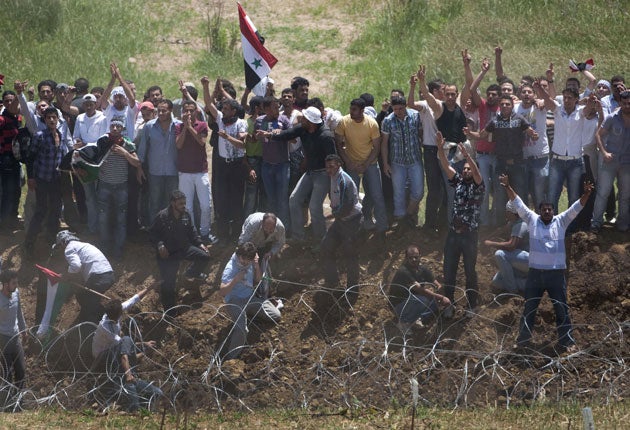
Israel's northern border with Syria was a scene of bloodshed yesterday after Israeli troops fired on pro-Palestinian protesters attempting to cross its ceasefire lines in the occupied Golan Heights. Syrian reports claimed that as many as 20 were killed, including a 12-year-old boy.
Clashes on Israel's borders have emerged as a recent and troubling phenomenon for Israel as Palestinian youths, including many refugees living in Syria, Jordan and Lebanon, seek to harness the energy of the Arab Spring's peaceful uprisings that have swept dictators from power.
The flare-up along the border fence erected in the occupied Golan Heights – a repeat of an incident less than a month ago – comes as Palestinians mark the anniversary of the 1967 Six Day War, when Israel won a stunning victory over Arab nations, seizing the Golan Heights, the West Bank, East Jerusalem, Gaza and Sinai Peninsula.
Israel accused Syria of using the protests to deflect attention from the crackdown of its domestic uprising, but Syria said it was a spontaneous demonstration borne of deep frustration. As Facebook activists urged Palestinians and their Syrian supporters to march on the border, Israel warned that it would act with determination but "maximum restraint" to defend its sovereignty and people. "Unfortunately, extremist forces around us are trying today to breach our borders and threaten our communities and our citizens. We will not let them do that," said Prime Minister Benjamin Netanyahu.
Events followed a similar pattern to protests on 15 May, when protesters marched on the Lebanese and Syrian frontiers, catching Israel unawares. Thirteen people were killed and dozens broke through the fence on the Syrian border, breaching the frontier for the first time in decades. The marches had been organised to commemorate Nakba Day, marking the mass displacement and exile of Palestinians in 1948.
This time, Israeli troops were braced for clashes. Marches on the Lebanese border were cancelled, but several hundred people congregated across from the Golan town of Majdal Shams, stopping short of a newly-dug trench and rolls of razor wire.
"Anyone who tries to cross the border will be killed," Israeli soldiers warned through megaphones as people waving Palestinian flags streamed towards the frontier. When protesters tried to cut the razor wire several metres short of the frontier fence, Israeli troops opened fire. Several people were seen being carried away on stretchers. Syria's state-run TV claimed 20 people had been killed, including a woman and child, and over 325 injured. Israel said it was not counting casualties.
A few miles along the border, near the Syrian town of Quneitra, many were hurt when anti-tank mines exploded. Israel's military defended the bloodshed, describing it as a "measured" response. "In the end, we are guarding our border," said Lieutenant Colonel Avital Leibovich. "I wish they had obeyed our verbal warnings, but they chose instead to clash with the soldiers."
At a checkpoint leading to Jerusalem, Palestinans threw stones at Israeli troops, who responded with tear gas and stun grenades. In Gaza, several hundred marched on Erez, Israel's border crossing with the besieged Strip, but were dispersed by Hamas, the Islamist movement in charge there.
Protests on Israel's borders set a worrying new pattern for the Israeli army, which is used to dealing with stone-throwing youths, but has little experience in dealing with peaceful marchers.
But support among Palestinians for a non-violent uprising, or third intifada, is gathering pace following a recent unity deal between rival Palestinian factions and the collapse of peace talks with Israel, widely perceived as a result of Israeli intransigence in refusing to halt expansion of Jewish settlements on occupied territory.
Mr Netanyahu disappointed many last month when he made a speech rejecting the Palestinians' central demands, which include negotiations for a state based on 1967 borders and with East Jerusalem as its capital.
Many now fear US and Israeli efforts to block Palestinian plans to declare statehood in September and Palestinian frustration over fruitless talks, could provide the spark for a mass uprising. France has offered to convene a peace conference by the end of July, hinting it will support a Palestinian declaration of statehood if Israel does not return to negotiations. The Palestinians have accepted the proposal, but the Israeli premier has reacted far more coolly, saying that he would first have to consult officials in Washington.
Join our commenting forum
Join thought-provoking conversations, follow other Independent readers and see their replies
Comments