Jewish activist faces jail for West Bank resistance

For free real time breaking news alerts sent straight to your inbox sign up to our breaking news emails
Sign up to our free breaking news emails
It is not every day that a leading Palestinian activist issues an emphatic statement of support for a Jewish Israeli – "this friend, whose friendship I am proud to share" – facing prison.
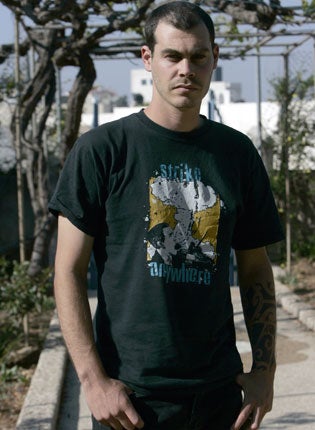
But then Jonathan Pollak, who could be jailed for between three and six months when the Tel Aviv Magistrates Court decides on his prosecution for illegal assembly today, is an unusual figure even in the long history of Israeli dissent.
The man praising him, Ayed Morrar, has become internationally known thanks to an award-winning documentary on the victorious unarmed struggle he led to change the route of the Israeli military's separation barrier in the Palestinian village of Budrus. Mr Pollak, 28, is already a veteran of that and many other battles against the barrier and settlements in the West Bank, protesting alongside Palestinian residents and sharing the same physical risks in the clashes between armed security forces – that sometimes use live ammunition – and stone-throwing young villagers that the struggle tends to generate.
Thanks to his media work for the Popular Struggle Co-ordination Committee, which loosely links these village protests, Mr Pollak is the best known of the small-but-persistent group of young Israelis who go week after week to the West Bank to take part.
Yet the current indictment is for something closer to home – his participation in a cycle ride through the streets of Tel Aviv some 30 Israelis held in protest at the siege of Gaza in January 2008. The cycle ride was similar to many others that have been held unimpeded in the city to further environmental goals. He was the only one arrested. "From the arrest itself to the indictment, this has been a political case," he said yesterday. "Had we not been protesting the occupation, none of it would have taken place."
Mr Pollak was born to leftist parents, who will be present in court today. His father Yossi is one of Israel's most prominent actors – among those pledged to boycott performances some of Israel's leading theatres are planning to stage in the West Bank Jewish settlement of Ariel. His maternal grandfather, Nimrod Eshel, was jailed for his leadership of a strike by seamen in the 1950s.
He attended the first of very many demonstrations as a months-old babe-in-arms at the huge mass rally in Tel Aviv calling for an end to the first Lebanon war in 1982. What makes him and his Israeli comrades unusual, however, is the decision to go beyond mere demonstrations to, as he himself puts it, "crossing sides, moving from protest to joining resistance".
A high school dropout at 15, he was a teenage animal right activist, a cause with few Israeli adherents – and most of those Israelis who were part of it were anarchists. Very much part of Tel Aviv's young counterculture in the politically relatively relaxed Nineties, Mr Pollak became one too. He remains an anarchist and a vegan, still a strong believer in animal rights, which he sees as consistent with his wider politics. For him, "racism, chauvinism, sexism, speciesism all come from the same place of belittling the other", he said.
A few minor brushes with the law appear to have been enough to convince the army that he was not suitable material for compulsory military service. "I don't think they wanted me any more than I wanted them," he said. He spent two years in the Netherlands, living in a squat, before being deported back to Israel.
By this time, the second intifada was at its peak, and Mr Pollak found himself drawn, despite the dangers for a young Israeli of visiting the West Bank at the time, to the unarmed dimension of the Palestinian cause – including, most significantly, the very first anti-barrier protests in the West Bank village of Jayyous.
According to Mr Morrar, a long-term opponent of armed uprising, "Jonathan... is a man trying to prove that those who believe in occupation cannot claim to be humanitarian or civilised. He also wants to prove that resisting oppression and occupation does not mean being a terrorist or killing". Just as Mr Pollak learned his Arabic on the Palestinian street, as a serial leafleteer he discovered a talent for graphic design, which makes him a living when he needs the money.
His lawyer, Gaby Lasky, has been arguing throughout the case that his indictment was discriminatory. But if he is convicted he will go to prison "wholeheartedly and with my head held high", as he hopes to tell the court in a polite but uncompromising address. He planned to say: "It will be the justice system itself... that will need to lower its eyes in the face of the suffering inflicted on Gaza's inhabitants, just as it ... averts its vision every day when faced with the realities of the occupation."
Subscribe to Independent Premium to bookmark this article
Want to bookmark your favourite articles and stories to read or reference later? Start your Independent Premium subscription today.
Join our commenting forum
Join thought-provoking conversations, follow other Independent readers and see their replies