Two strikes, and another family lay buried in rubble
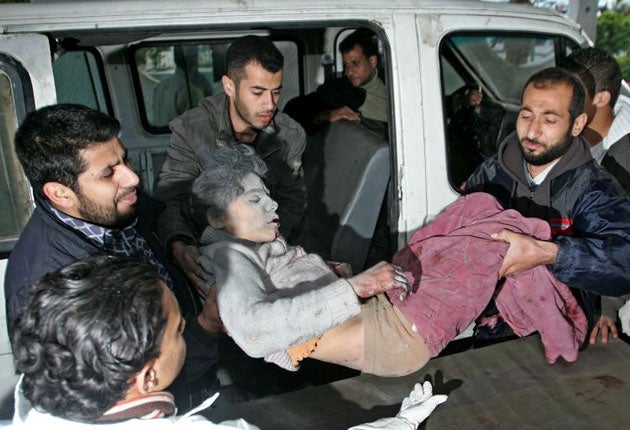
The extended Abu Eysha family were asleep when their three-storey house five minutes from Gaza's coast was hit by the first air attack early yesterday. Five minutes and another air strike later, Amer Abu Eysha, 50, who used to work as a tiler in Israel, his 30- year-old wife, Naheel, and three of his children lay dead under a pile of rubble.
Yesterday the children's uncle, Rashad Abu Eysha, said a missile fired by an Israeli F16 went through the second and first floors before exploding on the ground floor where his brother lived with his immediate family.
The attack on the Palestinian refugee family became the third since the aerial bombardment of Gaza started 10 days ago to prompt a specific call for an independent investigation by the UN Relief and Works Agency (UNRWA). Relatives said the dead children dug out from piles of debris were Sayed, 13, Muhammad, nine, and Ghayda, seven.
Rashad Abu Eysha, a former judge's assistant and an employee of the Ramallah-based Palestinian Authority (PA), said last night that after the second blast: "We dug into the rubble with our hands. I found the body of my brother Amer, then we found two thirds of a body, a half of a body, and remains of flesh. We put them in a sack."
Mr Abu Eysha, who said he had been on strike since Hamas's bloody takeover of Gaza in June 2007, explained that there are five separate apartments on the building's three floors. He lived on the second floor, with three of his brothers and his father also in the building.
He said that the first missile – which he thought came from a helicopter or a pilotless drone – hit the roof of the house. But it was the second, about five minutes later, that had penetrated two floors before killing his brother, sister-in-law and their three children. "Part of the ceiling fell on us," he added. "My own son Amr, who is five, was buried in the rubble. I thought he was dead, but God gave him another life."
Mr Abu Eysha said that behind the house, in the Nasr neighbourhood just north of Gaza City's Beach refugee camp, was a building used as a base by Hamas security forces, and that the dead children and their parents were bystanders in a conflict in which they had no part.
He declared yesterday: "We are the victims of damned politics. We are just figures in a stock market of Israeli elections, and victims of the Palestinian disputes. I am part of the PA authority in Ramallah, which is an authority for all people. My brother Amer was a tiler. He was unemployed, like everybody else in Gaza. He has never been involved with any faction.
Mr Abu Eysha said that luckily for them, Amer's second wife, Sabah, 45, and another son were not in the house when it was bombarded. But, he added: "This is a massacre against children, against human rights and all international laws. My brother's son Ahmad, who is five, will hate Israel."
UNRWA's chief spokesman, Christopher Gunness, said last night: "As with all civilian deaths we yet again call for an independent investigation and if international law has been violated, those responsible must be brought to book." The Israel Defence Forces said last night that it had not yet had an official report on the incident.
Inside Shifa Hospital, the largest in Gaza, medics are struggling to cope with the relentless tide of wounded, as anguished relatives scream at them to save their loved ones. Beds are full; the injured have long since spilt over into the hallways. There is little time to sleep for the overwhelmed doctors and nurses. "Whoever comes with a head, we check his pulse. If there's no pulse, he's straight to the morgue. If there's no head, well, goodbye," a hospital official, Raid Arini, told the Associated Press.
At the morgue, corpses are now packed two to a drawer. Blood pools on the floor, where some bodies have been left because the refrigerated containers are full. Among them are Salah Samouni's three sons – Issa, three, Mohammed, four, and Ahmad, five. Their father bangs his head against the wall, overtaken by grief.
But mourning can be a dangerous process in Gaza, as Jaber Abdel-Dayem knows only too well. He was watching over the body of his nephew, a paramedic killed in an Israeli air strike in the north, when the Israeli planes struck again. "We were sitting in the mourning tent when suddenly they bombed us. We ran to rush the casualties to hospital but they bombed again," he told Reuters. Medics said three people were killed and 17 wounded.
The grieving uncle said that all the rockets fired by Hamas into Israel paled into insignificance compared to one Israeli bomb. "They [Israel's leaders] must be brought before international courts," he said. "May God punish the Arab rulers who are silently watching us bleed like rivers."
Join our commenting forum
Join thought-provoking conversations, follow other Independent readers and see their replies
Comments