Yemen: The land with more guns than people
At least 150,000 people are displaced in Yemen by fighting between Shia rebels and Sunni government forces.

For free real time breaking news alerts sent straight to your inbox sign up to our breaking news emails
Sign up to our free breaking news emails
Entire villages of people in north Yemen are being forced to flee by bands of Shia rebels as a sharp escalation of violence in the region prompts warnings that the conflict could become as bitter as that in Darfur. Fighting in the unstable Arab country, where weapons outnumber people and 50 per cent are illiterate, has already displaced about 150,000 souls.
In the past month the conflict has worsened, leaving tens of thousands without access to water and sanitation.And in the past 48 hours, sources reported that two of the largest tribes have begun to polarise behind opposing sides, with one amassing behind the Yemeni president's "popular army" and another falling in behind the Shia rebels, known as al-Houthi. Aid agencies are concerned that a tribal element to the fighting could add immeasurably to its ferocity.
The Yemeni government has accused the Iranians and Muqtada al-Sadr, the Iraqi radical Shia leader, of helping the rebels who, in turn, claim that they have come under regular attacks from Saudi warplanes. The Shia rebels, Zaidis, were accused by the Yemeni government of carrying out the recent kidnapping of a group of foreigners including a Briton. Critics say that while waging its campaign against the Shias, President Ali Abdullah Saleh's administration has done little to combat Sunni al-Qa'ida.
Sources on the ground said yesterday that rebel gunmen fighting government forces in the Saada region, the area isolated by the conflict, are forcing civilians to join them in fighting or face torture or death. One who visited a camp in Haradh spoke to villagers at the centre of the violence who were given ultimatums by al-Houthi troops. The source said: "They are told to join the rebels or leave or be killed. The population of one village refused to join the rebellion and has fled to Haradh or Saada town. Two families were killed and many others have been tortured."
Last Thursday, the government in the capital, Sanaa, ordered air strikes directed at the rebels but which were reported to have killed 87 refugees sheltering in camps, prompting outrage from aid agencies. Following the air raid on Thursday, the al-Houthi rebels issued a statement condemning the "bloodthirsty" authorities for perpetrating a "massacre". It was claimed that many of the 87 killed were women and children. But there were counterclaims that the rebels had infiltrated the camps, forcing refugees to flee.
Yesterday, the government offered a conditional ceasefire to mark the three-day Eid al-Fitr holiday that ends Ramadan, but the rebels were not quick to seize on it. They said they would monitor the situation on the ground before responding formally. Ceasefires do not have a good record in the country. The last one, two weeks ago, fell apart within hours, and the conditions set by the government this time – which include removal of roadblocks and withdrawal of rebel forces – do not bode well.
Rebels and government troops have been fighting for years, but the violence has worsened in the past month. The UN issued a "flash" appeal for emergency aid earlier this month but received little response. Aid agencies are unable to get access to a large area of the Saada governorate. Roads are blocked; there are frequent blackouts and mobile phone signals are jammed. Water supply and sanitation services are virtually non-existent, and about 25,000 people are trapped in Saada town and have not received any assistance by any humanitarian agency for weeks. The World Food Programme is trying to gain access through Saudi Arabia.
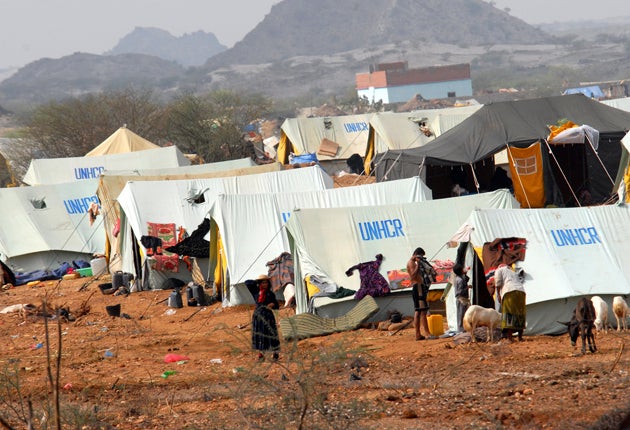
There are several thousand refugees living in tents at the camp at Haradh, in the south of Saada region and 12 miles from the frontline. The camp has been accessed by aid agencies but roads further north remained blocked. "There is very little access to water [in the area of fighting]. People are living in very poor conditions," said the local source. Oxfam and other aid agencies were providing clean water and sanitation at the camps.
A spokesman for Oxfam said: "Tens of thousands of lives hang in the balance, caught in the crossfire. Saada in particular has been virtually cut off from the outside world and countless civilians there are undoubtedly suffering abominable conditions. The situation is deteriorating for people who've had to go another day without food, water, or protection from violence. It is nearly impossible to know what the exact conditions are for 60 per cent of people who have been forced to flee their homes."
There is a long-standing rivalry between al-Houthis, who are Shia Muslims, and government forces accused of using extremist Sunni forces. Besides the sectarian divide, reports were emerging of a "dangerous polarisation" between various tribes, with the Hashed tribe rallying itself behind the government while the Bakil, the second largest in the region, has aligned itself to al-Houthi rebels.
Sources stopped short of warning that the situation was on the verge of ethnic cleansing on the scale of Darfur or Rwanda, but said there were "worrying parallels" and that the situation could worsen. The government in Sanaa claims the rebels want to restore a Shia state that fell in the 1960s and accuse Shia power Iran of waging a proxy conflict.
The rebels say they want autonomy and accuse President Saleh of despotism and corruption, as well as introducing Sunni fundamentalism via his alliance with Riyadh. Instability in Yemen has alarmed Washington, London and neighbouring Saudi Arabia. An aid source added: "There is a real risk that the Yemen will collapse to levels of insecurity seen in Somalia and Afghanistan."
Following the air strike, Foreign Secretary David Miliband called on both sides to avoid harming civilians and to allow humanitarian access to the victims. He added: "Continued fighting will only bring about further suffering for civilians in a region which has witnessed years of violent unrest. Both sides have a responsibility urgently to reach a settlement which protects the safety and security of the Yemeni people."
The current conflict, which began on 12 August, is the sixth in Saada since 2004 and follows a ceasefire in July 2008. The 22 million population of Yemen – 30 per cent of whom are Shia – is the poorest in the Middle East. Analysts claim economic reasons are fuelling the fighting. Yemen is set to run out of oil within a few years, while al-Houthis have been disproportionately denied resources.
The country has long been a breeding ground for Islamist militants, and Osama bin Laden's family migrated from there to Saudi Arabia. A group claiming to represent al-Qa'ida announced recently that it had merged with its Saudi counterpart to form "al-Qa'ida in the Arab peninsula", AQAP. According to Yemeni estimates, which the US maintains is too conservative, about 1,500 Islamist fighters are based there.
The tensions are not overly evident in the capital, Sanaa, where the slow pace of life becomes soporific in the afternoon when large numbers of the male population retire to chew the narcotic khat. But beneath the surface there are signs of the growing presence of international Islamists and militant preachers, followed by the arrival of Western counterterrorist officials. Both sides are seemingly preparing for Yemen to provide the next episode in the "war on terror".
Subscribe to Independent Premium to bookmark this article
Want to bookmark your favourite articles and stories to read or reference later? Start your Independent Premium subscription today.
Join our commenting forum
Join thought-provoking conversations, follow other Independent readers and see their replies