John Lichfield: Changing times on the most famous avenue in the world
Sign up for the View from Westminster email for expert analysis straight to your inbox
Get our free View from Westminster email
All is not bliss in the Elysian fields.
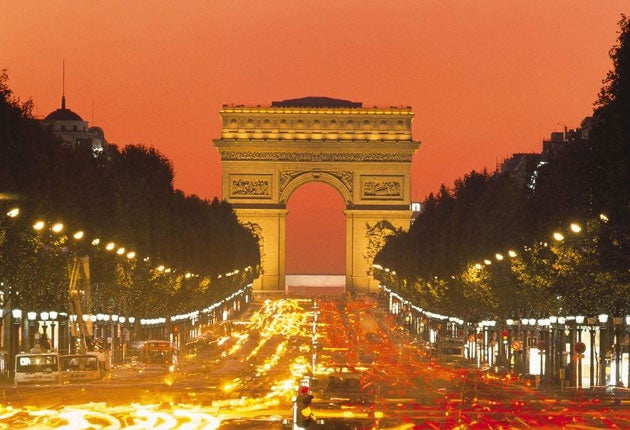
Paris has plunged once again into one of its favourite pastimes: worrying about the future of the Avenue des Champs-Elysées. Is the "most beautiful avenue in the world" heading uphill or down? According to a survey published this week, the Champs has become once again the most expensive commercial space in Europe, with average shop rents of over €7,000 per square metre a year, overtaking New Bond Street in London.
In many cities, this would be cause for rejoicing. In Paris, the news has been taken as further evidence that the Champs-Elysées is fated to become the maman of all high streets, consisting like all 21st-century high streets of rows of Benettons and Gaps and McDonald's.
The problem is that the Champs-Elysées is not supposed to be just a shopping street. It is also a centre of club, café and cinema life and a stage for national celebrations, both official and unofficial. In London terms, the Champs-Elysées is part-Oxford Street, part-Bond Street, part-Leicester Square and part-Trafalgar Square (and substantially more beautiful than any of them). It is now estimated that more than half of the commercial spaces are occupied by ready-to-wear fashion and shoe or perfume and cosmetics shops. The latest brand to announce its arrival on the Champs is the American up-market casual clothes shop Banana Republic (owned by Gap). Abercrombie & Fitch opened in May. Marks & Spencer is expected in November. There are six cinemas on the Champs, compared with 13 in 1985. Several of the survivors, and even some of the overpriced restaurants and brasseries, are threatened by rents which have quadrupled in 15 years.
Is the annual Bastille Day military parade doomed, critics ask, to take place in an open-air shopping mall? Must the final stage of the Tour de France end in a tree-lined centre commercial? My 20-minute pedestrian commute to work takes me down the Champs-Elysées in the mornings and up towards the Arc de Triomphe each evening. I have been observing the avenue's moods and shifts for almost 14 years.
The Champs-Elysées is changing but not all for the bad. The reality is more muddled or more subtle. There are, and always have been, several Champs-Elysées. The eastern, flat, leafy part, near to the Place de la Concorde, with few buildings, is unchangingly beautiful. The western, commercial part, sloping up to the Arc de Triomphe, is an extraordinary mish-mash of architectural styles, or lack of styles, from Parisian belle époque, to 1930s fascist and 1980s shoe-box. Even so, the 2km sweep of the avenue from Concorde to the Arc takes away your breath on a bright day.
The sunnier, northern pavement has always been busier than the southern side. Some posh shops have moved on to the southern pavement in recent years, but the rents on the busier, northern side remain much higher, reaching €10,000 per square metre a year. The notion that the Avenue des Champs-Elysées is "in decline" and "threatened with banalisation" has been a regular feature of Parisian life for almost a century. The complaint in 1912 was that homes were being pushed out by an invasion of shops and bars. The avenue's residential days (former residents include Thomas Jefferson and Sarah Bernhardt) are long gone.
By the 1970s and 1980s, the avenue was a dispiriting sort of place, dominated by car show-rooms and airline offices. The pavements were squeezed by broad parking lanes for cars. In 1994, the parking spaces were abolished. Broad new pavements were laid in large, granite slabs. More trees were planted. The Champs-Elysées is an infinitely more pleasant place to stroll today than it was 20 years ago.
According to an old French pop song, "il y a tout ce que vous voulez aux Champs-Elysées". In other words, you can find everything that you could possibly want on the most famous avenue in the world. When the song was written in 1969, it was a flagrant lie: almost all that you could buy on the Champs was a Renault Cinq or an Aeroflot ticket. Now, "aux Champs-Elysées", you can dine in a Michelin-starred restaurant or you can gobble a Big Mac. You can buy cheap knickers in Monoprix. You can join the young blond people (most of them Japanese) queuing to buy expensive leather goods in the Louis Vuitton store. You can buy a Cartier tiara, a Renault Espace, a Mini Mouse costume or Nike trainers. From November you will be able to buy M&S sausages and underwear.
Until recently, the Champs-Elysées appeared, nonetheless, to have become the world's high street, rather than the main thoroughfare of Paris. Most people on the pavements or in the shops or bars, even in winter, were tourists. This is changing. Because of the influx of trendy shops, it has become a favoured resort of two tribes of young French people who otherwise never meet. Youngsters from the multiracial suburbs and teenagers from bonnes familles in wealthy quartiers of Paris live utterly separate lives but they buy, or covet, the same clothes.
Enough is enough, all the same. The City of Paris complains that new pro-business rules make it impossible to resist the tide of jeans, handbags, perfume and trainers. A couple of the surviving cinemas are said to be threatened.
The original music for the 1969 song "Les Champs-Elysées" came, with bizarre irony, from a British song called "Waterloo Road". If rents continue to boom, the Champs, as a pleasant centre of Parisian evening life, may face a Waterloo of its own.
Join our commenting forum
Join thought-provoking conversations, follow other Independent readers and see their replies