Stanford cash leaves a bitter taste

Sign up to our free sport newsletter for all the latest news on everything from cycling to boxing
Sign up to our free sport email for all the latest news
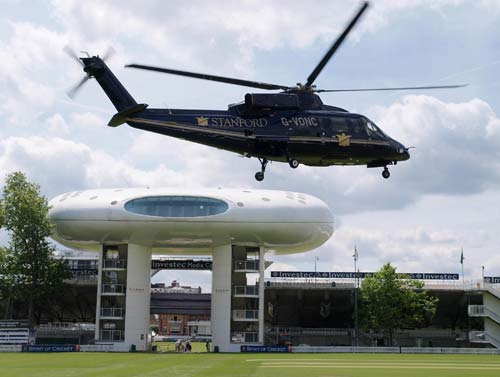
It is difficult to work out what was more tacky; the arrival of Sir Allen Stanford and his coterie on the Nursery Ground at Lord's in a private helicopter and the hierarchy of the England and Wales Cricket Board fawning over him, or the wheeling out of $20m in $50 notes in a plastic crate by a burly security guard at the end of the press conference.
England's cricketers will not give a hoot either way if they defeat the Stanford Superstars, Sir Allen's private side, in a Twenty20 game on 1 November this year at his own ground in Antigua. If selected Kevin Pietersen, Paul Collingwood, Stuart Broad and Ravi Bopara are each set to trouser a cool $1m for beating what will essentially be a West Indies team. Would you like to be the player standing under a steepling catch on the final ball of the game with the match in the balance and so much at stake?
But even if it were grassed the losing team should not become too vindictive or despondent, the deal struck between Stanford, the Texan billionaire, and the ECB is for five years and somewhere along the line they are bound to win one of the potentially life-changing games.
Though unprecedented the arrangement is not quite what it says on the tin. Initially it was to be a $20 million winner takes all game but that created resentment among the players and offered nothing to the ECB or the West Indies Cricket Board for going along with Stanford's concept. The new deal means that $11m goes to those who play, $1m to the unpicked members of the squad, $1m to the coaches and support staff, and $7m to be shared between the ECB and the WICB.
On the surface everyone seems to be a winner, and those on Stanford's payroll undoubtedly are. Cricket, like every sport, needs money and publicity and who wouldn't do a bit of shoe shining if a billionaire is handing out a portion of his fortune but, even so, there is something rather unappetising about the whole thing. The matches are authorised but unofficial because of Stanford's desire for his trademark black bats to be used. The MCC, the guardians of the Laws of cricket, will not sanction matches when such kit is present, making the richest game in the history of cricket nothing more than an exhibition match.
It is also the fact that this countries national cricket side are now, if the price is right, up for hire. It is not unprecedented in sport; the Brazilian football team do it and England's motives for playing recently in Trinidad were questionable. It makes the playing of 'Jerusalem' before the start of play on each Test day seem that wee bit hollower. Amazingly, player burnout, the hot topic after the 2005/06 Ashes defeat, is no longer an issue too.
Stanford described Test cricket as 'boring' but his commitment to West Indian cricket cannot be doubted, and he insists that his motive is to see the team return to the top of international cricket, not gain credibility in The City.
"I do not believe I am giving this money away," said Stanford. "I am investing it in the future of West Indies cricket. Right now they are at the bottom of the pot. I have been in the Caribbean for 26 years and when you see something that you love so dearly fall to the bottom you want to see it get back up, and I am doing the best that I can. I am doing something that has never been done before, taking the sport of cricket in the Caribbean to a professional level. I have taken my money to the ECB because they have the best organisation and structure in world cricket."
The man with the toughest task is Peter Moores, the England coach. Moores, ultimately, will be the person who decides who plays and who does not. It is a decision that could potentially cost an individual around £400,000. He will undoubtedly have to deal with a tad of envy from disgruntled and apparently under-appreciated Test players too, cricketers who made England an attractive team when they won the Ashes in 2005. But it is hard to believe Michael Vaughan and co felt sympathy for the one-day players when they were raking it in following their success.
"Selection can never be sentimental and I do not see it being an issue," said Moores. "You pick the team as fairly as any other team you pick. I don't think the fact that it is worth more money makes any difference because you still have to make the same judgements. You pick the team that you think can win the game for England and we will pick the best Twenty20 team we can. There is no guarentee that you get it right but you do it fairly and honestly.
"The whole thing about sport is that you are brought up knowing you will be rewarded differently. We have players in the England team who earn more than others through their endorsements because of their profile. I don't think there is any difference.
Giles Clarke, the Chairman of the ECB, refuted the suggestion that the games had been arranged to placate England's cricketers, who are being dissuaded from making major commitments to the lucrative Indian Premier League. I have not seen many players in the dressing room worrying about their finances recently, and I have not been try to appease them," said Clarke. "What we are saying to them is this is the chance to show that you can really perform under pressure and make money that is beyond the dreams of some of their predecessors."
Subscribe to Independent Premium to bookmark this article
Want to bookmark your favourite articles and stories to read or reference later? Start your Independent Premium subscription today.
Join our commenting forum
Join thought-provoking conversations, follow other Independent readers and see their replies