James Lawton: Memories of Thomson's valour live on at heart of Scottish game
Sign up to the Independent's betting newsletter for the latest tips and offers
Sign up to the Independent's betting newsletter
Around the time Diego Maradona arrived in Glasgow about as amiably as a cornered wolverine – "I do not speak in English" he told a wildly optimistic radio man waving a mike over the heads of a police cordon – Scottish football was gathering in a large banqueting room to honour, with immense feeling and great dignity, the life of a rather different kind of footballer.
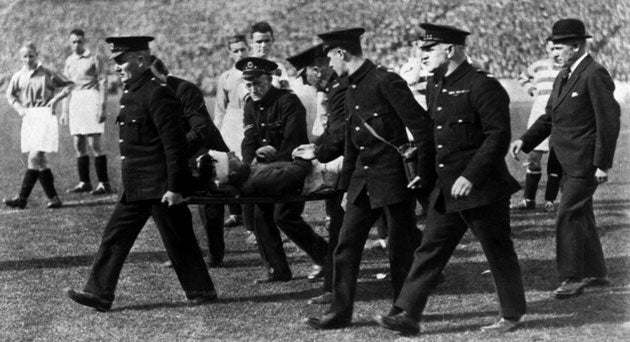
John Thomson, who was inducted into the Scottish Football Hall of Fame 77 years after his death, shared with arguably the world's most dynamic player just one obvious quality. It was extraordinary and, as it turned out in his case, fatal physical courage. He died, from fearful head injuries after diving into the path of Rangers' forward Sam English.
Thomson was the 22-year-old goalkeeper of Celtic who, the folklore of the game north of the border insists, would have grown into the fabulous, world-defying guardian of the net the nation has always craved.
This may all be news to non-Scottish football fans – it certainly was to me on Sunday night – but in Scotland we are talking about an article of old faith and unbroken homage.
Indeed, the hero is still so revered that the only astonishment is that it has taken so long to officially install the legend among Scotland's pantheon of most notable football men. This is a point, however, that would be rightfully dismissed if borne by an English tongue; if many Scottish greats have died, like their English counterparts, in penurious circumstances, in the main they have not been so lightly forgotten.
Thomson is maybe the supreme example. There are still pilgrimages to his imposing, immaculately kept tomb in West Fife. A rare English tribute, made by the English sports broadcaster and poet, John Arlott, is also as fresh as when it was penned half a century ago. Arlott wrote: "He was a great player who came to the game as a boy and left it as a boy. He had no predecessor, no successor. He was unique."
Fifty thousand mourners, by no means all of them Celtic fans, were said to have attended the funeral. Those who could afford it went by train. Many of the rest walked the 56 miles from Glasgow to the churchyard.
Plainly, few players have ever touched the heart of their followers quite like this young man who was raised up from his job of uncoupling the chains of coal wagons 300 yards beneath the surface to perform with stunning precocity and valour before vast crowds at places like Celtic Park and Ibrox, and, with haunting brevity, at Hampden Park.
He played just four times for Scotland, conceded one goal in a draw with Wales, and achieved clean sheets against France, England and Northern Ireland. No one doubted that the jersey was his for just as long as he stayed healthy. But that was the problem. His mother, a non-Catholic but a fervently devout evangelist, had a terrible premonition that he would die in his goal and his fiancée, Margaret, the daughter of a colliery boss, shrieked in dismay when she saw him go down beneath the charge of the determined but innocent Rangers player. "Johnny" had trailed his courage through every game – and a year earlier he had suffered shocking injuries in a match against Airdrie, including a fractured jaw and broken ribs.
When he was asked why on earth he took so many risks he said: "I'm a goalkeeper and it is my job to never take my eyes off the ball."
Seven other heroes, from the living and the dead, claimed their places in formal glory on Sunday night. The English-speaking son of the great Billy Liddell spoke of his pride in accepting the honour on behalf of a father who became a legend for Liverpool not just as a brilliant winger of relentless consistency but an imposing man of the world – and a justice of the peace. Rangers' manager Walter Smith said how proud he was to represent the memory of the astonishing Bill Struth, a former athlete who led the Ibrox team to 30 trophies in 34 years, including 18 Scottish titles.
Two grandsons of the indefatigable Celtic player Bobby Evans spoke of the enduring values he had imposed on his family – and said the first thing he would have wanted to say this night was that he couldn't have achieved anything without his manager and team-mates, a declaration that was bound to resonate with anyone who happened to be in a similar room in London last spring when Cristiano Ronaldo managed to accept his Player of the Year award without a single mention of Sir Alex Ferguson or any his United colleagues.
Of the living, Archie Gemmill, Ian St John, Jim Leighton and Derek Johnston were in sharp and passionate form, St John declaring that he was still deeply in love with the game, except, of course, for the diving and the cheating.
That wasn't, he insisted later, any veiled reference to Scotland's most famous football visitor, the brooding Diego. No, it was more a poignant evocation of those days when you played with your heart and it was all as important as life itself.
He did not labour the point. It was scarcely necessary on a night when Scottish football, in all its tormented glory, reached back to find the best of itself.
There, alive again, was the image of John Thomson, about whom they still from time to time sing a rather maudlin song in the bars of Glasgow and beyond. The words are somewhat trite, no doubt:
"On the fifth day of September
Against the Rangers team he played
From defeat he saved The Celtic
Ah, but what a price he paid."
However, the subject we know now all these years on, is imperishable. It is not just about a young and fallen hero. It is about how a mere game can sometimes define, and enrich, a whole people.
Capello stands up for England
Fabio Capello was right to call up Steven Gerrard for examination by the England medical staff.
This isn't to say suspicions that the Liverpool man's injuries carry the whiff of club-versus-country strategy are necessarily well founded. But it is to approve of the England manager's assertion of his right to go on more than the word of a club with a huge investment in sparing their star player the random hazards of a friendly.
Capello agrees that for all its accompanying history, Germany versus England will undoubtedly be a friendly. How could it be seen otherwise after the merest glance at England's injury list? But then Capello is almost certainly making another point. It is that every little bit of time he gets with the best available players is precious. Already, it is reasonable to believe that Capello may be on the verge of turning Gerrard's talent into something more vital in the cause of England than it has been in the past.
Capello's predecessors, Sven Goran Eriksson and Steve McClaren, played relentless footsie with the big managers, long after it was clear that it was a recipe for contempt.
Capello is not interested in footsie. He is a football man who knows only one way to play the game. The Americans call it hard-ball. One aspect is that you never miss a chance to stand up for yourself and your team's best interests. Truly, the battle, as it had to be if England are really going anywhere, has been engaged.
Such a numbingly inappropriate chariot
Those who have always had reservations about the Middle England glory of the Twickenham crowd had to be more saddened than surprised by reports of a particularly charmless performance during the defeat by Australia.
Yet there was surely a bonus for those who had to suffer the effects of the latest down-turn of the collective stiff upper lip. At least they did not have to wince at the sound of surely the ultimately smug and bizarrely incongruous hymn of celebration in any corner of world sport. You know the one, "Swing Low, Sweet Chariot". It oozes from the breasts of thousands of Barbour coats. It is the slave song borrowed by England's bourgeois. It is numbingly inappropriate in a failing sports master race. As a reshaped team attempt to come up with something original, maybe the supporters should follow suit. It might just be a good way to start minding their manners.
Subscribe to Independent Premium to bookmark this article
Want to bookmark your favourite articles and stories to read or reference later? Start your Independent Premium subscription today.
Join our commenting forum
Join thought-provoking conversations, follow other Independent readers and see their replies