James Lawton: Lightning Bolt seizes the world in ultimate one-man fast show
Sign up to the Independent's betting newsletter for the latest tips and offers
Sign up to the Independent's betting newsletter
Michael Phelps was being enshrined as the greatest Olympian of all time around about the time Usain Bolt surfaced yesterday to face a world he had not so much thrilled as mesmerised.
There was the difference. It was the one between a man who had become a pillar of sport over a number of years of astonishing dedication – and another who had seized that same world in less than 10 seconds.
It was also the gap between something deemed safe and ultimately worthy – and another thing, something both riveting and, let's be honest about this, dangerous. Something, to put it another way, as thrilling to see as, deep down, it was difficult to trust.
Phelps wept at the good things – and now the historically confirmed status – his swimming prowess and gold medals had brought him. Bolt just kept on laughing and joking as though what he had done in the "Bird's Nest" Stadium here a few hours earlier was roughly the equivalent of a run along some deserted beach back home in Jamaica.
It wasn't of course. It was a brilliant, in some ways troubling, statement of the ability of the human body to go beyond its known resources.
Yes, brilliant in its compelling impact on the watching billions, many of whom had no doubt told themselves long ago that they would never again take even at blinding face value the most astonishing athletic deeds, and, yes, troubling in that inevitably the first thing you did after catching your breath was ask: is he real, is he clean?
His, and our, problem scarcely needed any more elaboration than the eagerness with which Jamaican team officials outlined the scale of his testing for drugs on the build-up to the dash that, like the one of his fellow Jamaican-born Ben Johnson, shook the world.
Certainly, the effect was volcanic in the stadium packed with 91,000 spectators through whom an electric current had appeared to run the moment Bolt and seven others vying for the title of fastest man in the world, came out on to the track and began to fiddle and psyche their way to the most challenging moment of their lives.
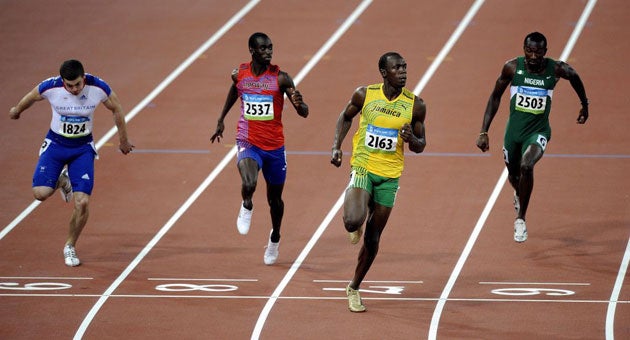
Then, when the race was just about run – in the 100m record-shattering time of 9.69sec, and when Bolt began to make a mockery of the idea that this was a competitive foot race rather than quite exclusively his own dramatic opportunity to dazzle the greatest audience any single athlete had ever enjoyed – anyone who had been in the Olympic Stadium in Seoul 20 years earlier found themselves thrust into a time capsule.
The sense that one of the most sensational, and ultimately controversial moments in sport had come back to life, was nothing less than eerie.
It was a sensation that came in three quite separate stages.
First there was the awe fired by the almost instant certainty that this was indeed a one-man race, that Bolt's compatriot Asafa Powell, 25, a world record holder just a few months earlier, had once again been overwhelmed by the mere presence of his 21-year-old rival, and that the men who would claim the silver and bronze, Trinidad and Tobago's Richard Thompson and the American Walter Dix, were no more than members of the most forlorn supporting cast ever assembled on one of the great peaks of international sport.
Stage two was the announcement by Bolt that he had formally ended the race 10 metres short of its allotted ground, a chest-slapping moment of hubris which led directly, and in the time it takes to move your head, to the final comparison with Seoul.
In Korea the crowd swivelled in the direction of the great scoreboard – and then gasped. They did precisely the same in the "Bird's Nest" Stadium. Both Johnson and Bolt had dwelt on their moment of triumph – and still managed to rip apart a world record.
Johnson also ripped through faith in what had become the centrepiece of the Olympics – the race which for just a few seconds matched the appeal of a great fight once defined by Muhammad Ali, who knew more than a little about how to grab the attention of the world. "It lasts for only a little time," said Ali. "It's like when you're chasing a beautiful woman and you slap on the cologne and for a short while it is the most important thing. Before a big fight everyone just wants to know the answer to one question – who's gonna win, who's gonna win – and then you move on to something else when you know the answer."
Johnson upset the delicate balance of that intrigue. He replaced it with another, much less uplifting question, the one that asks who has the best chemist, the best masking agent; not who is the fastest man when left to his own resources, but who is surrounded by the most practised cheats. This is the inheritance of everyone who has followed Johnson and Bolt cannot expect to be an exception.
It is a fact which will not be diluted by any of the brilliance and arrogant charisma he displayed here at the weekend. Nor by any great accumulation of negative tests to follow the six he had on the approach to these Olympics.
If it is his tragedy, it is also one for all those whose every natural instinct to celebrate great achievement was primed so suddenly here when an Olympics which had previously lacked a defining moment of the highest drama suddenly had something which would be, for good or bad reasons, be remembered as vividly as Johnson's illegal, but no less overwhelming for that, explosion from the blocks.
Donovan Bailey, whose 12-year-old Olympic record was swept aside by Bolt, argues that any suspicion is misplaced. "Usian has brought excitement and belief back into our sport," insists the man who greeted Bolt's run so rapturously. "When you look at him you see the most amazing natural talent, someone who has so much ability he can surely win on his own terms."
It is the most beguiling hope and certainly there are reasons to believe that it might just be true. Bolt is freakishly tall for someone who is now being described as potentially the ultimate sprinter. He does not look like the creation of steroids. He has muscles but they do not form the beginnings of a mountain range. His stride is phenomenal, taking just 41 to cover 100 metres as against an average in the middle-forties for other elite runners, and this is reason enough to justify the description of him by Ato Boldon, a winner of four Olympic medals, as a "force of nature."
There is also the psychological factor. Bolt is carefree. He does not appear calculating in his ambition; his desire to run extremely fast has, apparently, touched very little of his life not dominated by the need to train. When asked about his diet before Saturday's race, and whether he was taking advantage of the stunning range of nutrition made available by the kitchens of the athletes' village here, he confessed that he mostly lunched on chicken nuggets. "It's great to hold the world record, and it would be great to be Olympic champion," he said, "but I still want to enjoy my life."
It is another encouragement for the world to enjoy him. The odds are that, despite the risk, it probably will.
A giant leap for mankind Bolt's stride aids world-record run
*At 6ft 5in, Usain Bolt is taller than any of his 100m rivals, but what tells most crucially for him during races is his enormous stride. The 21-year-old took just 41 strides to win the Olympic title in a world record time of 9.69sec, four fewer – on average – than the rest of the field. After Bolt set the previous world record of 9.72sec in New York on 31 May, the American world champion Tyson Gay complained: "He was covering a lot more ground than I was."
In fact, Bolt's coach Glenn Mills has had to work hard for the last two years on reducing what he feels was the sprinter's natural tendency to over-stride. If Bolt had been left to his own devices, he might have completed the course in even fewer steps – although if Mills is right, he would not have travelled so swiftly.
Mike Rowbottom
Subscribe to Independent Premium to bookmark this article
Want to bookmark your favourite articles and stories to read or reference later? Start your Independent Premium subscription today.
Join our commenting forum
Join thought-provoking conversations, follow other Independent readers and see their replies