London 2012: Where drug cheats fear to tread
Laboratory handling over 6,000 dope tests at the Games has been unveiled

Sign up to our free sport newsletter for all the latest news on everything from cycling to boxing
Sign up to our free sport email for all the latest news
In an industrial estate on the edge of Harlow in Essex, next door to Ed's Autos, sits a glum, well-guarded block of a building. It is a world removed from the shiny new venues of the Olympic Park, some 20 miles to the south, but what emerges from within this unremarkable setting over the course of 19 days in late July and early August will do much to determine the sporting reputation of the London Olympics.
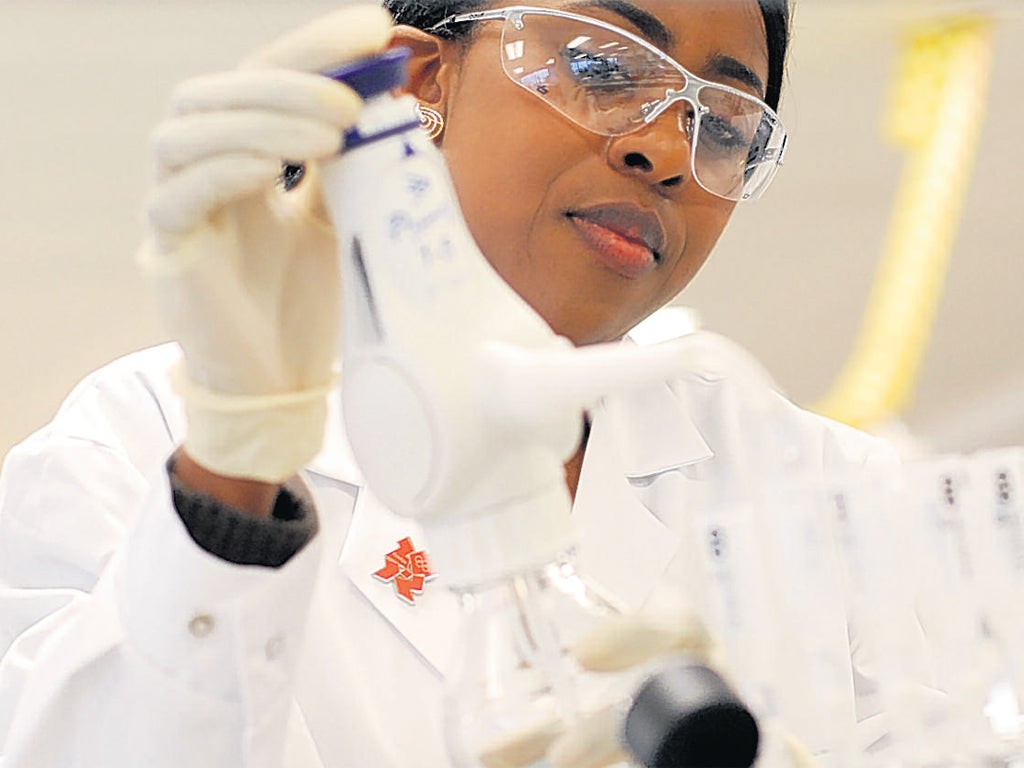
It is the home of the Games' drug testing laboratory, where 150 scientists – part of a 1,000-strong anti-doping team – will process the largest number of samples in Olympic history. They will work around the clock in a 24-hour shift pattern to ensure it is within these walls that the 2012 Olympics faces its toughest examination.
"This is about integrity and the integrity of London's Games," said Hugh Robertson, minister for the Olympics. In this Games more than ever, any medal winner who has taken one of the 200 banned compounds on the World Anti-Doping Authority's list is likely to be caught. The consequence may be London's Ben Johnson moment – for some still the single most shocking sporting moment of the last three decades – and that in turn could saddle the 2012 Games with its defining image, as Johnson cruelly did for Seoul in 1988. It is the outcome that always has and always will trouble the testers – does snaring a high-profile cheat, and the damage that brings, offer more convincing evidence the system is working than claiming a (relatively) drugs-free Games and the public scepticism that will accompany any such assertion?
"The audience want to know what they are seeing is a true and fair contest," said Robertson. "We cannot guarantee a drugs-free Games but we can guarantee the very best system possible to catch anybody cheating and that's a powerful message to send around the world. Athletes have to know they have a far greater chance of getting caught this time."
Professor David Cowan, in his fourth decade as a major player in the fight against doping, accepts the contradictions catching a drug cheat brings. "It is bittersweet," said the man in charge of the Harlow laboratory. "As a scientist it's exciting the first time you actually pick that substance up. We are human. If it actually helps sport by getting rid of guilty athletes it is an achievement. But sometimes it is just sad."
Cowan will have at his disposal the best facility of its type for any Games, set up with the support of GlaxoSmith- Kline (GSK) in whose grounds the laboratory lies, and he approaches the event exuding scholarly confidence, even certainty, that the dopers will be caught. There will be 6,250 samples, blood and urine, taken, a ratio of more than one in two of the competitors. That does not mean one in two are tested – if Michael Phelps wins six medals he will give six samples, whereas someone from a team sport finishing down the field, such as Bobby White, the British men's handball captain, may not be tested at all during the Games. (He is likely, though, to be visited by officers from UK anti-doping in the lead-up to the event.)
Having produced a sample, the athlete personally divides it between two glass bottles which are sealed and can only be opened by a special vice in the laboratory. Samples will be couriered from the venues at a rate of 400 a day. A negative test is turned around in 24 hours, positive results in 48 hours. A positive result means the B sample is tested, with the athlete in question, or a representative, present. An invitation to journey into Essex is not one to look forward to.
It is a simple process conducted with sophisticated equipment and knowledge. Teams and sports who have poor records – take a bow Bulgaria's weightlifters – will receive closer attention. But by the time the samples arrive in Harlow they are just a number on a bar code; names are only attached once a positive test is determined. And among their number are also plants by Wada to check the system is not missing anything.
In the anti-doping ranks there is confidence they are overtaking the cheats. GSK provide Cowan's lab at Kings College London (where British tests are processed outside the Olympics) with information on drugs that have yet to be released. "In the 90s, we were playing catch up," said Cowan. "We are now right up there. Sports cheats get things early and what [GSK] have said is that they are going to let us have them even before that. That is remarkable."
There will always be athletes who dope, and expect to get away with it – in Beijing Ukraine's heptathlon silver medallist Liudmyla Blonska tested positive for a second time five years after her first. With more tests, there is a greater chance 2012 will see medals stripped, but overall it also means Robertson's audience can watch with more certainty than for many years that those lucky few who scale the London podiums (and stay there) have done so on sporting ability alone.
"Testing does work," said Cowan, "and we are good at it. We are going to be fast, we are going to be sensitive, we are going to be efficient and we are going to be right."
The drugs don't work: Disgraced Olympians
Ben Johnson
Stunned the world by racing to 100m glory at the 1988 Games in Seoul. Shocked the world again just three days later when he tested positive for stanozolol.
Marion Jones
It was not until 2007 that the American sprinter admitted using steroids at the 2000 Sydney Games. She was stripped of her three gold and two bronze medals. Four of the first five women in the 100m final faced doping questions.
Adrian Annus/Robert Fazekas
The Hungarian duo were stripped of gold during the 2004 Games in Athens, in the hammer and discus. Annus was found to have tampered with his urine sample – which contained someone else's urine.
Theo Rowley
Subscribe to Independent Premium to bookmark this article
Want to bookmark your favourite articles and stories to read or reference later? Start your Independent Premium subscription today.
Join our commenting forum
Join thought-provoking conversations, follow other Independent readers and see their replies