James Lawton: Turning a blind eye to violence robs a noble sport of its integrity
Rugby regularly reminds us of its troubling relationship with outbreaks of psychopathic behaviour

Sign up to the Independent's betting newsletter for the latest tips and offers
Sign up to the Independent's betting newsletter
Anyone curious about the credentials Peter de Villiers brings to the job of coaching rugby world champions South Africa may now have an additional question. Would you trust him with a water bucket and a sponge?
And, maybe, there should be a supplementary enquiry. Does the coach of a team of ferociously committed athletes in the world's most relentless team contact sport really need the help of a working moral compass? Or can he just wing it to whatever side of the argument suits his purpose?
If all this sounds harsh, consider De Villiers' stance on day three of the Schalk Burger scandal.
He persisted with the view that Burger was innocent of anything but being a victim of the chance of a high-speed, hair-trigger game.
He interfered, essentially, with a dark but hardly complicated reality. He said our eyes, the ones that had not been assaulted, were in error.
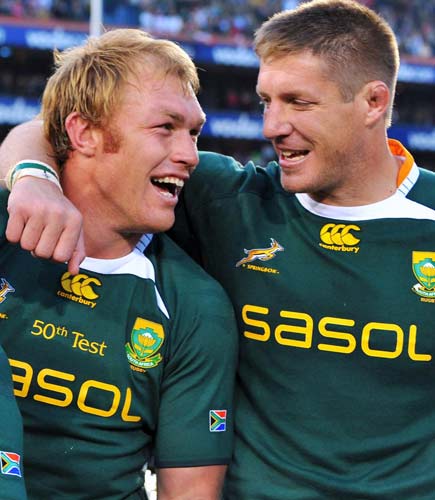
He claimed that Burger, a 50-Test veteran, a man who knows every inch of a rugby field and the strengths and weaknesses of all his opponents, didn't mean to eye-gouge the Lions wing Luke Fitzgerald in last Saturday's second Test match. No, it was an accident. His fingers performed their indelicate tracery quite involuntarily and had the Irishman suffered injury, perhaps even blindness, well, it's a hard game you know.
It's certainly not ballet. This is De Villiers moving on from the closed door of debate about Burger's precise intentions, and his two-month ban after being found guilty of one of international sport's most heinous offences: "If you know his nature and his character like I do, then you know he won't ever do something like that. If we're going to win rugby matches in the boardroom and in front of the cameras then we might as well close shop, go to the nearest ballet shop and buy some nice tutus."
As some exclaim, disbelieving what they've heard, in America: say what?
What De Villiers is saying, apparently, is that rugby is a rough game and from time to time bad stuff happens. Yes, we know, but eye-gouging? There are countless examples of rugby men skirting the basic issue of how long any front-rank sport operating in the early 21st century can show tolerance of nothing short of barbarism by handing out piffling suspensions.
If an athlete is found to have taken drugs he is banned for two years. The crime is cheating, and the possibility is that he may have created problems for himself. The difference between that offence and Burger's is that, while both are a form of cheating, the second one puts the health of someone else at serious risk. We should not keep running around this basic issue: a consequence of eye-gouging is, of course, damage to the eye. When your mother said, "Don't ram your finger down your ear," she didn't add, "and don't ram it your eye, either," because she thought it was a bit of a no-brainer.
Equally self-evident, surely, is that people who do it to other people's eyes have no place on a sports field and when they do it in full view of a camera and a touch judge it is a little disingenuous of their coach to claim it was an accident. Really, it is rather more than it. It is a complete abandonment of responsibility.
In his little polemic on the real nature of rugby, the interior game, as it were, De Villiers attacks the prying nature of the camera. Presumably it is there just to cover heroic deeds. Those of the gutter, it appears, should be shot only with a blurred lens.
It is an outrageous premise – as is the idea that Burger is adequately punished with a two-month ban. If things had gone as wrong as they could have done in the Fitzgerald incident, if he had suffered something more serious than double vision, then the punishment would have been exposed as a great scandal of sport.
That Fitzgerald escaped relatively unscathed is a great blessing but it does nothing to lessen the demand that the ban of Burger, and the three months handed to fellow perpetrator Alan Quinlan of Munster, who was forced to miss the tour, will one day soon be seen as absolute abandonment of disciplinary responsibility.
The rugby authorities, if they really want to move on from the barbaric tendency – no one is saying full- blooded physicality is not an inherent part of the game – certainly need to revise their scale of punishment, homing in on the despicable offences, the ones that turn your stomach, the ones that are so wretchedly cowardly you believe instinctively that the offenders have lost their right to play the game, if not permanently, at least for a very long time.
Eye-gouging and spear-tackling and stamping and head-butting are grouped right at the top of the league – a point that De Villiers, when he wasn't sneering at the ballet crowd, conceded when he said: "No coach would encourage gouging, biting, head-butts or spear tackles. We have brilliant, world-class players and have no need to do things like eye-gouging that belong in the bushveld."
But these things happen, regularly, and every time they do rugby reminds us of its troubling relationship with outbreaks of psychopathic behaviour. It is an ambivalent one too much of the time. Physical violence gives an edge, a selling point, and it often seems, in this professional age, it can be a matter for exploitation.
If rugby wants to complain about this interpretation of its reigning morality it has the easiest of solutions. It is to take something that is generally known as a moral stand. This would involve telling a leading coach that babbling about tutus and ballet is inappropriate when one of your players has been found guilty of an appalling offence.
Another good and more vital move would be to let someone like Schalk Burger know that eye-gouging is utterly unacceptable – a point underlined by a proper punishment, which is to say at least a year, ideally two.
Ashes fire would be fitting tribute to Vaughan
It is a sad time for Michael Vaughan to leave cricket in a summer of the Ashes he won back for England with brilliant leadership.
Vaughan brought two huge assets to the challenge of beating the Aussies. One was that he was a great, natural captain – the other was that he was also a great batsman.
Sometimes they do not always go together, and it is hard to criticise the England selectors for saying that Vaughan's game had deteriorated too severely for his motivational skills to compensate sufficiently in the new campaign.
If there is one team in the world against whom you cannot carry passengers it is surely the Australians. Still, it is only natural to mourn the loss of his leadership as much as his batting.
In his brief and miscalculated captaincy, Kevin Pietersen put himself under pressure from upstairs by fighting so hard to bring back Vaughan. The explanation was simple enough. Pietersen had played under Vaughan in England and Andrew Flintoff in Australia and he had noted the difference.
It was a huge division that said so much about both the demands and the art of leadership, and when England began to fall apart, in the on-field absence of Vaughan in Australia during the 2006-07 Ashes, it was poignant to recall the unity that made the summer of 2005 so unforgettable.
Also haunting were some of Vaughan's sentiments expressed a few days after his return to Yorkshire from the celebrations at Trafalgar Square and Downing Street.
The captain said: "I've told the team we have one challenge above all now. It is to get better. Most of all, we have to stay honest. We have to remember that we have just started the job. There is so much more to do."
There was but, sadly, it just didn't get done. A huge reason was that Vaughan was missing, which was why England were so desperate that he passed a series of fitness tests in grade level cricket. He didn't do that and it meant that England were a different and diminished team.
Andrew Strauss, who is facing the challenge of his career, needs more than anything to borrow the Vaughan handbook – and score a few centuries. That resolve would be the best possible tribute to a man who conjured some of the best of English cricket.
Subscribe to Independent Premium to bookmark this article
Want to bookmark your favourite articles and stories to read or reference later? Start your Independent Premium subscription today.
Join our commenting forum
Join thought-provoking conversations, follow other Independent readers and see their replies