Kvitova's fearless attack can fire a new generation
Sign up to the Independent's betting newsletter for the latest tips and offers
Sign up to the Independent's betting newsletter
It scarcely seems apposite to talk in terms of a "flowering" – whether in Eastern Europe, or the women's game overall – through the agency of Petra Kvitova.
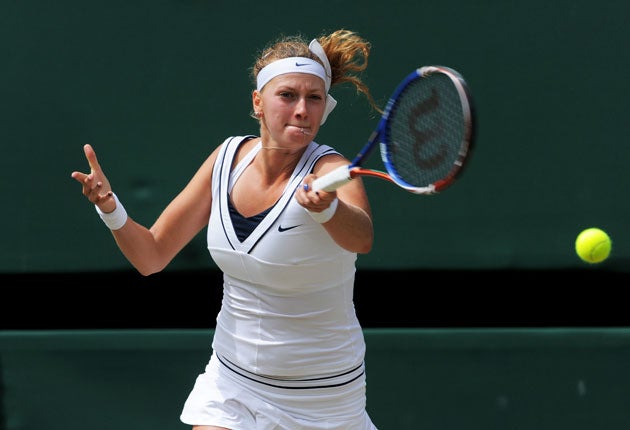
Her forehand meets the ball like a cedar branch ripped by a typhoon. Even so, her maiden Grand Slam final today not only confirms the blossoming of her own, formidable talent, but also contributes to a broader renewal.
Kvitova's meeting with Maria Sharapova guarantees the youngest Wimbledon champion since her opponent's precocious success here in 2004. Sharapova is now 24; Kvitova, meanwhile, was one of three 21-year-olds to complete the semi-final line-up.
With so little tennis between them since last year, the Williams sisters are easily excused their failure to seal a 10th success in 12. It would indeed have reflected bleakly upon the next generation, had Serena and Venus fared much better after prolonged injury, at 29 and 31. As it was, their expulsion on Monday seemed validly suggestive of a new era.
Some have sought to present the proliferation of different contenders, during their absence, as evidence of a void in genuine star quality. But it is not always easy to recognise the dawn of a new era. Billie Jean King, Virginia Wade and Margaret Court won their first Slam titles within seven months. The last time there were four younger semi-finalists here was 2003, when Serena, Venus, Kim Clijsters and Justine Henin averaged 21 years and six months.
As winner of three Slam titles, Sharapova sets Kvitova an exacting standard. And nobody knows better that each new generation shares perennial advantages and disadvantages. In her ferocious march to the final, Kvitova has exhibited all the energy and belief of youth, unimpaired by past battles. It is only now, on the biggest stage of her career, that its innocent vulnerabilities will also be examined.
Recalling herself at 17, Sharapova acknowledges that inexperience can be a double-edged sword. "You almost have that feeling of nothing to lose and you go for it," she said. "I didn't really know what was going to happen [in 2004]. I knew I was facing a former champion. But that didn't really bother me."
Sabine Lisicki duly came out and won the first three games of their semi-final, before Sharapova brought her experience to bear. She had herself abetted Lisicki with some deplorable serving, and accumulated 13 double faults through the match – as many as Kvitova in the entire tournament.
That is one auspicious measure of the Czech left-hander's temperament. If her nerve holds, she can also be expected to seize upon any slackness in Sharapova's serving. Kvitova's instinct is to attack hard, and attack early. With 39 return winners, she has hit nine more than any other player and 17 more than Sharapova. At the same time, the all-out power game must keep her on the edge, on the perilous margins of error.
Among the men, she compares her game to that of Juan Martin del Potro. "We both play flat and fast," she said. "We go for the point." Sharapova herself being no shrinking violet, there is obvious scope for fireworks today. For all her elegance, the Russian's game is underpinned by the flinty courage that sustained her comeback since shoulder surgery in the autumn of 2008. She has, moreover, had a painless passage to the final, yet to drop a set and detained beyond 90 minutes only by Laura Robson.
But Kvitova was ranked 62 when beaten by Serena in the semi-final in last year's tournament – before which she had never even won a match on grass – and is demonstrably on the rise. Now No 8, she is one of no fewer than eight compatriots in the top 100; and, following Tomas Berdych last year, becomes the second consecutive Czech to make a final here. The last left-hander to win the Venus Rosewater Dish was her idol, Martina Navratilova, by then a naturalised American. But she was Czech by birth, of course, and together with Jana Novotna, Hana Mandlikova and Ivan Lendl provided both legacy and example.
She has the blood; she has the power. Will she have the mind? In her own, inadvertently vivid expression yesterday: "I don't know. It will be hard, for sure. You know, it's the first time for me. I will see what it will be in the head, during the match."
Wimbledon Details
Weather
Today: Cloudy, mainly dry. Max temp: 22C
Tomorrow: Warm with cloudy intervals. Max temp: 24C
Television Times
Today: BBC 1 1-6.15pm, BBC 2 6.10-8pm.
Highlights: BBC 2 8-9pm
Tomorrow: BBC 1 1.05-5.30pm, BBC 2 5.30-8pm. H'lights: BBC 2 10.30-11.30pm
Subscribe to Independent Premium to bookmark this article
Want to bookmark your favourite articles and stories to read or reference later? Start your Independent Premium subscription today.
Join our commenting forum
Join thought-provoking conversations, follow other Independent readers and see their replies