Open University Business School celebrates 25 years by taking its MBA into China, India and South America

For free real time breaking news alerts sent straight to your inbox sign up to our breaking news emails
Sign up to our free breaking news emails
A few weeks before an Open University Business School course starts, a fat parcel arrives at the student's home, full of reading material. It can come as a shock.
Chris Martin, 36, from Sandwich in Kent, remembers the start of his studies all too well. "I hadn't written an essay since GCSE English at 16, so trying to write one in my thirties was a nightmare," he says.
Martin's background was in science – he works in business development with Pfizer – and that, he found, came in useful for the quantitative aspects of the course. Like many students, he completed a certificate in business administration with the school before progressing to the MBA proper. This modular process allows anyone, no matter what their academic background, to take the MBA.
Families, Martin says, are the unsung heroes of open learning courses. "We decided I'd work Monday to Thursday, not at weekends. But all my hobbies and sports – I sail dinghies – went by the way for the three years of the degree. I'd spend the day at work, get home around 7pm, have tea, start again at 8pm and work sometimes till 11pm."
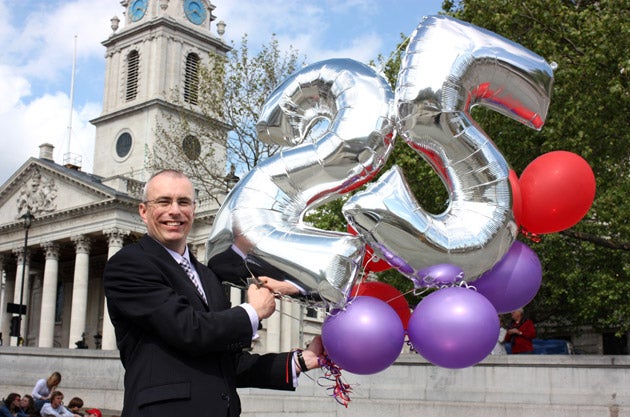
Undeterred by the essays, he persevered, and recently had the distinction of being named the school's 20,000th MBA graduate in the year that the business school reached the grand age of 25. Although it took its first business undergraduates in 1984, the MBA was not launched until 1989 and quickly became the biggest in the market.
"It was probably the pioneer for open-learning and distance-learning approaches," says Jeanette Purcell, chief executive of the Association of MBAs, "and the number of students who have passed through its courses has been phenomenal – good students who otherwise would not have considered an MBA. It really has been quite revolutionary."
Indeed, as the school's third and current dean, James Fleck, points out, the MBA ticks all the boxes when it comes to what other institutions call an executive MBA.
Fleck, a Scot with a background in artificial intelligence, took over at the school's Milton Keynes headquarters four years ago. He talks not of distance but of "nearness learning", arguing that communicating by text or phone is a more direct experience than listening to a lecture in a crowded hall.
"I was blown away by the whole concept when I came here," he says. "The learning experience is designed not by one professor but by a team of people creating the materials. Then there are around 1,000 tutors – 300 of them in Russia – helping the students. It's very intense."
Any part-time degree allows students to carry on working while they do it, and Fleck sees a great advantage in this. "I'm a windsurfer," he says. "And management is like windsurfing. You can't teach it in a classroom and expect people just to do it – yet most business schools think they can. You have to practise it in a whole range of conditions." And as his students do that, he says with satisfaction, they draw their colleagues into their studies too.
He is not, however, resting on his laurels. Though it sprang from the Open University, the school is now largely self-funded, and has big expansion plans. It is spending more than £3m on revising its MBA.
What that means is going beyond markets established some time ago – Russia, South Africa, Ethiopia – and taking the Open University Business School MBA into China, India and South America.
Some might say that the school is a little late into the global market, which has been flooded with competitors in the past 20 years. These days many MBAs are taken completely online. IBM, for example, has just partnered with the Boston-based Northeastern University to provide an online MBA course for its Indian employees.
"Our marketing people are identifying the demands," says Fleck. "We've brought in experts from other universities. Basically we're responding to the global nature of business, building in ideas, practices and case studies from other countries. Then we have to go for scale to recoup the investment. It's an industrial model."
In this market, will that fat parcel of literature still be relevant? Chris Martin, for one, thinks so: "I enjoy learning by reading," he says. "I like scribbling in the margins."
Others are happy not to, however. A completely online version of the Open University MBA, designed for the disabled and those unable to attend learning centres, exists and is increasingly popular, says Vyvien Pettler, who supervises the OU tutors. "We probably have between 400 and 500 students already taking the MBA online."
At the moment, that version depends on downloading PDFs. "But delivery methods change all the time," says Pettler. "It used to be television. Now it's DVD, podcasts and online conferencing." Fleck points out that half the world's population has access to a mobile phone. However you study, perseverance is vital – and here the OU, with its strong student support network, has a distinct selling point at the moment. Where other online learners drop out in droves, it can point to MBA completion rates (in 2006-7) of 74 per cent.
"At the end of all this," says Fleck, "we want people to give an in-depth idea of how the ideas work – we call it mastery, since, after all, this is a Masters degree. A key element in the mix is the residential school, a very valuable networking opportunity."
Chris Martin is proud to take his place among the school's alumni, the biggest such network anywhere in the world. "The OU Business School is a broad church," he says. "Perhaps I didn't get exactly the networking experience I might have got with a full-time degree – but I did meet some really interesting people, the kind I never would have encountered otherwise."
Was it worth it? Yes, he says. In particular, an elective course called Creativity, Innovation and Change gave him a completely new way of looking at things.
"For example, I now use mind maps every week at work. Being able to reduce quite complicated situations to a cartoon is a really good way of giving people a picture, something to respond to."
Subscribe to Independent Premium to bookmark this article
Want to bookmark your favourite articles and stories to read or reference later? Start your Independent Premium subscription today.
Join our commenting forum
Join thought-provoking conversations, follow other Independent readers and see their replies