Yes, Putin is a close ally of Georgia's new leader, but succession is no return to cold war power games
There's so much anti-Russian feeling in the country that a shift back to soviet lifestyle is unlikely.

Sign up for the View from Westminster email for expert analysis straight to your inbox
Get our free View from Westminster email
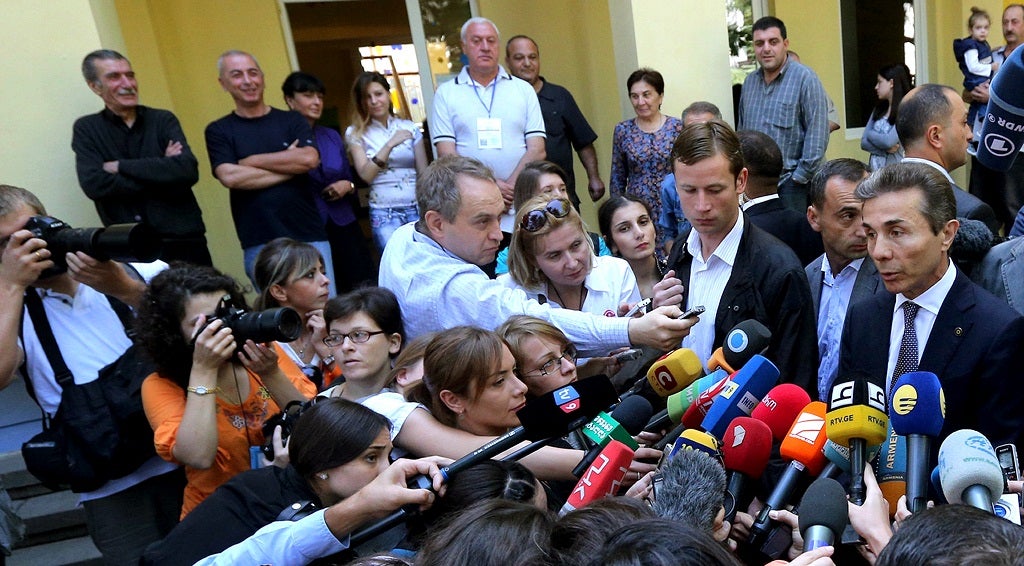
So, Mikheil Saakashvili has conceded defeat to billionaire Bidzina Ivanishvili, who won Monday’s elections and is all set to become Georgia’s new Prime Minister. He has already captured the imagination of the western media, understandably intrigued by a man who lives in a glass castle with his exotic pets, who has an albino rapper for a son, and who was, until recently, a recluse.
Journalists have also latched on to an almost irresistible storyline about the resurgence of Russian influence, amid suspicions of shadowy, John le Carré-style ‘cold war’ deals. This is certainly a remarkable moment, and one that was utterly unthinkable only a few years ago given Saakashvili’s tight grip on political power; focusing too much on the role of Russia would underestimate how much this is actually a Georgian story. Many comments posted on articles and blogs are clear: Russia is only part of the story, and it is risky to look at the east from a very western vantage point.
Even though Saakahsvili seemed invincible, many Georgians have been unhappy with his leadership for some time. From this viewpoint, the election results are not such a big surprise. While many agree that he led the country through important reforms, and successfully curbed the once pervasive ‘small c’ corruption that plagued everyday life, many Georgians, especially the Tbilisi middle class, have tired of his authoritarian style and want a change. There have been mass street demonstrations since autumn 2007 and the resulting violence has fuelled a series of tense electoral campaigns and created a toxic political climate. And all of this was only made worse by the 2008 war over the control of the Abkhazia and Ossetia regions, which undermined the credibility of the Georgian Government at home and abroad.
Although certainly the richest and most flamboyant of Saakashvili’s challengers, Ivanishvili is not the first. Georgian political life has seen a number of short-lived rising political stars, including a former UN ambassador and a TV anchorman. But opposition parties in Georgia were weak and governed more by the personality of their leaders than by any ideology or coherent policy plans.
Unlike the ruling United National Movement (UNM), most parties have, so far, been heavily concentrated in Tbilisi and only a few have been able to campaign actively in the regions. Most importantly, they had little money, while the UNM had heavy financial, as well as political, support from the USA. Not surprisingly, every previous attempt to challenge the UNM leadership has stalled.
Then Ivanishvili came on the scene, barely a year ago. Cash is not a problem: he owns a bank. Reaching the hearts and mind of the electorate beyond Tbilisi is not a problem: he is from the rural west of the country. Simmering tension with Russia is not a problem: he gets on well with the Kremlin, and will take Georgia back to its communist past, or so his opponents claim.
But while such assertions have fuelled the fantasy in the West about the return of soviet style dominance in the Caucasus region, it doesn’t ring quite true. For a start, there is so much anti-Russia sentiment in Georgia that a significant shift back towards a soviet lifestyle is unlikely. Ivanishvili has confirmed that he intends to pursue EU and Nato membership, which matter to Georgians much more than any other forms of political allegiance. On more pragmatic and economic grounds, Georgia needs someone to navigate the difficult diplomatic relationship and inflammatory rhetoric between Georgia and Russia to address important commercial issues, particularly on trade between the two countries.
To me this does not look like a return to the cold war era. Ivanishvili’s victory may have benefited from Putin’s support, but it can also be argued that Saakashvilii’s defeat is the necessary conclusion of an obsolete political alliance with the West – particularly the USA. Georgia is not the only European country that may need more Russian friends, rather than fewer, in the years to come.
Contrary to all expectations, there has been no violence in the streets of Tbilisi and Saakhasvili has conceded defeat gracefully. He may well step out of the way or even agree to power sharing in very western (dare I say, British) political style. If this paves the way to more open, balanced and sober political processes and dialogue, it will be to the credit of Georgians’ themselves, not the Kremlin or Capitol Hill. It would also mark a major step forward in Georgia’s democratic transition, and one that other countries in the region and beyond may wish to study.
Join our commenting forum
Join thought-provoking conversations, follow other Independent readers and see their replies