Joan Smith: How many times can a man turn his head?
Protest has given him a living, but Bob Dylan said nothing about Ai Weiwei and human rights when he meekly performed in China

Sign up for the View from Westminster email for expert analysis straight to your inbox
Get our free View from Westminster email
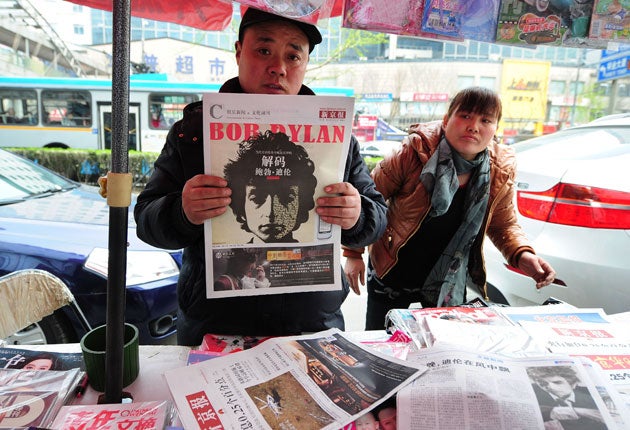
Let's start with a quiz. Which prominent American citizen made a speech in China last week praising activists who want more freedom from the state? And which well-known American took the opposite course, remaining silent about human rights and accepting state-imposed censorship? The answer to my second question is, of course, Bob Dylan, who meekly performed a set approved by the Culture Ministry at the Workers' Gymnasium in Beijing on Wednesday.
In a fascinating reversal, the one-time apostle of protest failed even to mention Ai Weiwei, the Chinese artist who disappeared for four days after being arrested while trying to board a plane at Beijing airport last weekend. It was left to the Obama administration's outgoing ambassador to China, Jon Huntsman, to raise human rights in a speech in Shanghai, where he praised activists who "challenge the Chinese government to serve the public in all cases and at all times".
The times, they certainly are a-changin', although that's one of several classic Dylan songs apparently considered too radical for audiences in China. The singer's management would doubtless argue that the dates of his China tour were fixed long before the latest crackdown on dissidents, although that doesn't explain why Dylan failed to seize the opportunity to show solidarity with an artist of Ai's international stature.
Ai's Sunflower Seeds are still on show in the Turbine Hall of Tate Modern in London, although it's hard to know how widely known he or indeed Bob Dylan is in China; the Communist Party's habit of censorship stretches back to Dylan's heyday in the Sixties, while attempts to search for Ai's name on the internet are usually blocked by the authorities.
On Thursday, in its first admission that it was holding Ai, a Chinese government spokesman announced tersely that he was being investigated for "economic crimes". The claim followed an ominous editorial in the previous day's Global Times, an English-language paper published by the Communist Party, which described Ai as a "maverick of Chinese society". In barely coded language, it went on to warn that Ai "will be judged by history, but he will pay a price for his special choice". The tone was in contrast to the paper's approach to the Dylan concert, which hailed the singer as "an iconic voice of protest in a nation that values harmony".
The Communist Party wasn't expecting trouble from Dylan, in other words, and appeared to regard his concert in Beijing as a propaganda coup. I've never been a Dylan fan – his politics and his lyrics have always seemed incoherent to me – but the authorities are clearly terrified of their own dissidents, who keep defying state censorship to expose the truth about the risible notion of national "harmony".
The government was furious last autumn about the award of the Nobel Peace Prize to a jailed intellectual, Liu Xiaobo, and tried to ensure that as many countries as possible boycotted the ceremony; now it has silenced Ai, who only a couple of months ago spoke eloquently about human rights abuses in a secretly recorded video. One of the things he talked about was his campaign to find out how many people died in the Sichuan earthquake in 2008, when shoddily built schools collapsed and buried thousands of schoolchildren.
Thanks to dissidents such as Ai and Liu, we know about this scandal and others, including the arrests of ordinary people who objected to the demolition of their homes to make way for Olympic stadia. Amnesty International and Human Rights Watch have documented a huge range of abuses, and in 2008, the year of the Beijing Games, the UK Foreign Office listed China among "major countries of concern" in its annual human rights report. According to the report, the British government's concerns included China's use of the death penalty, torture, the lack of an independent judiciary, arbitrary detention, ill-treatment of prisoners, failure to protect human rights defenders, harassment of religious minorities, repression in Tibet, and limitations on freedom of expression and association.
The problem isn't getting this message across to the rest of the world; it's getting people in influential positions to act on it. For decades, British politicians on both sides of the House – including a former prime minister, Ted Heath – argued for a non-confrontational approach to the Chinese government. Gordon Brown and George Bush were among more than a hundred prime ministers, presidents and monarchs who turned up for various ceremonies at the Beijing Games; so did Nicolas Sarkozy, who shamelessly did a U-turn after initially proposing a boycott. Last year, David Cameron went to Beijing on a trade mission during the furore over Liu's Nobel Peace Prize, and followed Sarkozy's lead by promising to raise human rights while he was there.
Guys, I have something to say to you: it's not working. Beijing only has to throw a party and you all turn up as though Tiananmen Square never happened, so why should the regime change? Being nice to the hard-line Communists who rule China – awarding them the Games, muting public criticism, endlessly sending political and business leaders to shake hands with them – has had no measurable effect on human rights. Ordinary people in China are still denied the most basic freedoms, harassed by state security officials – Ai filmed them in his recent video – and disappearing into labour camps.
The arrests of recent weeks demonstrate not the Communist Party's strength but its weakness. Its claims to power and popularity are so illegitimate that it dare not allow its critics to remain free; China's unelected leaders have seen what appeared to be immovable regimes in Tunisia and Egypt fall to popular revolts, while civil war rages in Libya.
In a country where the internet is tightly controlled, Ai's abduction is unlikely to be a catalyst for revolution, but it demands an unequivocal response from the international community. European leaders have called for his immediate release, but now they and President Obama face a bigger test: with freedom blowin' in the wind, how much longer can they go on treating China as the great exception?
Join our commenting forum
Join thought-provoking conversations, follow other Independent readers and see their replies