Mary Dejevsky: What the court battle of the oligarchs says about Britain
Why can someone shovel cash into the UK without any enquiry into its provenance?

Sign up for the View from Westminster email for expert analysis straight to your inbox
Get our free View from Westminster email
Today is the day when English justice delivers its verdict on the oligarchs. After seven months spent poring over the evidence, Mrs Justice Gloster returns to London's Commercial Court to hand down her judgment in the case of Berezovsky v Abramovich – Boris Berezovsky being a one-time Kremlin adviser now in exile in Britain; Roman Abramovich being the owner of Chelsea Football Club. Berezovsky claimed Abramovich cheated him in a share deal, and demanded £3bn in damages. Abramovich said he did nothing of the kind.
The huge sums of money, the intricacy of the arguments, and the ever-shifting political context in which the disputed events took place, all make this a landmark case. But there will be many Britons, myself shamefacedly included, who have already given up and pronounced a plague on both their houses. Whoever wins – and having sat in the courtroom a couple of days, I admit to flailing hopelessly in the rights and wrongs of it – here are two men of a certain age and uncertain wealth seeking to settle old scores through the British courts. Which of them emerges victorious troubles me very little.
It may be that one can afford to lose more than the other, and I would hazard who that might be. But each exploited the turmoil of immediate post-Soviet Russia to his own – considerable – advantage. Acumen came into it, but so – I suspect – did bluff, acquired street wisdom and not a little chance. Whether one behaved honourably and one less so, I would hesitate to wager, but the likelihood is of at least 50 shades of grey.
Corruption was endemic in the Soviet Union; it is endemic in Russia today. In between, there was corruption plus chaos. The times were brutal, and I almost doubt that it is worth raking over old coals in any court at all. Let any aggrieved oligarchs fight it out, in the old-fashioned way, and let the cannier, more ruthless man win. If there is blood on the floor, or the doors, or the car bumper, so be it.
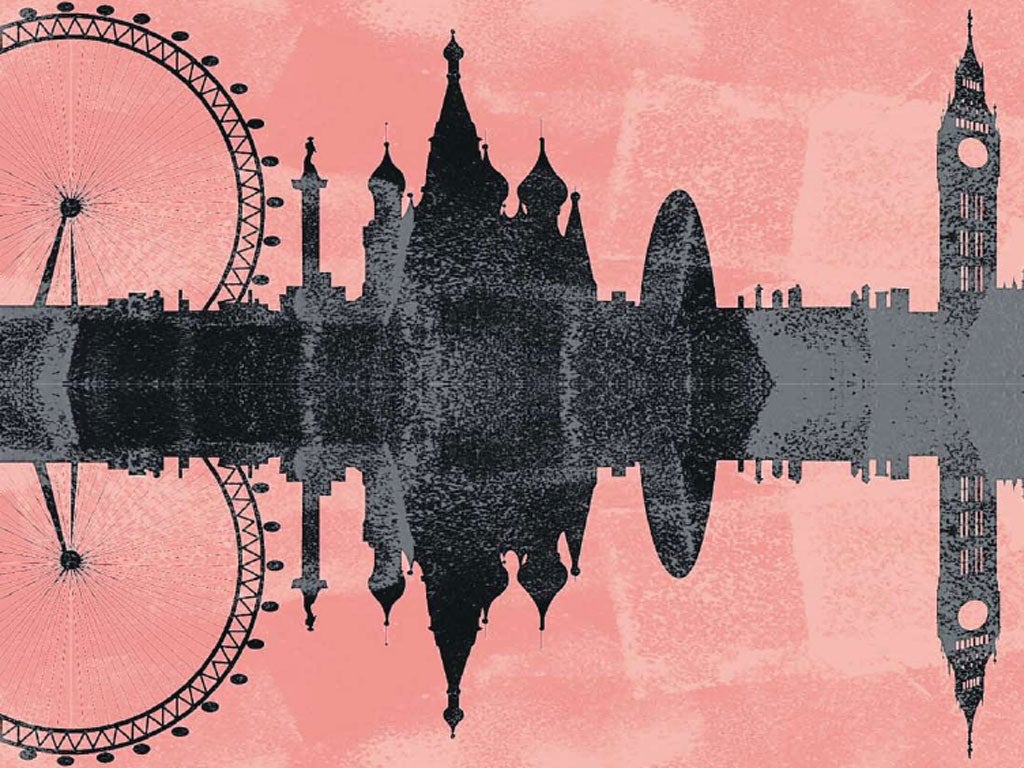
The trouble is that Berezovsky v Abramovich, and the parade of other oligarchs resorting to the London courts, says something not just about a very particular period in Russia (which is now gone), but also about Britain today. And I do care about that, as should the UK Government and the country at large. If Russians cannot get it together to run an honest state, then that reflects at least in part their state of development and their chequered history.
It is no good for us to try to impose our civic standards on them, as various do-gooding NGOs have long tried to do. If there is no domestic power or consensus to sustain change, no improvement will last. A quorum of Russians has to demand a less corrupt state, and there are signs – in recent protests and the rise of internet exposés – that they will.
No doubt that is why Berezovsky and his compatriots have petitioned the English courts to rule on events that have only the most tangential connection with this country – a meeting here, a hotel room there. In a way, that shows a flattering confidence in British justice and a distressing lack of faith in Russia's own. But has the arrival of so much Russian money in Britain, with high-profile members of its privilegentsia not far behind, really been an untrammelled good, or even neutral in its effects?
Someone who believes it has a downside is Alexei Navalny, the frontman for Russia's populist anti-corruption campaign. He has speculated that, while much of the Russian money oiling the wheels of London society is honestly acquired, some of it – obviously – is not. And he asked the question that we Britons should have been asking for a decade or more. Why is it so easy for someone with no obvious ties to Britain to set up shop here and shovel in the cash without any enquiries being made into its provenance? The image of a Russian paying for a Mayfair flat with a suitcase of cash became almost a cliché of the late 1990s. But why did we laugh it off, rather than ask how that could be acceptable or even legal?
Navalny notes that all a rich, or even modestly well-off, Russian had to do – if he chose not to invest £2m in a business to acquire a resident's visa – was to buy a flat, produce his ID and a utility bill, and lo he could set up a bank account and start transferring his billions. In his book, the process was too easy. In my book, as a Briton, opening and operating a bank account and transferring money across borders is too difficult. The very same procedures – the address, the ID, the utility bill – that make it so simple for a foreigner to import his ill-gotten gains cause endless hassles for us natives. Plus the UK bank must declare to the taxman outgoing transfers above a certain amount – but not those coming in.
You can only laugh really about error-prone ID checks that cause us untold delays in the name of preventing money-laundering, yet give foreign shysters a fast-track to legitimacy – so long, that is, that any actual fraud has not been committed here. As HSBC's admitted involvement in Mexican drug money-laundering showed, you have to be a big fish not to get caught in the anti-corruption safety net of a British bank.
It is not just Russians, of course, who feed dirty money into Britain. But it is their millions that have had some of the most obviously pernicious consequences. At the less harmful end are those flats paid for in cash and all the "bling"; at the opposite extreme are some mysterious killings and attempted killings. In between is the court time taken up by internal Russian squabbles – how many homegrown cases have to wait? – and the damaging effect on diplomatic relations of the UK's generous political asylum policy towards economic, if not criminal, exiles.
It might be said that every country gets the emigrés it deserves. In being more interested in the money than how it was acquired, we have brought many of these difficulties upon ourselves. But they are not ours alone. We can fulminate against corruption in Russia as we like, but unless the UK does more to stop dubious Russian money coming to London, we need to recognise that our own greed and regulatory laxness have also played their part.
Join our commenting forum
Join thought-provoking conversations, follow other Independent readers and see their replies