Leading article: A nation whose sense of itself has been utterly transformed
Sign up for the View from Westminster email for expert analysis straight to your inbox
Get our free View from Westminster email
Seven years after an astonished London beat Paris to host the 2012 Olympics, and 17 exhilarating sport-packed days after the Opening Ceremony, the choice of the International Olympic Committee has been joyously, wondrously vindicated.
Who now remembers the failure of G4S to supply enough security staff, or the wrong Korean flag that almost led to a first-round walk-out? Or the arguments about missile batteries on the roof and warships in the Thames, or the doom-laden forecasts about transport collapse and empty venues, and how the last thing that overcrowded and jaded London needed was the Olympic Games?
From the crowds that turned out to follow the very first leg of the torch relay, it was suddenly possible to believe that the whole enterprise could be an almost unheard-of feat: a successful British project on the grand scale. With the Games triumphantly completed, what seemed like a daringly optimistic judgement has been compounded many times over. It is not just the chairman of the London Organising Committee, Lord Coe, and the outgoing chairman of the IOC, Jacques Rogge, who have had broad smiles on their faces in recent days, but millions of Britons and their guests from all over the world.
After a characteristically hesitant start, British athletes – Team GB – rose magnificently to the challenge and expectations of home crowds. And the crowds repaid the compliment. Team GB overtook the impressive total of medals won in Beijing with days of competition still to go. Of all the gold medal winners, it seems almost invidious to name names, but there was Bradley Wiggins, adding an Olympic gold to his Tour de France victory; Ben Ainslie's fourth gold medal in the sailing. There was Somali-born Mo Farah adding the 5,000m to his 10,000m victory; Nicola Adams winning the first gold medal for women's boxing; Jessica Ennis's majestic run up the home straight to win the heptathlon, and former stable-girl Charlotte Dujardin's gold in the dressage.
Not just the victories, but the style of winning
Nor was it just the victories that impressed, but the grace with which all the winners accepted their medals, the tributes they paid to their families, their coaches and the crowds, or the message that each and every one of them so eloquently conveyed: that hard work and dedication brings its rewards. Their modesty was the best possible rebuttal to the spirit of easy credit and instant gratification that has set the national tone for so long. No wonder, as the new season gets under way, it is being suggested that our footballers might settle for less pay and a more modest lifestyle. There are other role models. It is just a pity that the next big television event is The X Factor.
The achievement of women at these Olympics warrants special mention. Not only was the performance of Britain's women especially encouraging – for the variety of their sports and the fact that British rowers won the country's first gold medal of the Games – but this was the first Olympics where every one of the national teams included at least one woman, and that is a far more impressive landmark than it might sound. It will not be possible to turn back the clock.
A morale-booster like nothing in living memory
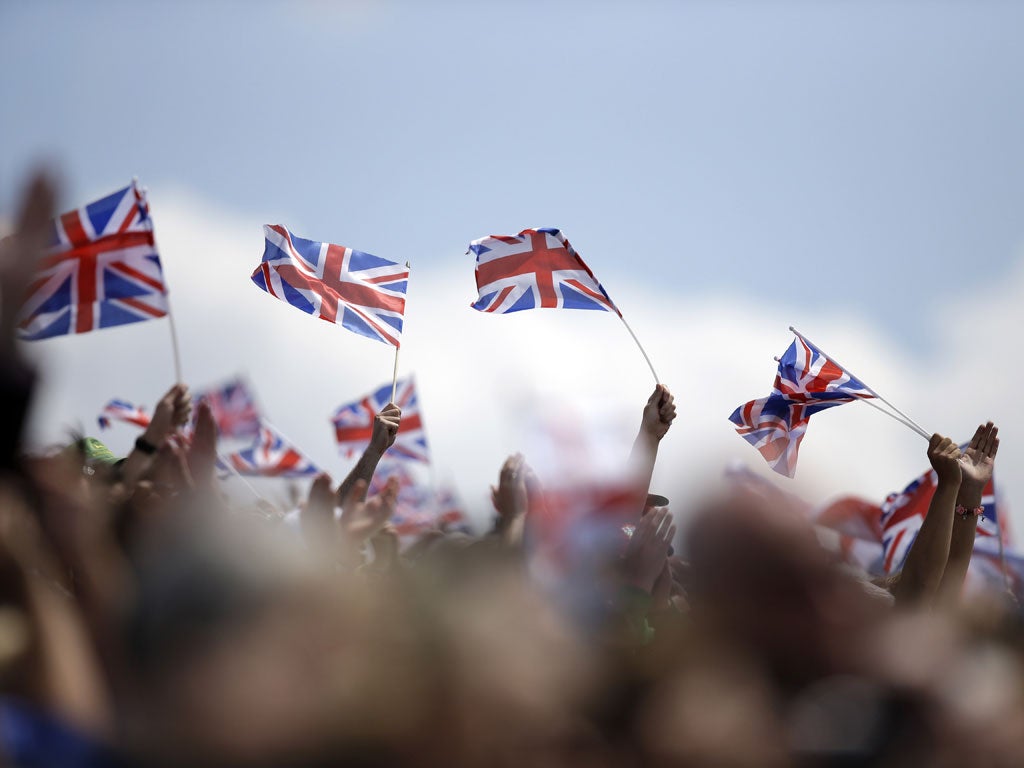
But it is the mood of the country at large, and most particularly of London, where the impact has been greatest. Hosting the Olympics has boosted national morale more than any single event in most people's living memory. The capital and the country have been transformed. From the sometimes dark, often humorous Opening Ceremony onwards, Britons relaxed and celebrated their multi-faceted identity in a way that allowed the country to wrap itself in Union Jacks, while cheerfully welcoming everyone else's national flags, too. It was not just the British winners who were cheered; audiences were generous to a fault, applauding victorious rivals, and reserving – in typically British way – special acclaim for those who came in last. Jamaica's Usain Bolt was cheered to the rafters as he sped to each of his three gold medals, but his premature claim to legend-status received the brush-off it deserved.
Tributes are due to a host of individuals and groups: most immediately and obviously to Lord Coe, as the chairman and public face of the organising committee; to those who designed and built the new facilities. Going back in time, honourable mention should be made of Sir John Major, who introduced the National Lottery that has made Olympic medal-winning possible in an age of largely professional sport; of Ken Livingstone and Tony Blair, who helped win the bid; Dame Tessa Jowell, who – as Labour's Culture minister – beat off those who thought it would all be too much trouble. And back to today: credit is also due to the Coalition ministers who inherited the project and saw it through, and to the ebullient Mayor of London, Boris Johnson, who remained the irrepressible cheerleader in a climate of doubt.
But this was not an undertaking that was, or should have been, about politics at all – which perhaps helps to explain its success. Those praised most often by the public – after the athletes – have been the Army and the thousands of volunteers. It may be a paradox, but a hopeful one, that the military-civilian covenant – which was in a parlous state after the war in Iraq – has been mended not by government fiat, but far more effectively by the demeanour of the troops staffing the Olympic checkpoints. Something similar could be said about Mr Cameron's vain efforts to conjure up a Big Society. It came into being spontaneously, in the shape of the 70,000 people of all ages and backgrounds who gave their time to help make the Games a success. There has to be a lesson here, even if it is not quite evident what it is.
Other lessons are clearer. The much-vaunted "legacy" has to be organised with the same competence and dispatch that distinguished most aspects of preparation for the Olympics. And it must be done visibly, so that the country at large knows that promises are being honoured and money not being squandered. That applies especially to the affordable housing planned for the Olympic Park – one giant shopping centre does not of itself regenerate a depressed area – and more thought should perhaps be given to the future of the main stadium. Is its best use really as the new home of West Ham FC?
We must build more public sports facilities
The Olympics also raise, with some urgency, the question of funding not only for elite sport, but for public facilities and the need for much-increased sports provision in schools. The glaring disparity that has been exposed, once again, between opportunities in private and state schools must be addressed. The generation that will undoubtedly have been inspired by London 2012 must not be disappointed. The Prime Minister was right to make a prompt announcement yesterday that Lord Coe would become Legacy "tsar" and that sports funding would be maintained. But politicians' intentions and reality too often turn out to be different things. This must be only the start of a whole new attitude to grassroots sports provision.
The most precious and unexpected result of the London Olympics, though, is the mood of national confidence and enthusiasm they have generated. The crowd's lusty rendition of the National Anthem that accompanied Farah's second gold-medal ceremony on Saturday summed up the change. The country, and the organisers, now have time to take a breath before the Paralympics in 17 days' time. London, for its part, must keep up the momentum. Record participation and record ticket sales bode well for these Games, too. For the longer term, though, the country and its leaders must do their utmost to capitalise on the sense of community and pride that the Olympics have so unexpectedly, and so positively, brought.
Join our commenting forum
Join thought-provoking conversations, follow other Independent readers and see their replies