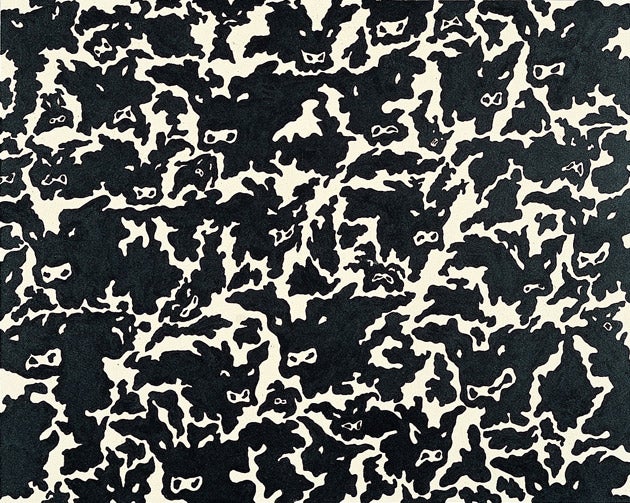
Great Works: Cow Mutations (1987), Tim Head
Walker Art Gallery, Liverpool
The concrete cows of Milton Keynes are famous. They were made by the Canadian artist Liz Leyh, in 1978. They are sited in a green space on the edge of the city. Seen from a distance they're a pretty plausible likeness of a group of Friesians. They could almost be alive.
Close up, the impression is quite different. Far from realism, what you see are some very vaguely quadruped blobs. The illusion was all in the paintwork, in the black-and-white markings. The effect is a neat lesson in how we pick up visual clues and jump to conclusions.
Almost 10 years later, Sainsbury's produced a range of milk cartons. Their design was an abstractish variation on the shapes of cows with markings. You couldn't call them Friesians or Ayrshires exactly. These illustrations used various unnatural colours to indicate the different types of milk.
Was this idea, cows reduced to a pattern, inspired by the Milton Keynes landmark? And if so, whose? We may never know. Commercial illustrations, however iconic, are usually anonymous. What we can say, though, is that this carton design found its way into an artwork: into Tim Head's Cow Mutations.
This painting is dense with connotations. At the heart of it, of course, there's a found image. We viewers are asked to recall the Sainsbury's carton and its design, and notice how the painting has mutated it – reshaping and multiplying it. On the carton, the cows' image was already slightly fragmented. The painting takes advantage of this, further fragments it, turning it into a mass of half-recognisable shapes.
Cow Mutations plays a trick of pop art. It adopts a piece of commercial art, and converts it into a finer art. In this case, the carton design is adapted into an almost pure pattern. You could see it as forming the repeat patterns of wallpaper. You could see it as an all-over abstraction.
On the other hand, Cow Mutations is also a kind of caricature, with more sinister intentions. The friendly carton cows are distorted and torn into something violated, violent. The shapes of individual creatures lose their identities. They are disintegrated and dispersed into bits and pieces, into meaningless black elements swarming and fusing on a white ground. Mutation? It's a visual equivalent of genetic engineering. It is nature broken down, melted down, in metamorphosis.
So Cow Mutations is itself a mixed-up painting. Its connotations are various and incompatible – conflicting, complicated, confusing. It could be high art or low, wholesome or menacing. Abstraction, for instance, is generally a solemn high art. Wallpaper is lower, a decorative art, probably benevolent. Commercial design is definitely low class, but tries to come over nice. Genetic breakdown is nasty and frightening.
If you try to put them together in an orderly way, the result is contradiction, irony, suspicion. And the dominant force usually ends up as breakdown. It subverts everything else. Nagging away, it undermines the gravity of abstraction, the decorativeness of wallpaper, the cheerfulness of commercial design.
What's more, the painting, since it is done through (pictorial) mutation, affirms the power of (genetic) mutation. Or again, since the painting's image is derived from the milk-carton image – since evil breakdown was lying potentially there in the friendly commercial design – this implicates industrial food production in dubious bio-science.
But all these effects were fragile. Because at some point Sainsbury's discontinued the carton design. The object of Cow Mutations' mutations, its target and essential reference point, was lost. The painting itself remains, though: a bizarre nightmare-cartoon-farmyard-abstract.
About the artist
Tim Head (1946) is an unclassifiable English artist, a post-medium operator, working in painting, photography, installation, digital light-projection – conceptual, formal and political. 'Cow Mutations' can be seen in an exhibition, John Moores Prizewinners 1957-2006, at the Walker Art Gallery, Liverpool, until 30 December. Head's next show, Raw Material, opens on 23 November at the Huddersfield Art Gallery.
Join our commenting forum
Join thought-provoking conversations, follow other Independent readers and see their replies
Comments
Bookmark popover
Removed from bookmarks