Great Works: Still Life with Peaches (c AD50) Anon
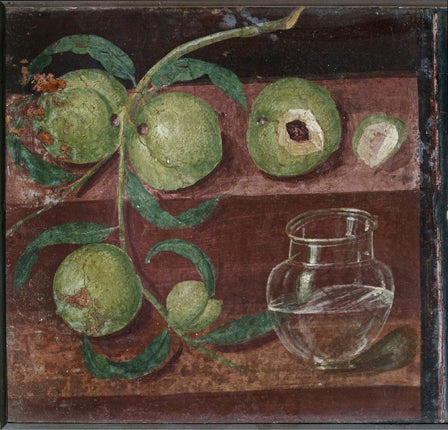
Classical art is often given a classic status. The works of the ancient Greeks and Romans have been taken up by many later artists as supreme examples. At least that's true of their statues and buildings. But when it comes to paintings, there's a problem. Very little remains, and what remains is puzzling.
For instance, we have no idea who painted this Still Life with Peaches. We have no idea what other works its maker did, and only a very limited idea about the works of contemporaries. The Roman still lives that have survived mostly come, like this one, from Pompeii and Herculaneum.
They were mural paintings, preserved (ironically) by the lava of Vesuvius, while the paintings in other cities, such as Rome itself, were destroyed or faded away. Was the art of these two provincial towns inferior to the art of the capital? If we saw real Roman painting, would that make the work that's survived look very average? Or is this as good as it got?
The Still Life with Peaches comes from a room in Herculaneum. It wasn't a free-standing image. Like other still lives, it was set on a wall among landscapes, narratives, decoration. But it occupied a contained square-ish section. And it uses the standard Roman still-life convention, the double (sometimes triple) level: the objects are arranged on a step or a sill.
Its subject is normal still-life stuff, pieces of the ordinary: a group of green peaches, with a curving twig and curling leaves, and a glass flask. There's a bit of damage and fading, but nothing ruinous. We can see the evidence. It looks familiar. We ought to be able to judge. But actually it's hard to tell whether this work is good or not. We can't quite speak its language or catch its tone.
Still Life with Peaches believes in a bold and simple design. It has a "modern art" look. There's a dominant colour contrast, lime-green and reddy-brown, strong and sweet. There's a composition of rounds and bars – an "overall" composition, where the top half of the picture has as much weight as the bottom (a benefit of the step device). The twig curves from top to bottom. The leaves furl in an elegant pattern.
In other words, there is a sophisticated eye at work. And at the same time, there is a barely competent hand. The depiction of the fruits is a mess. They are neither flat nor solid, and their contours are very uncertain. The shadows cast by everything are blobby. They completely fail – the main point of cast shadows – to attach the object to the surface beneath it.
This mixture of skill and bungling makes you wonder: what kind of artist did it? An amateur who's had a few lucky strokes? Or a hack at the fag-end of a tradition, who's half forgotten how to do it? Take the two peaches that have been cut open. They have some neat volumetric effect in mind: a concave scooped out of a convex. The visual idea is smart. Someone could do it superbly. This artist can't make it work.
The most beautiful and puzzling item is the glass flask of water. It sets itself another picturing problem: to depict transparency, one transparent element inside another. It solves it very economically, with an image made purely from highlights, streaks of white. Some are bolder, some fainter, some sharper, some softer, as they bring out the surfaces, the inside and outside. Each stroke is abrupt, a show-off point. It's as if the artist didn't simply know the pictorial tricks needed for doing a glass of water, but was consciously enjoying the performance of a code.
But then look at other aspects of the flask and the way it's painted. Look at the "perspective" of its forms. This is a round object, presumably, and seen at an angle. The rim of the neck, the circumference of the water surface, the flask's base – they should all be ovals of some kind. But the artist can't do proper ovals. They're all irregular. (The general shaping of the flask's outline is wonky too.) Or again, see how the mouth of the flask is quite a wide "oval", as if it was seen from above, whereas the base of it is shown directly side-on, as if it were viewed with the eye on a level with it.
The puzzle returns. In some ways this object is depicted with skill, with sophistication. You might think it was done with a kind of play or irony, as if each stroke of highlight had inverted commas around it. Yet, in other ways, it's rendered crudely and clumsily, as if the artist were a naïf. Or again, in view of the sophistication elsewhere, perhaps this is actually faux-naivety.
Who knows? Is this the work of a plodding, jobbing pub-sign painter? Or a playful first-century Hockney? Unless more Roman paintings turn up, to allow comparison, we'll never be able to tell. All we can say for now is that Still Life with Peaches is an awkward work and an awkward case. Like other surviving classical paintings, it has nothing of the serene, authoritative perfection of classical sculpture. It may have the charisma of the classical: since it's all we've got to go on, we make the most of it. But classical it is not.
Pliny the Elder and classical painting
Pliny the Elder (23-79) was a Roman of many accomplishments. He has remained famous for two reasons, both in a way accidents. The first is the almost complete loss of the painting of the classical period. We can't see much of it. We must read about it in Pliny's 'Natural History'. This universal encyclopaedia has a section devoted to painting. Pliny lists hundreds of painters with their achievements.
He mentions Piraeicus, patron of all artists who transfigure the everyday: "His subjects were barbers' shops, cobblers' stalls, donkeys, eatables, and the like... His paintings, however, are exquisitely pleasing, and have sold at higher prices than the very largest works of many masters." Pliny's other claim to fame is his death. He was killed in the eruption of Vesuvius, which destroyed Pompeii, but preserved a good deal of its art, such as this still life.
Join our commenting forum
Join thought-provoking conversations, follow other Independent readers and see their replies
Comments
Bookmark popover
Removed from bookmarks