Great Works: The Room (1952-54), Balthus
Private Collection
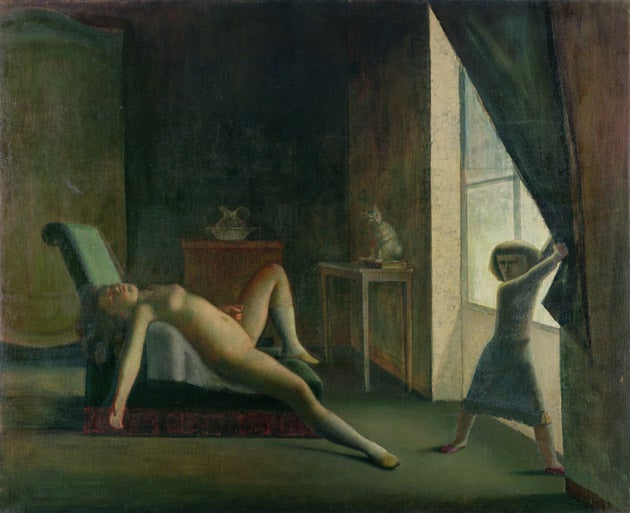
You may not believe in the unconscious, but paintings seem to. They believe in unconscious motives, desires, experiences. In a picture, figures are often subjected to forces that they aren't aware of in the least. These forces are not part of the literal subject matter of the scene. If you described the picture's story, the life of its figures, what they were doing, what they felt, what they knew, you wouldn't mention these things. Still, they are there to be plainly noticed – visual, pictorial phenomena, which involve the figures intimately.
They can be interpreted in different ways, as external or internal forces. In older pictures, they might register as supernatural agencies, providence, magic. In more modern pictures, they can represent the work of hypnosis, the content of dreams, the activity of the unconscious mind.
And what are these mysterious forces? They're perfectly normal features of pictures – the stagecraft, composition and lighting of a scene – but deployed in an unusually compromising way. They're things that are visible to the viewer, but not to the figures on the picture's stage, but which those figures seem to be affected by. A picture by Balthus shows how. Balthus's art can seldom escape or deny a charge of perversity. It harbours, more or less explicitly, fantasies of sexualised childhood and sexual assault. In The Room, these themes couldn't be more explicit, but also, in a way, more devious.
Does it make it better or worse that the central figure here seems not to be aware of these suggestions? Or rather, that the picture's fantasies are attributed to its protagonist herself – but attributed to her unconscious mind? Each way, the artist manages to off-load responsibility for his own imagination, onto the subject or perhaps the viewer of his picture.
He does it first of all at the level of plain story. A girl lies naked and spreadeagled across a couch, in a barely furnished chamber. She is literally unconscious, asleep, dreaming. Whatever else is happening to her, or in the surrounding scene, you can suppose (if you like) that it's something arising within her dreaming mind, or being filtered through it. If you like. But whose wishes are we being shown? This weird dwarfish familiar, drawing back the curtain to let in the blaze of the morning: is it a figment of her imagination, or perhaps a stage-setter, a chorus-figure exposing the scene and the girl for our benefit? The creature illuminates her. The girl opens her legs to the day. The light is a revealing and an invading force.
Then composition enters into it. It's composition as an impaling force. A straight line runs through the girl's body, a diagonal from breast to toe, fixing it in submission. This goes with the drawing of the curtain. The creature pulls it back to an angle almost parallel to the girl's diagonal. So it's not just her body's own unnatural geometry: the curtain's slanting edge helps hold her at her slant. At the same time, the morning beams themselves, blasting down, seem to press her figure into a straight line. It is what makes the light fall like violence.
Light and composition overwhelm. The girl is exposed and invaded and impaled and fixed and flattened. She's subjected to a complex of pictorial forces, each enforcing the others. They are powers that come upon her, touching intimately on her body but not present to her conscious mind. She wants it really? You want it really? But of course the artist has done it all.
About the artist
Balthus (1908-2001) was the nom de pinceau of the Polish aristocrat-turned-French painter, Count Balthasar Klowssoski de Rola. An untaught child prodigy, he became a leading exponent of non-modern art. Against abstraction and distortion, he developed a style of craftsmanly, realist painting that paid direct homage to old masters like Poussin and Piero della Francesca. He protested innocence, but his favourite subjects were Lolitas, either naked or wearing skirts, which the pictures do their best to look up. It's a tendency of which it is easy to think the worst – until you see the monstrously sadistic pictures that his brother Pierre did.
Join our commenting forum
Join thought-provoking conversations, follow other Independent readers and see their replies
Comments
Bookmark popover
Removed from bookmarks