Great Works: The Ruins of the Kreuzkirche in Dresden after the Prussian Invasion, 1765 (80cm x 110cm), Bernardo Bellotto
Gemäldegalerie Alte Meister, Dresden
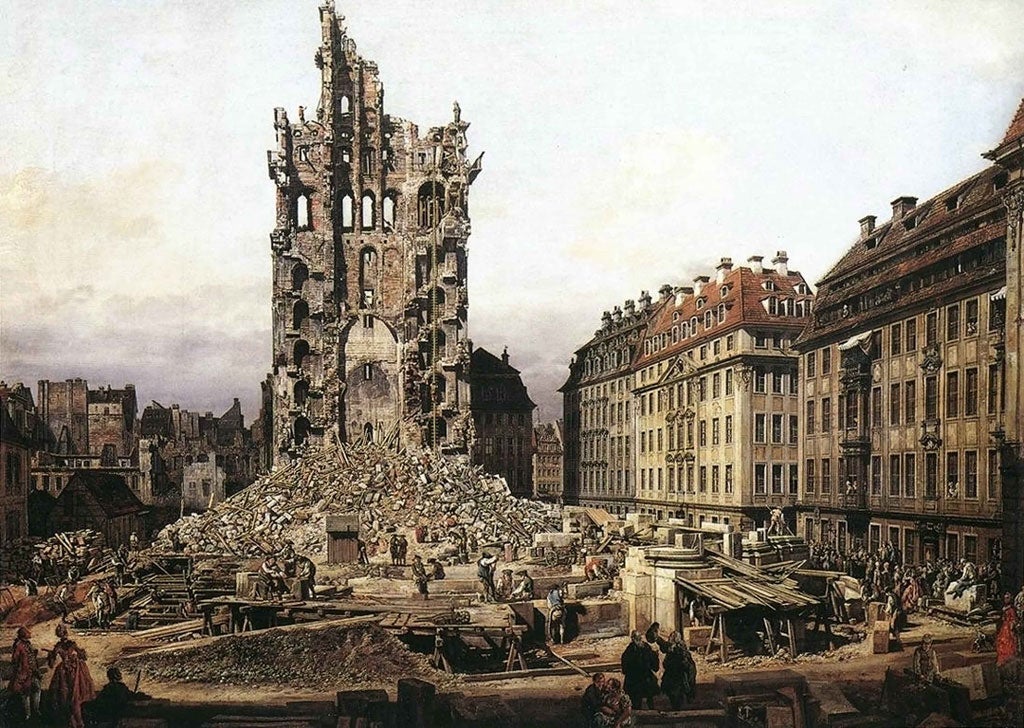
There are ruins and ruins, distant ruins and more recent ones. There are ruins that are set apart from us, as much mythical as physical, and other ruins that are painfully close to us, and seem to be almost extensions of our personal tragedies. Compare the ruins of Ancient Rome with the ruins of Passchendaele in 1915, for example. The 18th century had a great appetite for the contemplation of ruins: think of Claude Lorrain or Nicolas Poussin. Those ruins were often the remnants of the great classical civilisations of Greece and Rome. Such scenes could be heady, if not blurry, with mythological association. They were great stage sets against which immemorial dramas were still being re-enacted. Gods made mischief amid the fallen columns. Such ruins were not necessarily for the prying eyes of ever curious archaeologists. Nor were they to be swarmed over by tourists. That painterly enterprise represented a conjuring of vanished worlds that neo-classicism would strive, in part at least, to re-create. The 18th-century poet delighted in the idea of the laurel crown.
This ruin, painted by the Venetian nephew of Canaletto, is an unusual one. It is not an old ruin, but a relatively new one – new to its painter, that is. Yes, it is of its time. And yet we are momentarily fooled. To us, at first glance, it could be yet another ancient ruin. In fact, it is painfully recent. It shows us a great medieval church in the centre of Dresden, the oldest church in the city, felled by the Prussians during the Seven Years War. Bellotto had painted the glory that was Dresden before the Prussians invaded. He had even painted this extraordinary church. Later, he returned to record its partial destruction by the barbaric Prussians who had struck down a mighty symbol of the capital of Saxony.
There is a strange sense of déjà vu as we look at this image. We think immediately of the destruction of Dresden by the Allies at the end of the Second World War, and in particular of the obliteration of the Frauenkirche that stood at its centre, that 18th-century church which, by 2005, had risen from the dead, stone by stone, as if by some miracle. Cities can be destroyed many times over, and so it was with Dresden. We destroy and we remake. This is not an old ruin then. It is contemporaneous, vitally alive. It reveals evidence of new wounds, of the consternation and the hurt pride that would have attended its destruction. It puts us in mind of those postcards that were produced immediately after the destruction of the towns of northern France during the First World War, in order to demonstrate to us quite how pitiless the filthy Boches were capable of being in those days of bloody mayhem.
Ancient ruins are usually bereft of humanity. They exist to be contemplated as if they existed in some distant otherwhere, an otherwhere towards which we travel only imaginatively. This is no such ruin. There are many people in attendance here. Masses of townsfolk are gathered. There are irreverent, moneyed gawpers at the outer edges, tricked out in all their finery – frock-coated, bewigged – who look as if they have just had their Grand Tour interrupted by something poignantly local. When they have done with this spot of voyeurism, they will doubtless pass on to grander places, grander scenes of devastation. The ruin itself is being swarmed over by men of Lilliputian dimensions – see the extraordinary ladder that runs the full height of the tower. Yes, this could be a scene out of Swift. They are examining the church's tower. Repair is already underway on the ground – see the workers with their mattocks etc.
Neo-classical ruins are often presented in a context of harmonious make-believe. This is no such place. This terrible, jagged remnant rears up from a panoramic view of the civic grandeur of Dresden like some terrible, ungainly, carious tooth which both shames and alarms. It is a perfect model of harmony destroyed, and yet it is still set within the context of smooth civic harmony – see the beautifully appointed, architecturally harmonious street to the right of it, stretching away, with its clean lines. There is nothing clean about the church. It is all noise and dirt and blasted ruck. Christ's body has been violated all over again. The civic wounds are weeping-fresh.
ABOUT THE ARTIST
Bernardo Bellotto (1722-1780) was the son of a sister of the painter Canaletto and, like his uncle, he gained fame and fortune as a view painter. He spent much of his early career emulating and reworking the paintings of his uncle, but at the age of 25 he left Venice forever, and he gained his mastery as a painter at the courts of northern Europe.
Join our commenting forum
Join thought-provoking conversations, follow other Independent readers and see their replies
Comments
Bookmark popover
Removed from bookmarks