Great Works: Tobias and the Angel (1607), Adam Elsheimer
Frankfurt Historisches Museum
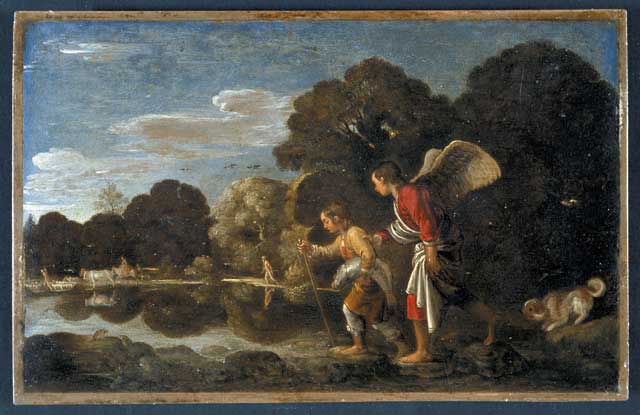
Sometimes painters can seem too industrious by half. Think of Picasso, Rubens or Titian. We almost tire of their immense productivity. There is always another work to be examined and explicated. We almost wish they might have died sooner...
This not not the case with the 16th-century painter Adam Elsheimer, the son of a none-too-prosperous tailor from Frankfurt. Elsheimer was no titan bestriding a busy workshop, with rich patrons banging at the door. He painted few works. He painted small – some of his paintings are scarcely larger than postcards. He also painted very slowly. His friend Rubens even had the audacity to call him "slothful", which was far from the case. And he died at the tender age of 32, in 1610, perhaps of stomach problems, which may have come about because of a fondness for leaning at a particularly acute angle over his paintings, hair-thin brush in one hand, magnifying glass in the other. And, unlike Rubens, he wasn't both a painter and an impresario for painting. He didn't court courts. In fact, he was rather introverted. He preferred just to paint. And to learn. His passion for astronomy, for example, had one fascinating consequence. He painted the Milky Way with an extreme degree of accuracy, something that no painter in the Western tradition had done before him
Only 34 paintings are known to exist by him, but a number of them are amongst the most exciting and innovative works of their time. Tobias and the Angel, which was probably painted three or four years before his death, is one of those tiny, innovative works which show us why he is so important. The subject itself is not uncommon – Verrocchio, Lippo Lippi and Raphael made paintings of the same title. But Elsheimer's way of dealing with the subject was quite different. If you look at the three treatments of the subject by the other masters, you will find them all to be brilliant, and almost gaudily worldly, displays of painterly excellence, bathed in the light of day – self-preeningly so, you might even add. Elsheimer turns the subject into a much more mysterious and almost hole-in-the-corner affair. What is more, the scene is mysteriously under-lit, and variously lit – another trait common to many of Elsheimer's best works.
The story is taken not from the Bible, but from the Book of Tobit in the Apocrypha, that collection of narratives which got excluded from the Bible by the Church Fathers. Tobias is the son of Tobit. A fish attacks him while he is washing beside the River Tigris. He kills it, removes its guts, and later uses them to exorcise a demon, and to cure his father of blindness. An angel guides him across the water to safety. One important matter which Elsheimer more than suggests is that Tobias, who is represented as a small, vulnerable boy stumbling his way across the waters in the half-light, does not necessarily know that his protector and guardian is an angel because Tobias is not looking at him.
In the three versions by Raphael, Verrocchio and Lippo Lippi, the angel and Tobias are almost companions in arms, of a similar height, and similarly clothed. The most singular detail in Elsheimer's version is the size and the bulk of the fish. What a huge and alarmingly realistic burden it is, stuffed there underneath his small left arm! In the other versions, the fish is a mere small and decorative bagatelle of a fish. In Elsheimer's scene, on the other hand, Tobias seems to be labouring to carry it. In spite of the fact that the fish is so realistically painted, the very fact of its size and its burdensome nature Christianises the painting to an extraordinary degree – everyone looking at this painting in 1607 would have remembered that the fish was an important Christian symbol.
But there are other equally extraordinary things to be seen in this painting. The luscious, half-lit scene beside the river is a little reminiscent of the work of Claude Lorrain – Elsheimer helped to propel the painting of nature in a new direction. The clothes of Tobias and the angel sing out in the murky light – the angel's outer robe warbles in a particularly brilliant silver. The silver itself has a peculiarly distinctive shine – if not sheen. This is enhanced by the fact that, as with so many other masterpieces by Elsheimer, the work was painted on copper, which leaves the painting with a hard, shiny, brilliant surface, very good for showing off the showy costuming of angels.
The light is mysterious too. Where exactly is it coming from? Perhaps from several sources at once. Look at the man on the yonder side of the Tigris. He seems to be gifted with his own peculiar light. There is something essentially Christian about this rare dedication to the importance of light. The light of the Word. The Light of the World. This learned painter – he was also very well versed in astronomy and botany – is likely to have had these words ringing inside his head as he applied each hair-fine stroke of the brush.
About the artist
Adam Elsheimer was born in 1578 and died in 1610. Early in his career he migrated to Rome, where he participated in a remarkable flourishing of the arts alongside Caravaggio and his circle. He painted on copper, and his careful deployment of light and shadow was hugely influential.
Join our commenting forum
Join thought-provoking conversations, follow other Independent readers and see their replies
Comments