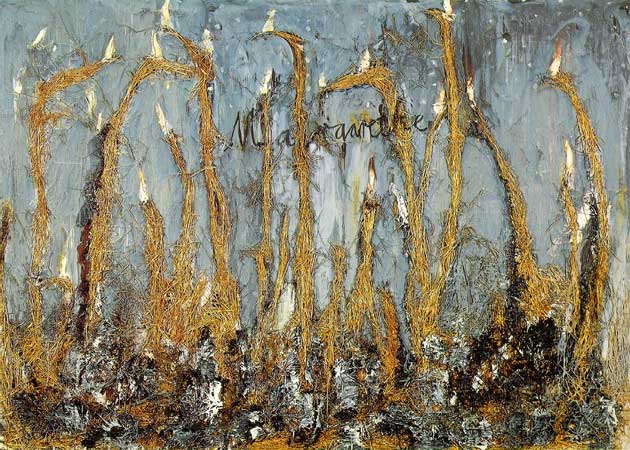
Margarete (1981) by Anselm Kiefer (Saatchi collection)
The Romanian poet Paul Celan was the only member of his family to survive incarceration in a concentration camp during the Holocaust, but committed suicide in 1970, at the age of 49, after producing a body of work that included the searingly painful poem, "Death Fugue". In it he talks of the inhabitants of the camp drinking black milk and digging graves in the sky. Two figures are contrasted in the poem and act as the central metaphor: Margarete, with her cascade of blonde Aryan hair, and Shulamite, a Jewish woman whose black hair denotes her Semitic origins, but which is also ashen from burning.
The theme of Celan's poem has been a preoccupation of the German artist Anselm Kiefer, for whom Margarete and Shulamite have become the metaphoric protagonists in a series of paintings, of which Margarete (1981) is the concluding work. Art and history have a complex and uncomfortable relationship within Kiefer's work. In the Seventies, he was concerned with depicting the land where historic events might have occurred. An archetypal landscape began to dominate where the earth was burnt or blackened, and the high horizon line seemed to prevent escape.
As Kiefer's 1980s series on Margarete and Shulamite evolved, like Celan, he developed a series of visual tropes to characterise the two women. Shulamite's black hair is usually painted, while Margarete's is depicted in straw embedded in the paint. Mirror images of each other, Kiefer implies that the destinies and cultures of these women were inextricably linked. Straw added to a painting of Shulamite suggests Margarete's golden tresses, while black lines or tangled areas of black paint in Margarete imply the silent, erased presence of Shulamite. For Kiefer, Germany had maimed itself by the Holocaust. By pairing these two women in paint, he attempts a restoration of wholeness.
Having exploited the metaphoric resonances of lead and sand, Kiefer first used straw in the early Eighties. With its potential to be burnt and turn to ash, it not only implied a landscape scarred and formed by history, war and fire, but also the possibility of alchemical transformation. Margarete, indicated by straw, symbolises the German love of land, and the nobility of the German soul, allowing Kiefer to play with complex notions of racial purity. The image of Margarete owes much to the vision of German womanhood created by Goethe. In Faust, Margarete (also known as Gretchen) exhibits a pure, innocent love for Faust. But love leads to a series of deceits and the killing of her own baby. While lying in prison on a bed of straw, Faust murders her brother. Thus Margarete's innocence is tainted. Goethe depicts women as sacred preservers of moral values, undone by male power, yet able to be both saved and redeemed. This is a model to which Kiefer often refers, though, for him, there's an ambivalence about the implied purity of such women.
In Margarete (1981), the name is scrawled in black across the surface like graffiti, part-prayer, part-memorial. Tendrils of straw curl upwards like smoke from death-camp chimneys, ending in candle-like flames. Meaning is ambiguous. For this flourishing crop might imply resurrection, yet the soil from which it grows is charred, while the tangles of black paint evoke the shorn piles of hair found at Auschwitz. Of his limited palette, Kiefer has said that only the French traditionally use a range of colours; as a German, he's less familiar with the practice.
Kiefer abandoned law in 1966 for art. His intellectual and artistic evolution mirrored the concerns of other German artists. He rejected the American influence of Abstract Expressionism, Pop and Minimalism to search for a German viewpoint to reflect the upheavals of the war-torn past. Moving from art for art's sake, he explored the past to learn lessons for the future. Influenced by Beuys, he saw art as a healing, spiritual process, and adopted myth and metaphor to investigate the "recent terror of history".
This impetus for examining the Nazi era may have partly derived from the 1960s spirit of revolt against the legacy of previous generations. Sensing the unaddressed presence of the Second World War everywhere within contemporary Germany, he felt compelled to confront the silent taboos of post-war German society.
These straw paintings are among the most powerful of Kiefer's works, and echo Rilke's words: "For /beauty/ is nothing but the beginning of /terror/, which we are still just able to endure." In Margarete, straw acts as a symbol for emotions stirred by the idea of land within German history. There is, Kiefer seems to imply, a dark blemish on the soul of the German nation that it will still take generations to erase.
About the artist
Anselm Kiefer was born in Donaueschingen in 1945. He studied law at Freiburg University, giving it up, in 1966, to study art. He is best known for huge paintings that deal ironically with 20th-century German history. He has developed an array of visual symbols commenting on the tragic aspects of German history, particularly the Nazi period. In the Seventies, he painted a series of landscapes that captured the sombre German countryside. In the Eighties his paintings became more physical, and featured unusual textures and materials.
Join our commenting forum
Join thought-provoking conversations, follow other Independent readers and see their replies
Comments