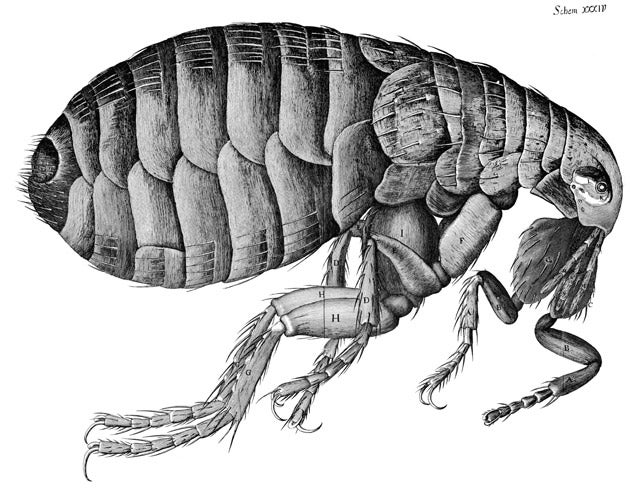
The Flea (1665), Robert Hooke
engraving published in his Micrographia
The traditional monster is a composite. The unknown is put together from pieces of the known. It is a work of imagination as defined by Thomas Hobbes: "Imagination being only of those things which have been formerly perceived by sense, either all at once, or by parts at several times", as when "from the sight of a man at one time, and of a horse at another, we conceive in our mind a centaur".
A centaur is a simple splice. Most monsters have more complicated recipes, a bit of this, a bit of that, batwing, horn, tusk, claw, fang, snake, fishtail, feather, scale, sometimes fused very finely. Think of the various dragons and demons that appear in pictures, such as by Bosch or Grünewald. But even the most monstrous, the most inventive, are collages of the normal. What makes them unnatural is their incongruous compound nature.
Words make this even clearer. At the climax of Racine's Phèdre, a vast and terrible creature rises from the sea-depths, off-stage, embodying all the destructive feelings of the drama. When it's described, it's a mix-up. "The wave came near; it broke, and spewed up/ Before our eyes, from the foam, a furious monster./ Its broad head was armed with threatening horns;/ Its whole body was covered with yellowy scales;/ An untameable bull, an impetuous dragon,/ Its back was rippling into tortuous folds;/ Its prolonged bellowings made the shore tremble..." (C H Sisson's translation.)
But words can also disguise something that monster-pictures make all too clear: the fact that anatomical collages often make very implausible organisms. They can scare the living daylights out of us, but could these beasts live? Painters have put their imaginations into the shapes of their monsters, without imagining how they'd go. Even with the straightforward centaur, you may wonder whether a creature with two cardiac, respiratory and digestive systems could operate.
Monsters don't need to be imagined, though. The scientist and draughtsman, Robert Hooke, was a contemporary of Hobbes and Racine. He demonstrated how the extremes of nature can far exceed the extremes of the mind. All you need is a microscope. In Micrographia: or Some Physiological Descriptions of Minute Bodies Made by Magnifying Glasses with Observations and Inquiries Thereupon, Hooke described and illustrated dozens of minuscule phenomena, animal, vegetable, mineral, from the point of a needle to vinegar worms. The book has some marvellous images – the strands of silk, the barbs of a stinging nettle. The most spectacular is The Flea.
It is 18 inches across. It folds out from the book. And the first reaction is shock at the sheer magnification. Imagine if a flea were that big! But other responses follow: curiosity, amazement. Magnification is a revelation: a new world. A creature normally known only as a speck that bites is made familiar in every detail. We can view its anatomy with the same intimacy as, with normal eyesight, we view some middle-sized animal. How complex this little body is. And gradually we forget the surprise of small-made-big, and treat the flea as an animal in its own right.
Hooke himself, having got to know his subject, is full of praise and affection for our blood-sucking enemy. "The strength and beauty of this small creature, had it no other relation at all to man, would deserve a description." He notes the flea's powerful jumping mechanism: "These six leggs he clitches up altogether, and when he leaps, springs them all out, and thereby exerts his whole strength at once." (In his other scientific projects, Hooke studied springs.)
And "as for the beauty of it, the Microscope manifests it to be all over adorn'd with a curiously polish'd suit of sable Armour, neatly jointed, and beset with multitudes of sharp pinns, shap'd almost like Porcupine's Quills, or bright conical Steel-bodkins; the head is on either side beautify'd with a quick and round black eye, behind each of which also appears a small cavity, in which he seems to move to and fro a certain thin film beset with many small transparent hairs, which probably may be his ears; in the forepart of his head, between the two fore-leggs, he has two small long jointed feelers, or rather smellers..."
This fierce creature, its body armed with plates and spikes, is as monstrous as anything in art. But the purpose of Hooke's words and picture is to incite not horror but a sense of strangeness-cum-friendship. See how this anatomy, though utterly different from any mammal, bird or reptile, is built on the basic animal model, with head, body, limbs. See how this mini-monster, for all its peculiarities, is perfectly viable. A flea is not a collage, a fiction, composed of bits. The picture stresses how its separate parts go together. It is an integrated, articulate individual, a fellow organism.
We often take imagination as the great achievement of art. But the refraining from imagination can be just as great and often harder. What we see in The Flea is the discipline of observation. The wonder is that nothing has been made up (except perhaps by God): this extraordinary beast is nothing but the truth.
About the artist
Robert Hooke (1635-1703) has been called "England's Leonardo". It's a bit of a stretch but it recognises the variety of his talents. Hooke's draughtsmanship may have been self-taught, though there are stories that, when a child, he was apprenticed to Peter Lely, the Dutch portrait painter. As for science, he belonged to the great generation of British scientists, including Isaac Newton and Robert Boyle. He was curator of experiments of the Royal Society, and the range of his work is remarkable: microscopy, elasticity, gravitation. He worked with Wren rebuilding London after the Great Fire and originated the flat map. He coined the word "cell" for the unit of living organisms (after monks' cells).
Join our commenting forum
Join thought-provoking conversations, follow other Independent readers and see their replies
Comments