Ai Weiwei: Sunflower Seeds, Tate Modern Turbine Hall, London
An ode to the lost and forgotten
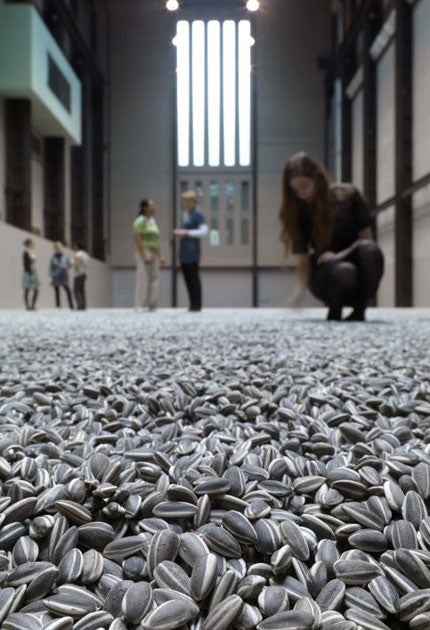
China’s most famous and politically outspoken artist, Ai Weiwei, has filled the back half of London’s cavernous Turbine Hall with what appears, from a distance, to be a mass of small grey pebbles. In fact these are 100 million tiny sculptures of sunflower seeds, made out of porcelain and hand-painted by skilled artisans in the Chinese city of Jingdezhen. The installation is rather unmonumental looking, for something so immense in scale and effort, and brings to mind the work of the late American artist Felix Gonzalez-Torres, who laid out glistening carpets of wrapped sweets in specific measures for viewers to take away and eat (they often weighed the same as his lover, who had died from Aids). Like those, Sunflower Seeds seems simple, but in fact is complicated and stridently political.
The stripy husk shapes are a grey mass – you can crunchily stomp across them – and they appear uniform and featureless until one picks one up and looks at it closely.
Is this about the way we look at China? Do we see a label that says “Made in China” and inwardly shrug at the thought of millions of faceless factory workers? Or about Chinese- government censorship, so much in the news following the award of the Nobel Peace Prize to Liu Xiaobo? Do we see those oppressed or killed under the regime of Chairman Mao, cut off before they could grow, or a city full of immensely skilled crafts-people, whose skills are no longer needed in mass-industrialised China? All this, yes, and more.
Though a celebrated artist, ironically Ai Weiwei is perhaps best known for his role as an artistic contributor to the Bird’s Nest stadium in Beijing, for the 2008 Olympic Games. Since then he has
been a voice of dissent, demanding free speech and democracy for the people of China. His conflict with China’s government came to head over his investigations of the 2008 Sichuan earthquake and the deaths of many children in schools in the disaster. Following that, he was badly beaten by police, suffering a brain tumour as a result. Ai’s concern with these lives cut short is present in Sunflower Seeds.
The Turbine Hall is perhaps the hardest commission to fulfil in this country. One might argue that this is not an intensely visual piece of work in the same way that Anish Kapoor’s Marsyas (2003) and Olafur Elisasson’s The Weather Project (2004) were. Ai Weiwei knows how to make big, sparkly things, installations that wow with bright lights and grandiose scale. But this is not one of these, and it is all the better for it. In recent years, with his campaigning, Ai has shown himself to be an artist who is above all concerned with the individual and their relationship to society. This, in the end, is rather a melancholy piece. It allows us to think about those who are repressed, and of those flowers that are killed off before they have the chance to grow and bloom bright. But it’s also about our responsibilities to one another, and the energy we share, and so it contains a seed of hope. Make that 100 million seeds of hope.
To 2 May 2011 ( www.tate.org.uk/modern)
Join our commenting forum
Join thought-provoking conversations, follow other Independent readers and see their replies
Comments