Billy Childish: Unknowable but Certain, ICA, London
Rage against the art-world machine
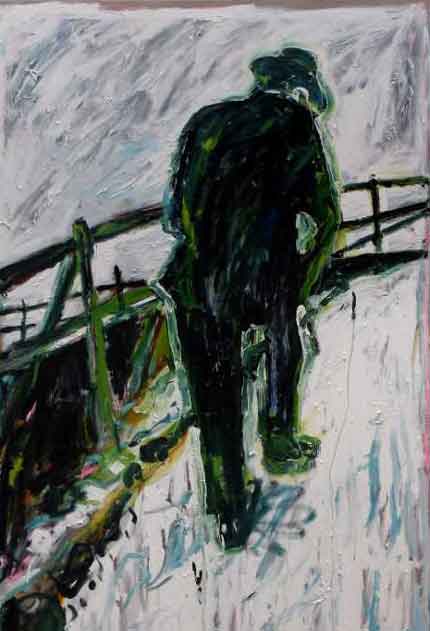
Billy Childish – poet, artist, film-maker, musician – is a professional anomaly. You may have seen his name hanging at the back of Tracey Emin's infamous tent (Everyone I Have Ever Slept With 1963–1995); you may remember seeing him with a placard, protesting against conceptual art, when he was part of the Stuckists group; or you may have heard his music in his various garage rock bands. You probably won't, however, have seen his work in a prominent art gallery or institution. Childish's projected anger towards the art world has positioned him as something of a resentful outsider – though this seems to be the coat that most easily sits on his shoulders.
It is the identities of other artistic outsiders that Childish calls upon here. In the ICA's lower galleries is a gently hung painting exhibition on dove-grey walls. Childish's luridly colourful expressionist paintings occasionally look as though paint has been quickly slung at the canvas, emotional and drippy. The colours are lucid and hallucinatory, and are indebted to painters such as Van Gogh, Gauguin and Baselitz. The best of these are the melancholy images of the Swiss writer Robert Walser in the snow. Walser's most experimental writings were made at a time when he was struggling with mental illness, residing at a sanatorium, nearby which he died while walking in the snow. Childish's paintings of Walser's death are bleak, sorrowful and full of a heavy loneliness, yet this loneliness is rendered somehow shameful and destitute. The white of the snow is turned shades of bruise-purple and piss-green, and elsewhere Walser's heavy, dark-green coat resembles a tramp's. The madness of Dostoyevsky's Raskolnikov and the protagonist of Knut Hamsun's Hunger come to mind; their minds ravaged by guilt, desperation and ecstasy.
Upstairs and in the ICA concourse are further elements of Childish's work – his books, music, placards, films and poetry, and it's no surprise to find references here to Hamsun, Dostoyevsky and Walser. However, if we consider the idea that all Childish's work is a complete art, would his paintings not be better placed among all this messy output – rather than in the more sanctified gallery downstairs?
Childish's poetry, complete with his dyslexic spelling and lack of grammar, show the artist at his most vulnerable. Even his bitterness and rage, which is well expressed in music, but threatens to engulf the rest of his output, here seems sorrowful, painful, or, as Childish himself puts it in a documentary shown here: "impotent rage about fuck all". His egotism begins to come undone: "i see that truth only comes staggering up the mountain/side/like a sad donky teetering under the weight of a fat man/smiling." In poems like "yellowi – like piss" (1981) his connection to the landscape, occasionally beautiful, occasionally suburban, miserable and ugly, is keenly felt.
Childish constantly threatens this whole exhibition with his ego, with his ranting, on placards, in poetry and in documentary. Bitterness is a poison, and it's not absent here. However, there's much to like about this show. Childish (and by extension the curators at the ICA and White Columns in New York, who partner this exhibition) are right to question the dogma of the art world, and particularly one in which financial interests have been pushing a kind of superluxe glossy conceptualism to the fore. There are other ways of being an artist and of showing art – there are those who mine the darker underbellies of our culture and of human existence, and it is the work of those precious galleries like the ICA to investigate and experiment with this. Sometimes I just wish Childish would shut up. But then he wouldn't be Billy Childish. A belligerent outsider, an anomaly and an artist.
To 18 April (020 7930 3647)
Join our commenting forum
Join thought-provoking conversations, follow other Independent readers and see their replies
Comments
Bookmark popover
Removed from bookmarks