Corot to Monet, National Gallery, London
The world's most famous school of painting has a political history that is satisfyingly explained in this clever show
Pierre-Henri de Valenciennes is not a name that trips off the tongue in the way that, say, Claude Monet does. Nonetheless, without Valenciennes there might have been no Monet.
In 1800, the 30-year-old Toulousain published Elements of Practical Perspective – a treatise that floated the astonishing idea that landscapists should quit the studio and work en plein air, out in the open, direct from their subject. The effect on French art was swift and long-lasting. In 1873, Monet showed an en plein air picture of Le Havre harbour called Impression, soleil levant, ("Impression, Sun Rising") thus giving a name to what would become the world's most famous school of painting. But Impressionism's roots went back more than seven decades, to Valenciennes' championing of the great outdoors.
So why may you well not have heard of him? Art history has a way of casting shadows backwards: it is easier to believe that Impressionism sprang from a single eureka moment than to learn all the lesser truths that led up to it. These are the subject of an excellent new exhibition at the National Gallery, called Corot to Monet. (The show might more properly have been called "Valenciennes to Monet", Corot being three years old when Elements of Practical Perspective was published; but you can guess which name is likely to draw the larger crowd.)
Still, Valenciennes does get his 15 minutes of fame in the form of a lovely little picture called Cowshed and Houses on the Palatine Hill, painted in 1782. The first word of its title is telling, for its day even shocking. French painters in Rome had looming over them the shadow of Nicolas Poussin, a giant whose stature went unchallenged for 300 years: even Cézanne claimed to want to "re-do Poussin from Nature". If Poussin had sketched the Roman countryside, he had certainly not painted it. The background in pictures such as Et in Arcadia Ego are stage sets rather than landscapes, these sitting at the bottom of the 17thcentury league of painting. To show the goddess Selene with a cowshed was one thing. To show a cowshed plain and simple was quite another.
And so Valenciennes' unassuming byre is actually a revolutionary document, in the way that Beaumarchais' Marriage of Figaro, premiered the year before, was revolutionary. The idea that ordinary things were worth depicting – that landscape was as good as history painting – was eagerly taken up by Valenciennes' pupil, Jean Victor Bertin, and in turn by Bertin's pupil, Jean-Baptiste-Camille Corot. Corot's The Seine near Rouen (c. 1830) is remarkable not least for its view being from, rather than of, the city's famous clock tower. (In the 1890s, Monet would square the town-country circle by painting Rouen Cathedral as a landscape.) Corot's ideas were adopted by a group of artists working around the village of Barbizon which included Jean-François Millet and Gustave Courbet.
As you walk through this clever show, you're struck by the dates on its labels: 1789-93 (Simon Denis' Torrent at Tivoli), 1848 (Millet's The Winnower), 1871 (Monet's The Thames below Westminster). You don't have to be a Marxist historian to feel that painting and politics went hand in hand in the years of France's great revolutions. If the work of Corot and Daubigny is implicitly subversive, then that of Millet and Courbet gets close to being explicitly so – certainly explicit enough for the authorities. Courbet's apparently peaceable Beach Scene (1874) was painted in Swiss exile, the artist having been ordered to pay 330,000 francs for the rebuilding of the Vendôme column, torn down on his orders during the 1871 Commune.
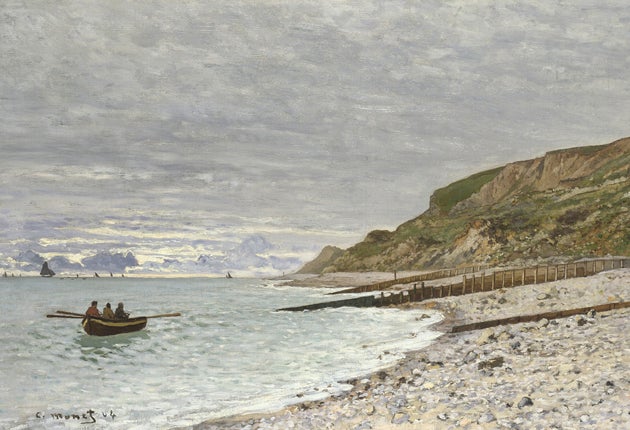
It is Corot, though, who foments formal revolution. His quartet of woodland studies, The Four Times of Day, was painted in a week – a speed that struck the artist Alexandre-Gabriel Decamps, who had commissioned the works, as shocking. Not so Monet. Within a decade, the man who gave Impressionism its name was outpacing even Corot, throwing the old-fashioned Academic virtues of finish to the winds in works such as La Pointe de la Hève, Sainte-Adresse (1864). To say that Monet had painterly ancestors is not to impugn his genius, merely to make his story more satisfactory. Satisfying, too, is that this show is free, that its works are pretty well all from the National Gallery's collection and that barely a quarter are normally on view. If this is how things are going to be under the directorship of Nicholas Penny, let the good times roll.
National Gallery, London WC2 (020-7747 2423), to 20 Sep
Join our commenting forum
Join thought-provoking conversations, follow other Independent readers and see their replies
Comments