Jonathan Monk, Lisson Gallery, London
A Jeff Koons favourite, and the puffed-up era it embodied, comes in for witty scrutiny
On the walls of Jonathan Monk's new show are pairs of neon ovals like an "OO" dyed in acid hues.
For all their blankness, these are oddly expressive: cartoon eyes, their wide-open look suggestive of faint alarm. You might think the "O"s owe something to the American master, Dan Flavin, although their more direct derivation is from Jeff Koons. Not from Koons's art, you understand, but from his name. Monk has visited his fellow-artist's website and copied the middle letters of its logo, so that the eyes are also "O"s.
It is Koons who stares down at us, and he seems not to like what he sees. As well he mightn't.
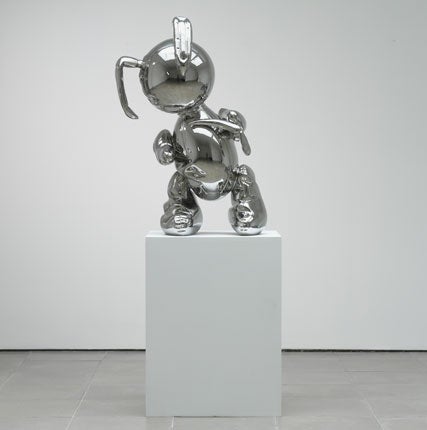
Monk's show is called The Deflated Inflated, although it could just as well be the other way around. Its hero is Koons's iconic Rabbit (1986), an inflatable bunny, cast, shinily and at some expense, in polished stainless steel. Rabbit was, in various ways, a platonic child of the Eighties. It was, as I say, shiny and expensive, although it also asked inscrutable questions about the link between aesthetic and market values.
Long before Damien Hirst's diamond-covered skull, Rabbit mocked the art world by playing it at its own game – by laughing at the kind of collector who pays millions of dollars for contemporary artworks, and charging them millions of dollars for the pleasure of being laughed at. For all its apparent dumbness, Koons's bunny was a clever little animal, an icon of its day.
So letting its air out seems a churlish thing for Monk to have done, as well as rather risky. Koons, the subject of much litigation, may himself be litigious: the walls have eyes. More, Rabbit was, in its own way, great. Its puffed-up air was a metaphor for the spend-spend-spend mores of Reaganomics, one kind of inflation replacing another.
As you will have read, we are now paying the price for 30 years of bulimic over-spending, not least on works such as Rabbit. So Monk's five takes on the subject, each progressively more wilting and detumescent, seem vaguely ill-natured: a gloaty rubbing of the hands at the art market's collapse, a swipe by one man at another's virility.
Were this all that the five Deflated Sculptures were about, they would be dislikeable things. Actually, though, their feel is playful rather than mean-spirited, their comedy worthy of Koons himself. Far from lampooning Rabbit, Monk's variants play with it – the bunny was always a toy, after all. In their sad little way, the Lisson Gallery's five deflated inflatables have a touch of the pathos of The Dying Gaul. And they have something else besides, which is a genuine interest in sculptural form.
Monk has always liked to echo the work of modern masters – Bruce Nauman, Ed Ruscha, Sol LeWitt – and his echoing has always been ambiguous, part homage and part jape. If the neon circles in The two 'O's in Jeff Koons used as Eyes are taken from a website, they do nonetheless also derive from Dan Flavin. Equally, Monk's flaccid bunnies-on-plinths are changed by having had the air let out of them, and changed not just metaphorically but formally. In the end, the question the Deflated Sculptures both ask and answer is whether they can stand up as artworks without referring to Koons. It is a rather old-fashioned (and very un-Koonsy) question, particularly as the answer to it is "yes". Although gallery notes suggest that Monk's bunnies are hinting at the soft sculptures of Claes Oldenburg, they seem to me to be more broadly concerned with ideas of sculptural abstraction – with the moment when a wilting rabbit ceases to be a wilting rabbit and becomes something else, something in its own right.
It is worth pointing out that Monk's bunnies aren't actually deflated but deflating – that their action isn't finished, that they suggest a between-state rather than an end point.
All kinds of things may happen to them: they might suddenly reinflate, for example, or they may carry on deflating. However, you choose to read that in allegorical terms, their open-endedness does pose the question of where art is going from here – what it will look like now that market tumescence has gone out of style.
One possible answer seems to be a return to abstraction, to the lost, Flavin-ish values of pure form. Could Monk be right? I do hope so.
Join our commenting forum
Join thought-provoking conversations, follow other Independent readers and see their replies
Comments
Bookmark popover
Removed from bookmarks