Moctezuma: Aztec Ruler, British Museum, London
Sacrificial vessels, phallic daggers, nightmarish imagery the art of the Aztecs was meant to inspire terror
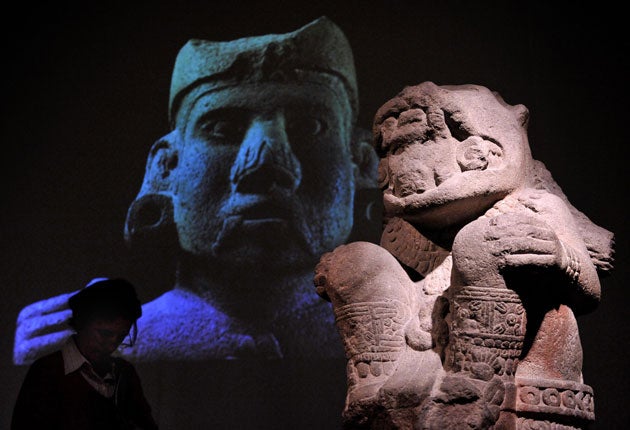
Prepare to be haunted by Moctezuma, the British Museum's scary autumnal blockbuster.
Approaching the show along a dark, narrow and claustrophobic corridor, we can already hear the sound of mournful winds blowing far beyond. But then, hung with extravagant flair at the top of a staircase, a full-length painting of the last elected Aztec emperor confronts us. He presents an exotic spectacle. Brandishing a feathered shield, a bejewelled lip-plug and ornate loin-cloth, Moctezuma II flaunts his physique like a poseur shamelessly addicted to fancy dress.
But don't be deceived into thinking that he was merely a playful show-off. His full name, Moctezuma Xocoyotzin, means "Angry Lord". Despite his love of gold bracelets and anklets festooned with dangling bells, he was a battle-hardened killer. Nor did he spare himself physical pain. Next to his outrageous portrait, painted by Antonio Rodriguez in the late 1680s, we find an ominous stone casket which may have contained the instruments Moctezuma employed to draw his own blood as a sacrifice to the gods.
During the 18 years of his reign, from 1502 until 1520, the emperor's ruthless military control over his subjects was underpinned by an ability to intercede with deities. According to sacred legend, the site of the Aztecs' capital city, Tenochtitlan, was chosen after a lethal struggle between their patron god and the deity's nephew, Copil. The battle only ended when Copil's heart was sliced out of his butchered body and thrown across Lake Tetzcoco to an island. There, on terrain now inhabited by Mexico City, the capital was founded around 1325 and swiftly expanded into a powerful metropolis.
Sacrificial rituals lay at the alarming centre of the culture developed by these people, who adopted the name "Mexica". And wherever we look, the British Museum's mesmerising show testifies to this remorseless obsession. A spectacular eagle vessel, carved from andesite stone, has suffered from damage inflicted on its fierce and frowning face. But the cavity in the eagle's body is still visible, enabling us to peer down into the place where the hearts of human captives were once held. They had been sacrificed to feed the Sun, and a dedication stone for the Great Temple is carved with the dynamic figures of Moctezuma's uncles, zealously piercing their ears with sharp bones to let blood flow into the toothed mouth of the stone, channelling it into the earth.
Fangs leapt out even from the sculpture installed in the emperor's own palace. Moctezuma, who had many wives and 19 children, built a colossal residence with volcanic stone hewn from the nearby mountain slopes. But he made sure that visitors to his grandiose residence felt terrified rather than welcomed. They were confronted by images as nightmarish as the feathered serpent, carved from a basalt block, who bares immense and rapacious teeth at everyone rash enough to gaze at him. Physical contact with Moctezuma was forbidden, and citizens were ordered to lower their eyes in his presence. Anybody who refused might well have ended up as one of the real skulls ranged in public display on racks around the Great Temple. These, alas, have not survived to appear at the British Museum.
Carved stone skulls, once covered in lime to make them look intimidatingly real, are included, however. Yet they are neither as skilfully wrought nor as inventive as the sculptural highlights here. One, a knife, takes the form of a crouching eagle warrior who clasps the phallic blade with the ardour of a lover. It is made with the same consummate panache as the alluring turquoise mosaic mask and double-headed serpent, both eager to devour Moctezuma's enemies.
Soon after Hernan Cortes and his well-armed Spanish troops arrived in 1519, the emperor was himself sacrificed. The circumstances of his death are still debated by scholars, but they all agree that his people were subsequently devastated by diseases such as smallpox, contracted from their Spanish conquerors. The final painted portrait of Moctezuma shows a dejected victim, utterly unlike the exuberant despot who greeted us with such a flourish at the entrance to this macabre, spellbinding survey.
To 24 Jan 2010. Information: 020-7323 8299
Join our commenting forum
Join thought-provoking conversations, follow other Independent readers and see their replies
Comments
Bookmark popover
Removed from bookmarks