On the Move, Estorick Collection, London
A show curated by Jonathan Miller raises all kinds of questions, not only about how we perceive movement in still images, but also about what art is
When Vittore Carpaccio set out to paint the story of St Jerome and the lion, he faced the same problem Walt Disney did with Mickey Mouse: how to get his character from A to B when drawings, by their nature, stop at A.
Disney did it by making a huge number of sequentially different images, photographing them one by one and running the stills together so that his multi-mouse skipped across the screen. Carpaccio tackled motion by painting the saint and his leonine sidekick half-a-dozen times in the same picture, entering foreground left, frightening monks in the midground and arriving at the church door background right. Neither man really cracked the problem, which is that pictures – even moving pictures – do not move.
This paradox was of particular annoyance to the Italian Futurists, obsessed as they were with speed. For Giacomo Balla and the rest, the essence of modernity lay in action and action lay in motion – racing cars, aeroplanes, speeding bullets. But how to represent speed in oil on canvas, or, in the case of a sculptor such as Renato Giuseppe Bertelli, in black glazed terracotta?
This was made all the more irksome by the fact that painting's nemesis, photography, had found a way of doing just that in the sulphurous hands of Eadweard Muybridge, né Edward Muggeridge. Born, disappointingly, in Kingston upon Thames, Muybridge emigrated to San Francisco in the 1850s and made his (embellished) name as a zoopraxographer, or specialist in animal locomotion. His electrically activated photo-strips, often of unclothed people running and jumping, answered the immortal question of whether all four of a galloping horse's hooves leave the ground at the same time. (They do).
The dynamic form of these strips, their freezing of the thunderous and violent, appealed to the Futurists, and, later and predictably, to Francis Bacon. Even more so to the former did the zoopraxographic photographs of Muybridge's French rival, Etienne-Jules Marey, these blurring a complete sequence of movements – a pole vaulter clearing the bar, say – into a single, sweeping image. Pictures still couldn't capture movement, of course, but Muybridge and Marey did at least provide conventions for suggesting what they might look like if they did.
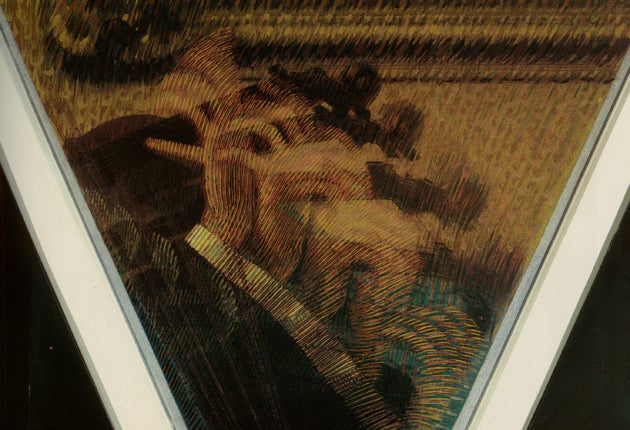
Thus a show called On the Move at the Estorick Collection, curated by the neurologist (and opera director, etc) Jonathan Miller. Eric and Salome Estorick collected Italian Futurist art, their collection being housed in a pleasant Georgian house in north London. Various of its works fit Miller's bill, notably Balla's oddball The Hand of the Violinist – a sequence of furiously fiddling fingers blurred, à la Marey, into a single image and framed in what looks like a dinner jacket. Less Disney-ish and thus more successful is Bertelli's Continuous Profile (Head of Mussolini), its unending form showing Il Duce as all-seeing and ceaselessly energetic.
At least as extraordinary is a small bronze by Marey, actually the zoopraxographic model of the flight of a seagull but inadvertently lovely even so. Alongside all these are the instruments Marey used in his research, notably a camera rifle which calls to mind Roland Barthes's remarks on the ambiguous verb "to shoot". And other rooms bring Miller's story up to date by focussing on the modern interest in depicting motion motionlessly, from Jonathan Shaw's shot of a triple-jumper mid-jump to the sequentially flailing fists of Billy Whizz.
This is fascinating stuff, although more needs to be made of its central cognitive drama. As Miller points out, the perception psychologist, Sigmund Exner, found that the eye actually registers the gaps between frames in the apparently seamless story of, say, Steamboat Willie. It is the brain that fills in the narrative, preferring its stories complete. This knowledge raises all kinds of questions about how and what we see, but also about what art is and what it is for.
The 18th-century German polymath Gotthold Lessing, the Jonathan Miller of his day, noted that the point of art is that it is not nature but an imitation of nature – that pictures and sculptures, being unable to move, must find a moment that represents all movement. Thus the Greek obsession with contrapposto, a static pose that suggests the imminence of motion. Balla, in setting out to make painting that looked mobile, was on a hiding to nowhere: art is not, and cannot be, complete, must not tell the whole story. Trying to do so will make us titter, whether we are watching cartoons on the box or standing in Carpaccio's Venice scuola.
'On the Move' (020-7704 9522), to 18 Apr
Join our commenting forum
Join thought-provoking conversations, follow other Independent readers and see their replies
Comments
Bookmark popover
Removed from bookmarks