Wild Thing: Epstein, Gaudier-Brzeska, Gill Royal Academy, London
Of three pioneering sculptors celebrated in a stirring show, it is the one who died young who is the star
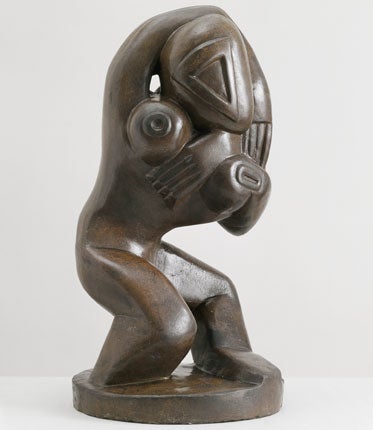
From its title, you might think Wild Thing was going to be a Tom Stoppard play. Its leading players certainly read like the cast list of one: Jacob Epstein, a bolshie New York Jew; Henri Gaudier-Brzeska, young, French, and doomed; and Eric Gill, the omnisexual son of a nonconformist Sussex clergyman.
You can picture the three holed up, à la Stoppard, in an hotel in Trieste, although they met more prosaically in London in the 1900s and are currently on show there, at the Royal Academy. Here anything ordinary about the trio ends, though, as this clever exhibition makes clear. (It is curated by Richard Cork, a reviewer on these pages.)
We tend to think of modern art in England as beginning in 1910, rather as Philip Larkin dated English sexual intercourse to 1963. Late in that year, the painter, critic and Bloomsbury groupie, Roger Fry, staged the first French Post-Impressionist show in London: “On or about December 1910,” wrote Virginia Woolf, “human character changed.”
Actually, the first frail buds of British Modernism had appearedfive years earlier, when Jacob Epstein stepped off a train from Paris. Quickly setting himself up as a lion of the avant-garde, the ex-American – he married a British woman in 1907 and changed his citizenship – won the commission for a suite of sculptures for the façade of Charles Holden’s new British Medical Association building in the Strand.
The result was furore. Under the guise of clinical candour, Epstein used the works to indulge his pet subject, which was sex. (His five children were born to three different women, none of whom was his wife. She, long-suffering, eventually shot a rival.) A figure called Maternity particularly outraged the National Vigilance Association, whose offices, unhappily for Epstein, were opposite the BMA’s. The sculptures were completed – you can see them on what is now Zimbabwe House – although their more prominent overhangs were sawn off in the 1930s on the unlikely grounds of public safety.
All this was heady stuff to Eric Gill, raised in Brighton in a sect of strict Methodists. Two years younger than Epstein, Gill, like him, saw liberation in free love. In this regard, he surpassed his master. The stone relief, Ecstasy, made shortly after the two men met, depicts Gill’s brother-in-law having sex with the artist’s sister, an intimacy Gill also enjoyed, as he did with his children of both sexes and the family dog. This catholicity aside, Wild Thing reveals the most British artist in the showto have been the least farouche. For all his interest in carving secondary sexual characteristics, Gill's real interest was in carving: Ecstasy has the distant whiff of the Pre-Raphaelite taste for Piero della Francesca, a simplicity that has nothing to do with Epstein's mechanical polish. Nor could Gill ever have made the most striking image in this show, Rock Drill.
In 1913, the same year that Marcel Duchamp made his first "readymade" (ordinary manufactured objects that he selected and modified), Epstein incorporated a real pneumatic drill into the plaster sculpture of a robot-man. In a country used to the classical bronzes of Charles Sargeant Jagger, the response was predictable. If the critics had grumbled at Maternity, they gibbered at Rock Drill: it was "indescribably revolting", frothed one. In the carnage of the Great War, Epstein came to agree. Rock Drill was soon dismantled – the version here is a reconstruction – its Vorticist games no longer funny by 1915.
It was in that year that the youngest of Wild Thing's trio died in the trenches at Neuville-Saint-Vaast, aged 23. Henri Gaudier-Brzeska – the second surname was that of his older, Polish lover – had also fallen under Epstein's spell when he came to London in 1911. Like Gill, he saw in Epstein's taste for direct carving – working straight on to the stone, without any preliminary maquette – a compelling way of making art.
For Gill, the touch of the hand was both sensual and, in a Ruskinian way, simple, the ideal mode for a sex-mad monk. For Gaudier, direct carving feels rather more like hand-to-hand combat.
In him, even more than in Epstein, you sense psycho-history at work; something in the unrealised violence of the years that led to the Great War finding itself in the blow of hammer on chisel, chisel on stone. As much as Wild Thing is about the likenesses of these three most unalike sculptors, thrown together by Stoppardian history, it is also about their differences. It is easy to say of an artist who died at 23 that, had he lived, he would have been the greatest of his cohort; but everything about Gaudier-Brzeska suggests this to be true. We look at his Red Stone Dancer and we mourn.
Royal Academy, London W1 (020-7300 8000) to 24 Jan
Join our commenting forum
Join thought-provoking conversations, follow other Independent readers and see their replies
Comments
Bookmark popover
Removed from bookmarks