Hollywood is poison – and few films understand its horrors like Sunset Boulevard
Seventy-five years after its release, Billy Wilder’s melodramatic satire on celebrity culture and faded stardom – starring Gloria Swanson as its grotesque heroine – retains its tragic grandeur, writes Xan Brooks


In the autumn of 2012, a team of archeologists trekked into the Guadalupe-Nipomo dunes on the coast of California. Digging into the sand, they uncovered the ruins of a lost Egyptian city that included 21 giant sphinxes, a gate, a temple and four plaster statues of Pharaoh Ramses II. This excavation provided a fascinating piece of buried history, an insight into a forgotten world, although it proved nowhere near as old as first appearances would suggest. It was the mouldering set from The Ten Commandments (1923), a silent epic directed by Cecil B DeMille and subsequently abandoned in the desert for future generations to find.
DeMille, as it happens, appears as himself in Sunset Boulevard (1950), Billy Wilder’s classic portrait of Hollywood’s musty relics, which has itself been dug up and dusted down for its 75th birthday reissue. Sunset Boulevard is variously labelled as a noir thriller, a Gothic melodrama and an acid satire on celebrity culture, but it is also – at least in part – a comedy-horror about the accelerated nature of American time.
Its grotesque heroine, Norma Desmond, lives in a “grim sunset castle” – leaking and rat-infested – that was built in the suburbs not quite three decades before. “Norma Desmond? She must be a million years old,” marvels a studio employee to DeMille, when the woman is actually 50, around the same age that Angelina Jolie and Reese Witherspoon are today. Wilder’s film depicts a period in which the industry was moving at such a breakneck pace that the silent era already felt like ancient Egypt and the stars of the 1920s seemed as distant as the pharaohs.
Sunset Boulevard should by rights feel like a relic itself, but it’s nimble and supple and fairly springs off the screen. William Holden – a last-minute replacement for Montgomery Clift – plays the failed screenwriter Joe Gillis, locked in a mutually parasitic relationship with a faded movie queen. Gloria Swanson – herself a major 1920s star – embodies Desmond, who insists that she’s still big and it’s only the pictures that got small. Wilder’s ahead-of-his-time masterstroke was to juggle Hollywood facts with fiction and force the viewer to spot the joins. The veteran director Erich von Stroheim co-stars as Desmond’s doting butler Max (who is later revealed to have once been her director), while Buster Keaton is among the silent-screen antiques (“the waxworks,” Gillis calls them) who gather each week for forlorn games of bridge. When Desmond sits down to rewatch one of her old movies, the clip we see is from Queen Kelly (1929), an actual collaboration between Swanson and Von Stroheim.
Wilder initially envisaged his film as a romp, carefree and jokey, only for the tale to darken in the telling, veering from black comedy towards tragedy and grandeur to become as much a Hollywood totem as the 50-foot sign on Mount Lee. It’s a ghoulish tale of a recent past that won’t stay buried; a Tinseltown ghost story in which all the ghosts are alive, except for the young narrator, who’s lying face-down in the pool. “It’s funny how gentle people are with you once you’re dead,” he remarks, and this is presumably because dead people are safer, less embarrassing and less likely to rock up at Paramount Pictures, imperiously demanding to play the role of Salome.
Obviously there are many fine, upbeat movies about the business of making movies – Singin’ in the Rain (1952), Bowfinger (1999) and The Artist (2012) spring to mind – but the sour takes have a better strike-rate, possibly because they’re more interested in the truth than the lie, even when the truth is murky, disturbing and half-poisoned by fakery. Sunset Boulevard doffs its cap to F Scott Fitzgerald’s Pat Hobby Stories and Nathanael West’s savage 1939 novel The Day of the Locust in its portrait of the industry fringes, a tatty backstage world full of has-beens and also-rans, while simultaneously laying the ground for all the pictures that followed. These tell us that most Hollywood residents are hopped up on unrealisable dreams. Most feel overlooked and cheated. Some are teetering on the brink of madness.



I like most Hollywood inside jobs. The bleaker the better; it’s like a creative act of self-harm. Films such as Maps to the Stars (2014), The Substance (2024) or The Neon Demon (2016) like to depict Los Angeles as a hysterical day-glo nightmare with every emotion italicised and all the lights turned on. Mulholland Drive (2001) and The Canyons (2013) paint it as a mythic underworld, smoggy and hazardous. But all of these pictures are essentially horror movies, creature features in which the characters can be read as vampires, zombies or ghosts. Sooner or later, they are bound to either combust or go rogue. John Schlesinger’s adaptation of The Day of the Locust (1975) ends with an apocalyptic mass riot outside Grauman’s Chinese Theatre in which an angry mob literally tears down the dream factory.
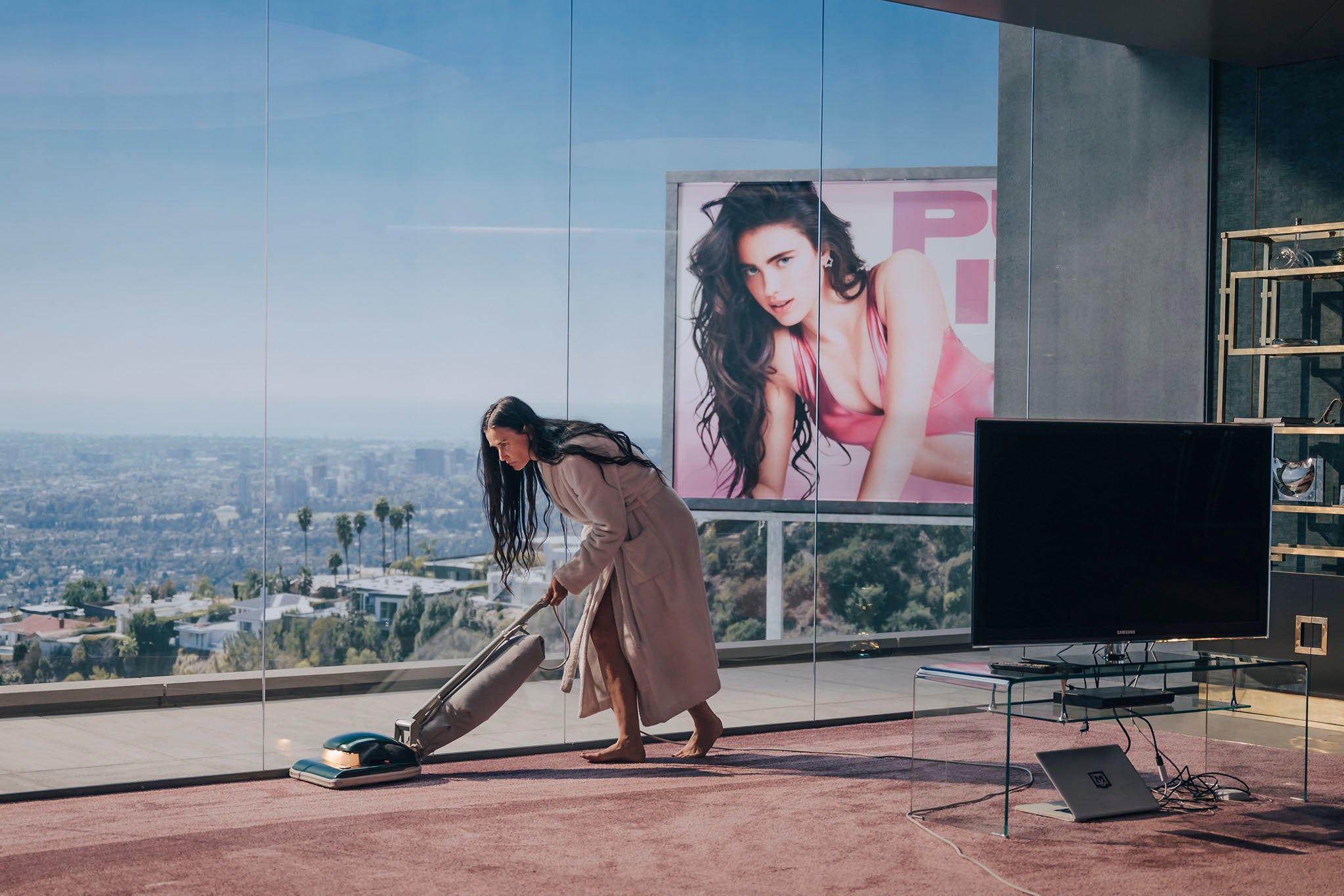
“The stars are ageless, aren’t they?” murmurs Norma Desmond towards the end of Sunset Boulevard. She draws some comfort from this notion, although I’m not sure that she should. Probably all of us peak at some point in our youth, whether it’s physically, professionally or both. Afterwards, fingers crossed, we transition to a peaceful, managed decline and consign precious memories to a sealed box in the attic. It’s only the stars who are blessed or cursed enough to have their heyday preserved forever on film: projected 10 feet high on the screen and serving as a constant reminder of exactly what’s been lost.
It gets to the point where this younger self comes to feel like a standalone presence, a malign alter-ego that’s so much more successful and desired. This accounts for the theme of dual identities in David Lynch’s sublime Mulholland Drive, and for the arrival of the monstrous younger model in Coralie Fargeat’s The Substance. But it also explains the creeping Gothic horror of Sunset Boulevard, a film about a woman who is haunted by the movie star she once was and who, in turn, haunts the studio, painted and primed for her close-up.
‘Sunset Boulevard’ is in cinemas
Join our commenting forum
Join thought-provoking conversations, follow other Independent readers and see their replies
Comments