French novelist Le Clézio wins Nobel literature prize
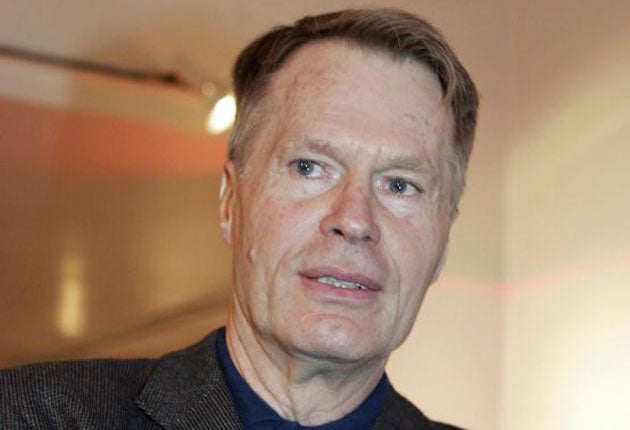
The Nobel literary committee today infuriated the bookies, delighted the bookish and thumbed its nose, again, at the American book industry. The 2008 Nobel Prize for literature was awarded to Jean-Marie Gustave Le Clézio, a half-British French novelist and philosopher, who lives in America and champions the "lost" wisdom of non-Western cultures.
By choosing Le Clézio, 68, who was the clear favourite, the Nobel committee of the Swedish literary academy caused substantial pain to British bookmakers. The committee also, implicitly, restated its much-publicised criticism last week of the American literary establishment as too inward-looking and too ignorant of foreign literature and thought.
Le Clézio is regarded by many students of literature as the greatest living French writer (even though he was relatively little-read and little-discussed in France until yesterday). But he has established a worldwide reputation as a "modern Homer", a student of almost every culture on the planet, written and unwritten, and a passionate advocate for the superior wisdom of "non-rational", non-Western ways of understanding human existence.
There are few modern writers more cosmopolitan than Le Clézio. He was born in France. His father was a Mauritian-born British doctor. He spent part of his childhood with his father in Africa and several years in the 1970s living with an Indian tribe in Panama. He now lives and teaches for most of the year in Albuquerque, New Mexico. He once said: "The French language is my only country, the only place that I call home."
His best-known book, written in 1980, is Desert, which contrasts the ugliness and ignorance of Europe, as experienced by immigrants, with the simple nobility of a lost Tuareg civilisation in the Sahara, destroyed by French colonialism.
The Swedish Academy said it had awarded Le Clézio the prize of 10 million Swedish kroner (£790,000) because he was an "author of new departures, poetic adventure and sensual ecstasy, an explorer of a humanity beyond and below the reigning civilisation".
Horace Engdahl, the permanent secretary of the Swedish Academy, caused a literary storm last week by suggest
ing that no contemporary American writer deserved the award because US literati were too parochial and never read foreign works in translation.
Jean-Marie Gustave Le Clézio was born in Nice in 1940. His mother was the daughter of a Breton family which had moved to Mauritius in the Indian Ocean where his father was working.
His father abandoned the family, something which Le Clézio has dwelt on in recent works, including Onitsha (1991), and became a "jungle doctor" in Guyana and Nigeria. After schooling in France, Le Clézio studied at Bristol University and the University of London.
He is bilingual in French and English and had considered becoming a writer in English before deciding it was too "colonial" a language. His first novel, Le procès-verbal (The Transcript), published in 1963, launched his early career as a writer in the post-war French tradition of the "New Novel", playing with language and challenging standard, narrative forms. From the 1970s, he began a second career as a writer and philosopher possessed by the clarity and purity of non-Western and "early" forms of human thought and civilisation. Many of his main characters are nomads or exiles. He once said that his influences ranged from the English poet John Keats to the Scottish novelist Robert Louis Stevenson, from the Irish novelist James Joyce and the American novelists, Ernest Hemingway and J D Salinger, all exiles or recluses.
Asked about his passion for "early" cultures, Le Clézio said: "The dawn of peoples is important because we seem now to be living in the dusk. You have the sense that we are getting near the end."
The French Foreign Minister, Bernard Kouchner, said the Nobel award "crowns one of the most remarkable novelistic creations of our time and one of the most demanding and inventive of writing styles. From Albuquerque to Seoul, from New York to Panama, from London to Lagos, Jean-Marie Le Clézio lives, travels, sees and loves a great number of countries, peoples, civilisations and cultures."
Join our commenting forum
Join thought-provoking conversations, follow other Independent readers and see their replies
Comments