Posthumous blow to the author who hated book prizes
Forty years on, shortlist for the Booker's 'missing year' announced
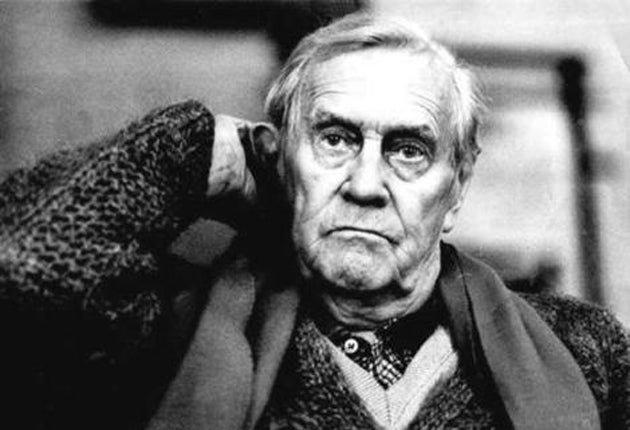
Patrick White, the late Australian novelist who loathed literary accolades, has now, in death, been subjected to the thing he hated most: the prospect of winning the Booker Prize.
White, who detested literary prizes so much that he demanded to have his name removed from the Booker shortlist in 1979 and begrudgingly sent a friend to collect his Nobel Prize, has been nominated for a belated Booker award that recognises the best books written in 1970. He is on a shortlist of six, four decades after writing The Vivisector and two decades after his death.
Tobias Hill, one of the judges of the "lost" Man Booker Prize shortlist announced yesterday, observed the irony in White's posthumous nomination. The prize attempts to amend the oversight of 1970, in which the Booker was not staged owing to administrative complications.
Mr Hill suggested that White may, if he was picked as winner, be spinning in his grave.
He said: "The difficult thing about him is that he refused to accept prizes – he turned multiple prizes down in his lifetime. He was one of those writers, like John Le Carre, who said, 'I don't need a prize, give it to someone who does!'
"In a quiet way, he would make a controversial winner if he wins. I'm sure he would turn it down if he were alive," said Mr Hill.
As well as eschewing the 1979 Booker, for which his book The Twyborn Affair was temporarily selected, White also refused to accept his Nobel Prize in Literature in person in 1973 but sent his friend, the Australian painter Sir Sidney Nolan, to collect it.
Born in England in 1912, White's family moved to Australia, where his father owned a sheep farm, when he was still a baby. He was later educated in England and settled in London, where he wrote several unpublished novels and served in the RAF during the war. Returning to Australia after the war, he become one of the most significant figures in the country's literary canon.
His novel has been nominated posthumously, alongside three other dead novelists, JG Farrell, for Troubles, about the struggle for Irish independence in 1919, Muriel Spark for The Driver's Seat, detailing a woman's doomed journey in an unnamed southern city, and Mary Renault for her historical fiction, Fire From Heaven, on the reign of Alexander the Great.
Two living authors, Shirley Hazzard, nominated for The Bay of Noon, about a woman's emotional dramas in war-torn Italy, and Nina Bawden, selected for The Birds on the Trees, are also on the list.
Three of the authors on the list have previously seen Booker success – Farrell's The Siege of Krishnapur won in 1973; Spark was shortlisted for her novels The Public Image in 1969 and Loitering With Intent in 1981, and Bawden was shortlisted in 1987 for Circles of Deceit.
Mr Hill said in the judging process distinct themes emerged in the fiction, including the continuing repercussions of the Second World War, and the illicit nature of homosexual desire as "the love that could not be named".
The winner will be announced on 19 May – some 40 years late.
Join our commenting forum
Join thought-provoking conversations, follow other Independent readers and see their replies
Comments