Science-fiction author Arthur C Clarke dies at 90
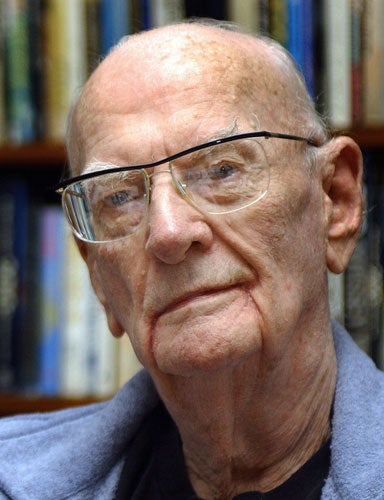
Arthur C Clarke, the science fiction author of over a hundred books including 2001: A Space Odyssey, has died in Sri Lanka at the age of 90.
The author, who is credited with acting as a bridge between science and the arts, died after suffering breathing problems, an aide said last night.
Clarke, whose grounding in science allowed his fiction to act as the forerunner to real inventions, predicted as early as 1945 that satellites would one day broadcast TV images around the world. Geosynchronous orbits, which keep satellites in a fixed position relative to the ground, are known as Clarke orbits.
Born in Minehead, Somerset, in 1917, Clarke moved to London in 1936 and pursued his early passion for space science by joining the British Interplanetary Society. He also began to contribute to the BIS Bulletin and to write science fiction.
After the outbreak of war in 1939, he joined the RAF, becoming an officer in charge of pioneering radar equipment. His only non-science-fiction novel, Glide Path, was based on his role in the military. But it was for 2001: A Space Odyssey that he was most famous, published in 1968 while the author collaborated with Stanley Kubrick on the film by the same name.
Clarke moved to Sri Lanka in 1956, attracted by marine diving which he said was as close as he could get to the weightlessness of space. He was knighted in 2000.
The astronomer Sir Patrick Moore last night described his friend Clarke as, "a great visionary, a brilliant science fiction writer and a great forecaster ... he said there would be a man on the moon by 1970 – while I said 1980 – and he was right."
Join our commenting forum
Join thought-provoking conversations, follow other Independent readers and see their replies
Comments
Bookmark popover
Removed from bookmarks