From commuters absorbed by Harry Potter books to the wide appeal of JRR Tolkien's The Hobbit, the mystery of why some grown-ups like reading children's books may finally be solved. Adults are hacked off with the disappointment of modern life.
Dr Louise Joy, a Cambridge University academic, believes classic children's books, and the work they inspire, attract older readers because they give them things they cannot find in their everyday lives, including direct communication, tasty home-cooked food, and tolerance towards eccentricity. The researcher claims such books represent a "symbolic retreat from the disappointment of reality".
"Books such as Lewis Carroll's Alice in Wonderland and Roald Dahl's James and the Giant Peach offer a world where self-consciousness is overthrown and relationships are straightforward," says Dr Joy. "But relationships in the real adult world are often fraught by miscommunication and the impossibility of understanding one another properly."
Dr Joy will unveil her theories in a forthcoming book, Literature's Children, which focuses on Kenneth Grahame's The Wind in the Willows, AA Milne's Winnie the Pooh stories, and the works of Tolkien, Carroll and Dahl. She will present her findings next month at the Cambridge Festival of Ideas, an arts and humanities festival.
Dr Joy claims The Hobbit's characters hanker after simple meals, whereas "in the real world we rarely sit to down to a home-cooked meal".
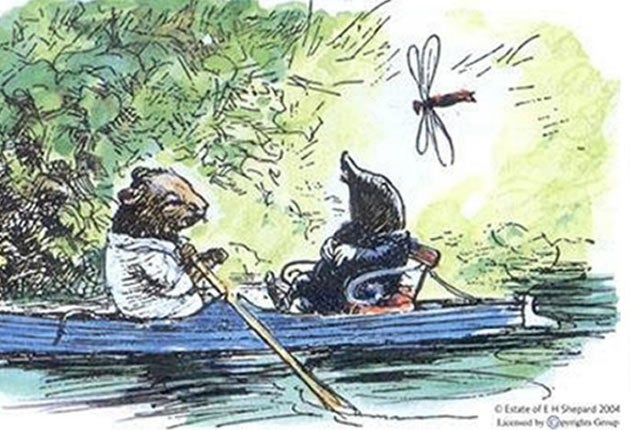
She says adults are drawn to The Wind in the Willows because its characters speak clearly to each other to "provide information", while normally "we are always anxious about how we come across". Meanwhile Winnie the Pooh's varied characters "seek out each other just to pass the time". She adds: "Present-day society is obsessed by the idea of seeking out a perfect soulmate who is just like us."
The academic says her research applies to modern children's books, like the Harry Potter series, which resemble older classics.
Julia Donaldson, children's laureate and author of The Gruffalo, says: "I have recently re-read The Wind in the Willows and also the Alice books, and they are very different.
"Alice's world can often be disconcerting and confusing in a dream-like way, something which struck me more as an adult than when I read it as a child. With The Wind in the Willows, the character of Toad becomes quite squashed at the end, which is in a way quite sad, and Mole's homesicknesses, conflicting with his desire to go on adventures with Ratty, is quite complex. It's hard to generalise."
The children's author Charlie Higson, who will be attending the Cambridge Festival of Ideas, says: "I get irritated when people try to come up with great theories... The nostalgia which inspires us to read children's books written 100 years ago is the same as what attracts us to watch period dramas on television."
Join our commenting forum
Join thought-provoking conversations, follow other Independent readers and see their replies
Comments