A Swamp Full of Dollars, By Michael Peel<br />Crude World, By Peter Maass<br />The Squeeze, By Tom Bower
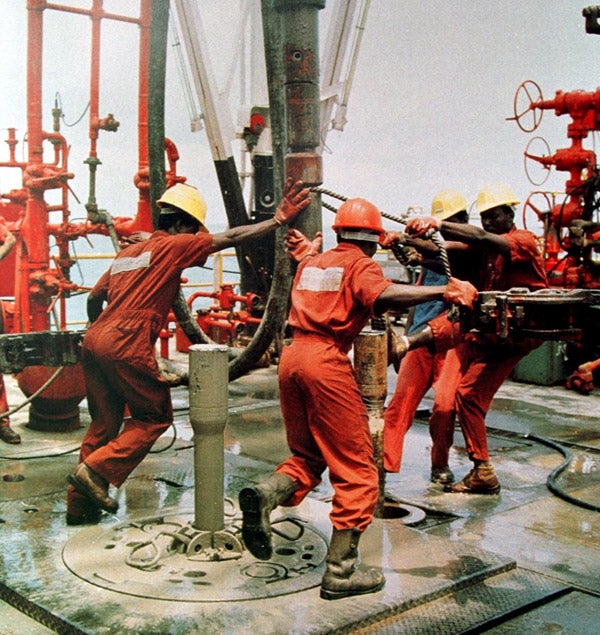
At the beginning of his book about "pipelines and paramilitaries at Nigeria's oil frontier", Michael Peel travels to a place believed to be the source of oil in the island nation of Sao Tome and Principe, off the coast. He manages to get to the spot where some day an oil company will begin drilling. Once that happens, Sao Tome's bucolic charms will vanish – but the people there don't seem to mind. They can't wait for oil. They want to become like Nigeria.
Yes, Nigeria. The reserves of sub-Saharan Africa's largest oil producer were deemed sufficiently important for the Pentagon to create a special African command. With the Middle East unstable – particularly after the war in Iraq – it became important for the US to secure supplies from Nigeria. But as Karl Maier, former correspondent of The Independent, accurately showed in his 2002 book This House Has Fallen, Nigeria was anything but stable.
Peel, a Financial Times correspondent, takes us to the country that has become synonymous with continuous gas flaring, where massacres occur routinely, where the oil legacy includes the execution of Ken Saro-Wiwa and his fellow activists, where the economy is drained by overwhelming, pervasive corruption, where stoned militia steal oil in ramshackle boats racing through creeks, and where armed men claim control over resources. Each time they abduct an employee of an oil company, production declines, and oil prices spike higher. Peel delivers a gory account of the sepulchral landscape with enormous sympathy for the people who live there, and has nothing but contempt for the authorities who have brought the Niger Delta to this pass.
Oil and democracy, it would seem, don't mix. When Dick Cheney ran Halliburton, the controversial company with interests in oil industry services, he famously remarked that it was unfortunate that the good lord did not place all the world's oil beneath the soil of democratic countries.
With the obvious exceptions of Canada and Norway, the people in most countries which have discovered oil have lived to regret it. In many producing countries a kleptocracy has emerged, with the dominant elite fortifying their hold over their societies. Other minerals have wrought havoc, too – the Democratic Republic Congo is an obvious example. But oil remains unique.
Peter Maass, a writer for the New York Times, paints a harrowing picture in his indictment of the industry, Crude World. Maas meets Matthew Simmons, the bearish industry expert, who presents a fairly credible case that the world has reached "peak oil", the stage where new discoveries cannot keep pace with global demand, so raising the price.
Maass goes to Ecuador, seeing environmental degradation; he meets Russian tycoons who think of Putin as an idol; he blames Western bankers happy to collect ill-gotten gains of the president of Equatorial Guinea; he meets Western generals in the desert fighting insurgents in Iraq; and Nigerian fishermen rueing the loss of fish stocks.
The world needs that black gold: we want our companies to extract oil wherever it is found, whatever the cost, in spite of the vocal lobby of activists concerned about environment, corruption and human rights. To quench the thirst of the industry and consumers, companies will go to the remotest parts of the world to drill and scoop out the black gold, which a former Venezuelan leader called "the earth's excrement," and Maass calls "black oxygen."
On paper, oil revenue can give a much-needed boost to economies, providing resources to governments to defeat poverty. In reality, oil revenues have distorted national balance-sheets, inflating currencies and killing any incentive to develop other industries. Its corrosive impact has deadened the psyche of many economies where people look for ways to get rich quick; its easy money has corrupted politicians; and its legacy has been incendiary, plunging nations into conflict, with governments attacking their neighbours, even their own people. Maass presents a convincing case for what's gone wrong, seeing an industry in its twilight.
Tom Bower's The Squeeze, on "oil, money and greeed in the 21st century", is not so sure. He takes readers on a ride through the business of oil, introducing traders and businesses, including oil companies, whose actions influence, and arguably control, the price fluctuations which can devastate economies.
Challenging the idea of peak oil, Bower suggests that the supply of new oil is restricted through complex manipulations by traders who benefit from artificial scarcities. There's no fundamental reason why the abduction of a few industry workers in the Niger Delta should increase the price by $20 a barrel. But traders have exploited our anxieties, placing an artificial premium which benefits some at the cost of many.
Bower questions the assumption that we might run out of oil within decades, suggesting that technological improvements will allow companies to drill in more demanding terrains, to keep energy-hungry economies fuelled. But traders and companies have an incentive in keeping supply restricted – or at least maintaining the perception that we are running out of oil – for profit.
Bower is scathing when he criticises major Western oil companies. But while the "seven sisters", as Anthony Sampson called oil majors in his 1975 book, once appeared to control the global market, that is no longer the case.
The emergence of the large state-owned oil companies – of Saudi Arabia, Iran, Mexico, Venezuela, and Indonesia – has diminished the power of Exxon, Chevron, Shell, Total or BP. Today, the so-called Western majors command less than 10 per cent of the global share; state-owned oil companies rule the roost. They – and traders exploiting fears due to instability in oil-producing countries – bear the bulk of the blame for the squeeze that consumers in poor countries feel when oil prices rise beyond reason.
Whether we blame the greed of the traders, the venality of politicians, the cruelty of militia, or the disregard for the environment shown by some executives, it is clear that none of them cares for the pensioners whose fuel bills become steeper, for the farmer in whose field a pipeline has exploded, or the child whose mother has been murdered by soldiers protecting the critical infrastructure that oil represents for the country's economy. These three journalists present a shattering critique which will leave their readers angry.
Salil Tripathi's 'Offence: the Hindu case' is published by Seagull Books
Picking the peak: the future of oil
M King Hubbert, who in 1956 predicted that US oil production would reach a peak in the late 1960s, is credited with classic "peak oil theory". It aims to identify a point at which global petroleum production will begin to decline as both demand and extraction costs rise. Nationally, UK fields (left) peaked in 1999. Pessimists argue a global moment is imminent, with the prospect of economic crisis. Optimists look to mitigation in the form of new exploitable fields or rapid moves to non-oil energy.
Join our commenting forum
Join thought-provoking conversations, follow other Independent readers and see their replies
Comments