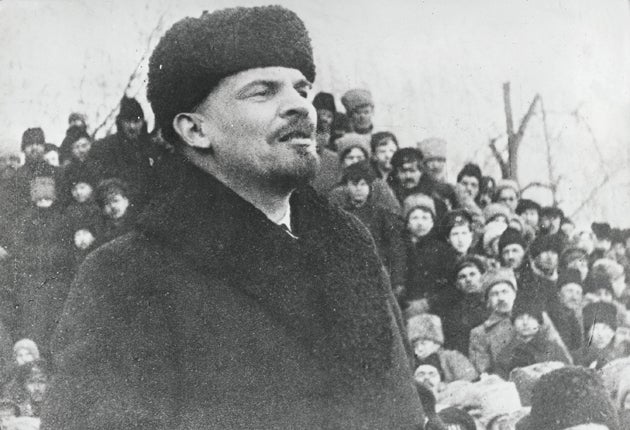
One of history's most discredited ideologies is having a comeback - not as a political force but as a commodity in the marketplace.
No longer confined to dingy meetings of ageing Trotskyites or the longueurs of the academic seminar, communism has been reinvented as a kind of intellectual cabaret act. The 20th century's biggest mistake is being marketed as high-end entertainment, with a modish neo-Bolshevism promising the jaded consumer an exciting experience of forbidden ideas.
Commonwealth is the last in a trilogy of books co-authored by Michael Hardt, an American professor of literature, and Antonio Negri, an Italian academic and political activist arrested in 1979 for alleged involvement in the kidnap and murder of the former prime minister of Italy, Aldo Moro. Those charges were dropped but others led to Negri spending years in exile and in jail. The first volume, Empire (2000), was something of a publishing sensation, welcomed as a radical new version of Marxian theory. In fact the book owed more to the facile theories of globalisation in vogue at the time.
According to Hardt and Negri, a new international system had emerged: a borderless cosmopolis in which sovereign states were obsolete. It is a view reminiscent of Thomas Friedman's fantasy of the flat world presented in The Lexus and the Olive Tree, published in the same year as Empire. Like Friedman, Hardt and Negri equated globalisation with Americanisation and never imagined that the process could stop or break down. The supra-national governance coming into being was the American Revolution writ large. A new multicultural proletariat was being formed worldwide, they argued in Multitude (2004), with the power to realise Marx's dream of communism.
Commonwealth, the last volume in the series, adds very little to the previous two. There are a couple of sections purporting to deal with the collapse of American hegemony but nothing that addresses its real impact, which is to recreate a decentred world of several great powers competing with one another much as the great powers did at the end of the 19th century.
The style remains a mix of strangulated jargon and toe-curling uplift. "The notion of social becoming," the authors inform us, "suggests the possibility of moving out of the anti-modernity of indigenism in the direction of an indigenous altermodernity". Moving from intra-academic obscurity to bad poetry, at the end of the book they write: "The process of instituting happiness will constantly be accompanied by laughter... While we are instituting happiness, our laughter is a pure as water."
This is radical theory in the idiom of Monty Python. The painful quandaries of politics are wiped away, and all that remains is feelgood blather dressed up as neo-Marxian analysis. It is a relief to turn from this pap to Slavoj Zizek's First As Tragedy, Then As Farce, a book which for all its faults makes clear that revolution necessarily involves large doses of suffering and coercion.
A Slovenian philosopher, psychoanalytical theorist and film critic, Zizek has become a gadfly of the left establishment, a prolific provocateur whose principal aim seems to be to confound his tender-minded readers. His target throughout this book is not the right but the soft, democratic, meliorist left, which imagines that the egalitarian goals of communism can be realised by non-repressive, liberal means.
Zizek is savagely scornful of this view, writing sharply that "One of the mantras of the postmodern left has been that we should finally leave behind the 'Jacobin-Leninist paradigm' of centralised dictatorial power. But perhaps the time has now come to turn this mantra around... Now, more than ever, one should insist on the 'eternal Idea of Communism' - strict egalitarian justice, disciplinary terror, political voluntarism, and trust in the people."
In other words, dictatorship is indispensable to the communist project. Mass coercion and terror are not departures from a humane vision, brought about by tyrannical leaders acting in backward conditions. Lenin and Stalin were genuine masters of revolutionary strategy, who knew that without organised terror their goals would never be achieved.
In this if in nothing else, Zizek is unquestionably right. In the real world, communist revolutions are not achieved by rhetoric; they require firing squads, secret police and gulags. This is as near as Zizek ever gets to the realities of revolution, however. He passes over the fact that systematic terror has nowhere realised the utopian goals of communism, but instead created new and worse forms of tyranny while killing millions of people.
When applied to contemporary conditions, his much-vaunted Leninism is comical. First As Tragedy, Then As Farce differs from the pap dispensed by the authors of Commonwealth chiefly in virtue of the gleeful enthusiasm with which Zizek defends the necessity of terror. But no more than Hardt and Negri can Zizek identify any social force that actually wants communism. For all his insistent tough-mindedness - "If you can get power, grab it", he declared in an interview the other day - he is at the furthest possible remove from anything that could be described as serious politics.
The essential frivolity of this latter-day Leninism is a pointer to the true reasons for the revival of radical leftist thinking at the present time. The global financial crisis has left many people frightened and confused. Faced with the failures of capitalism, they look around for alternatives - and here capitalism itself comes to the rescue.
A feature of the hyper-capitalism of recent years is that it abolishes historical memory. The squalor and misery of communism are now as remote to most people as life under feudalism. When Zizek and others like him defend communism - "the communist hypothesis", as they call it - they can pass over the fact that the hypothesis has been falsified again and again, in dozens of different countries, because their audience knows nothing of the past. Hence the appeal of Zizek's works, which are being avidly consumed by young people across much of Europe and beyond.
Whether as Hardt and Negri's embarrassing rhetoric or Zizek's parodic Leninism, the intellectual revival of communism is best understood in terms of capitalism's ability to produce compensatory spectacles.
The media-confected communism of the present time has as little connection with everyday life as does reality television - possibly even less. But precisely because of its unreality, the neo-Bolshevik spectacle has a definite function in contemporary society. The clowning cabaret of 21st-century communism does what entertainment has always been meant to do. It distracts those who watch it from thinking about their problems, which secretly they suspect may be insoluble.
John Gray's most recent book is 'Gray's Anatomy: Selected Writings' (Allen Lane)
***
Revolution, exile and jail: Toni Negri
Born in Padua in 1933, Antonio Negri became a professor at the city's university. From 1969 he took a leading role in the revolutionary groups Workers' Power and Workers' Autonomy. In 1979 he was arrested and later cleared of involvement in Aldo Moro's murder, but separate charges of 'instigating' violence brought a heavy sentence. In 1983 he fled to France and taught there, but returned to Italy in 1997 to serve time in jail until 2003. 'Empire' (2000) began his trilogy of treatises with Michael Hardt
Join our commenting forum
Join thought-provoking conversations, follow other Independent readers and see their replies
Comments