Dubai: Gilded Cage, By Syed Ali
"I didn't come to Dubai for anything 'real'. I've already lived in real places." So says a perceptive young Lebanese expatriate in Syed Ali's Dubai: Gilded Cage. Such a desire for suspended reality was for years the cornerstone of the tiny emirate's socio-economic environment and, if you read this book, you will learn that most of the population – 95 percent made up of foreigners – was firmly in on the act.
Since Ali began the book, economic reality has finally hit Dubai, with its massively leveraged developments in real estate and tourism infrastructure now floundering in the wake of the credit crunch. The emirate's ruler - the grandiosely titled General Sheikh Mohammed bin Rashid Al-Maktoum - had been styling himself as the chief executive officer of "Dubai Inc". But with a string of broken promises to investors under his belt and with the tiny indigenous population of his emirate now the most indebted per capita in the world, his economic stewardship is under serious question.
What hasn't yet happened is for the full and disturbing social reality of the Dubai experiment to hit. A number of books have recently appeared, most of which try to grapple with this. Overall, the best is Raymond Barrett's Dubai Dreams: Inside the Kingdom of Bling, but Ali's is a useful contribution, with Gilded Cage making a sporting effort to reveal the threads that hold together the diverse, multinational population, and the widespread socioeconomic and legal discriminations that underpin the fabric of Dubai's supposed "community".
In Dubai itself many of Ali's revelations will either fall on deaf ears or will simply be rebutted. The book is certainly uncomfortable reading for expatriates, as most are based in Dubai for a common purpose: to make money as smoothly and painlessly as possible, even if that means turning a blind eye. Most British expatriates, for example, made a conscious decision to abandon taxed employment in the UK for a new life in the sun, while some even invested in the Dubai property market. Few will now welcome serious questions about their adopted home.
At the other end of the scale, the thousands of Indian and Pakistani labourers, given much attention in Ali's work, were also there for a profit. Their conditions may have been those of a "gilded cage" but ultimately they were there to make a little more money in Dubai than they could in their home village. Provided they didn't fall off a skyscraper in mid-construction, the majority got to go home with at least something in their pocket.
How did these groups co-exist? A booming economy helped to keep sensitivities in check, but with widespread redundancies the gloves are coming off and the blame game has begun. The "living in a bubble" high-end expatriates of which Ali writes so evocatively are finding that their protective halo has disappeared, with disgruntled locals seeking imprisonment for any behaviour they deem inappropriate. In the last few months this has led to custodial sentences for a British couple kissing cheeks in a restaurant, a veteran British expatriate apparently sticking a finger up at a dangerous driver, and an Indian couple exchanging racy text messages.
What of those who have been living in Ali's "iron chains"? This is one of the first books to give such underclass expatriates proper consideration. These are the maids who were bought and sold upon being delivered to Dubai by their agents, and have faced years living in tiny, windowless rooms in suburban mansions. Many are raped by male members of their host family. Many are strangled, stabbed, or go over the balcony if things go wrong. Sometimes Amnesty International manages to file these cases; sometimes not.
Also living in iron chains are the thousands of Oriental and Eastern European prostitutes who flood the emirate's hundreds of bars and nightclubs. The former pick up the lower end of the market, while the latter offer white flesh to the occupants of the many Mercedes with blacked-out windows and Saudi number plates that crawl Dubai's kerbs each weekend. Most of these women have been brought to the emirate under false pretences, separated from their passports, and then made to "work" in return for their accommodation.
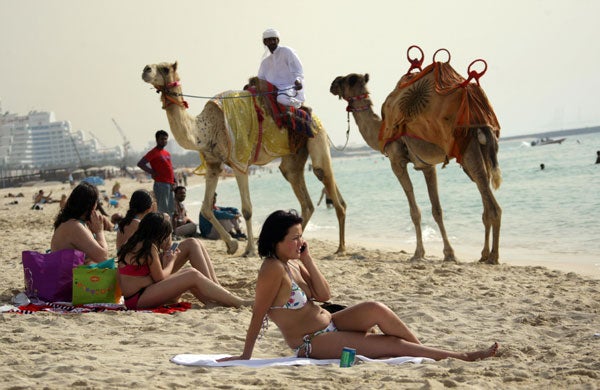
Thankfully, Ali doesn't let us forget the poor camel jockeys either: "the most exploited of all workers in the Gulf". These were infant Pakistani boys sold by their parents to visiting agents of sheikhs. Why did they have to be infants? As Ali tell us, the reason was rather insidious: "when scared or in pain – they scream; and the louder the child screams the faster the camel to which he is strapped will run."
To be fair on Dubai, if that is possible, camel jockeys are now outlawed (having since been replaced by bizarre looking little robots), but it's worth noting that this only happened in 2006 following a threatened lawsuit in a US court against the ruler. In fact, I witnessed such jockeys at a race in 2005: one little boy fell and was trampled on by all the pursuing camels. The race did not stop, the spectators kept cheering, and it took a good ten minutes for anyone to come and pick up the corpse.
Somehow Dubai and its parent UAE federation have since managed to upgrade themselves on the US Trafficking in Persons Index. Ali does well to expose the empty promises behind such cosmetic improvements, citing an embarrassed US ambassador-at-large for Trafficking in Persons admitting his gullibility and stating that "the UAE really sold the State Department a bill of goods".
Overall, Gilded Cage is worth a read, as most of the books on this fast-paced and hypocrisy-ridden part of the world tend to be. It is neither an academic book, nor an easy-read, but someplace in between. Anecdotes keep the reader hooked, and the author adds colour and life, avoiding burdensome jargon.
Nonetheless at the end one is left with a feeling of punches having been pulled. The title and blurb promise a full-on character assassination of the struggling, much lampooned city state, and most readers will probably pick up the book will such schadenfreude-fuelled expectations, especially given recent press coverage. Such readers may come away disappointed, having perhaps hoped for a fuller exposé of a regime that claims Islamic credentials yet is happy to exploit the world's poorest in slave like conditions, while pandering to the interests of wealthy foreigners and ignoring the sensitivities of its own citizens.
Christopher Davidson is senior lecturer in politics at Durham University and author of 'Dubai: The Vulnerability of Success' and 'Abu Dhabi: Oil and Beyond'
What's in a name? A tower of power
At a height of 828m, and a cost of $1.5 billion, the Burj Khalifa tower in downtown Dubai was planned to be the tallest tower on earth and a symbol of the emirate's soaring success. Begun in 2004 and finished in January 2010, it achieved the first goal - but not the second. By the time of the opening ceremonies, Dubai had been compelled to go for a loan to Abu Dhabi, its more cautious, and richer, neighbour. Hence a last-minute title change that gave the former Burj Dubai the name of Abu Dhabi's ruler.
Join our commenting forum
Join thought-provoking conversations, follow other Independent readers and see their replies
Comments
Bookmark popover
Removed from bookmarks