His Majesty's Opponent, By Sugata Bose
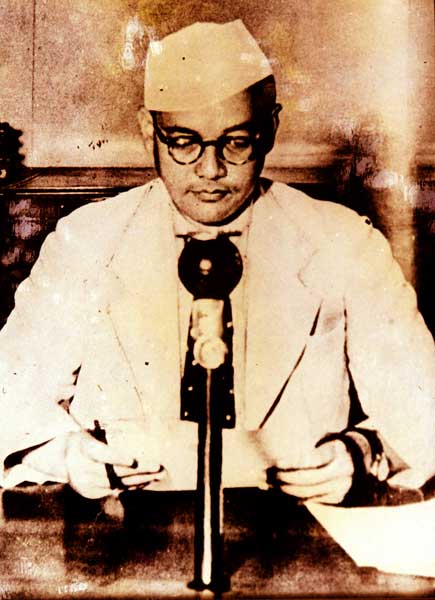
Subhas Chandra Bose (1897-1945) – affectionately known as Netaji, "the revered leader" of India's struggle against the British Raj - was an unusual His Majesty's Opponent. He came from a middle-class, affluent Bengali family. Unlike the Gurkhas or the Panjabis, the colonial government regarded the Bengalis as a "non-martial race".
He studied at Cambridge, passed the bureaucratic Indian Civil Service examination with good results, admired the openness of English society and later married a Western woman. And yet he was the staunchest firebrand of all Indian nationalists. Early in his political career, he successfully campaigned to remove Lord Curzon's offensive "Black Hole" memorial of 1901 from a prime spot in Kolkata.
The account of Bose's adventurous escape from house arrest and constant surveillance in Kolkata to Nazi Germany would humble Osama Bin Laden's ingenuity. His accidental death in a plane crash in Taipei finally turned Bose into a legendary hero.
I grew up in Kolkata with the stories of his derring-do in my school history primer. His garlanded moon-faced portrait hung at a prominent place in our home among other Bengali worthies. Later, I read about his disagreements with Gandhi and Nehru and his association with Hitler and Mussolini during the Second World War, and felt uncomfortable with his politics - though I knew of Rabindranath Tagore's endorsement of Bose as a prospective political leader of India in 1939.
At the height of Nazism in Europe, he absconded to Germany and lived with his German wife-to-be, enjoying the privileges of an expatriate diplomat and political ally. Even the Führer had to address him as "Your Excellency" and allowed him the facilities for regular broadcasts into India.
Though Bose's first communiqué from Germany after his departure created a stir when he announced that the Germans were going to defeat the British and that India was about to win her freedom, his words had little impact. By then, Mahatma Gandhi had already launched his "Quit India" movement with mass support.
Undeterred, Bose began creating an Indian Legion from about 3000 Indian soldiers of the British Army captured by the Italians as POWs. In spite of the soldiers' pledge of loyalty to the colonial army, Bose managed to persuade them to join him by speaking individually and promising appropriate rank, salary, benefits and, of course, certain victory. He had an excellent gift of speech. Strategically, Bose expected that when the German army, approaching from the southern USSR and the Middle East reached India with newly-converted Indian soldiers in the frontline, the colonial army would be hesitant to attack them. Even if they did, the Indians would protest at the massacre of Indian soldiers.
In theory it was a win-win scenario, but actually Bose's masterplan ended in disaster. Germany's defeat at El Alamein in 1942 halted Hitler's progress and the Indian Legion's leadership and morale collapsed. Ultimately, Bose's men were absorbed into the retreating German army; some joined the French resistance, others deserted.
After Japan's victory at Pearl Harbor, thousands of Indian soldiers in the Allied forces fell into Japanese hands. Once again Bose began to organise an Indian unit to attack British India from Japanese-occupied territory at the India-Burma border. Hitler helped to transport him secretly in a German submarine to the coast of Mozambique, where he boarded another submarine bound for south-east Asia.
The Japanese prime-minister Tojo welcomed Bose and regarded him as the Indian head of state in exile. Without any qualms about Japanese war atrocities, Bose was comfortable with his reception. He then took charge of a pre-existing Indian National Army (INA) with integrated regiments of Hindus, Muslims and Sikhs; more significantly, he established a female brigade – the Rani Jhansi Bahini – celebrating the rebel queen who fought the British in 1857.
He formed a provisional government of Azad Hind in Singapore during October 1943, collected tax, enforced laws, recruited soldiers and acquired a personal motorcade, aircraft and honour guards He also designed the tricolor Indian national flag of saffron, white and green horizontal stripes with a leaping tiger, reminiscent of Tipu Sultan's mechanical toy. Though Bose's INA once reached a peak strength of 50,000, his flawed logistics and an untimely monsoon caused them a heavy defeat at Imphal.
Bose boarded a Japanese bomber in Saigon on his way to China, once again preparing to attack British India from a Russian territory. The plane crashed in Taipei, fatally injuring him. He died in a Japanese military hospital on 18 August 1945.
This competent biography by Bose's great-nephew, a historian, is the best work to date to clarify some of his paradoxes. With unpublished material from family archives and public records, Sugata Bose supplies a fuller back-story of Netaji's predicaments. The book has illuminated my understanding of a controversial and charismatic Indian militarist who remains inspirational to many in India, despite his questionable status in the global politics of the period.
Krishna Dutta's 'Calcutta: a cultural and literary history' is published by Signal
Join our commenting forum
Join thought-provoking conversations, follow other Independent readers and see their replies
Comments
Bookmark popover
Removed from bookmarks