The Anatomy Of A Moment, By Javier Cercas, trans. Anne McLean
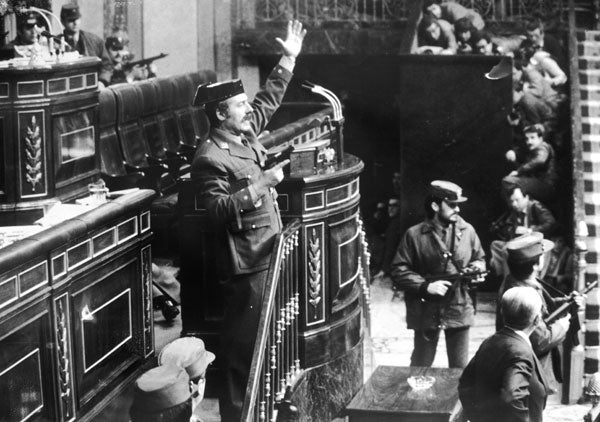
In his prologue, Javier Cercas cheerfully calls this book a "humble testimony of a failure" to complete a novel he had drafted about Spain's defeated coup d'état on 23 February 1981. He came to feel that the real coup was too messy, full of contradictory events, and that a novel would make this untrimmed reality too neat. In addition, the night of the coup was already seared into people's memories as if it were fiction or legend: especially, the television images of the braggart moustachioed Lieutenant Colonel Tejero brandishing his pistol as he occupied the Parliament with his Civil Guards at 6.23 pm.
So Cercas discarded his novel and embarked on the non-fiction narrative now published (including three dramatic photographs of the "moment"). His aim was to explain the coup without imposing any fictional order: in a sense, to return a historical event, fictionalised (falsified) to rigidity in people's memories, to its real complexity. The Anatomy of a Moment is extensively researched, rigorous with the facts. It is not only history, though, for where the facts end Cercas enters people's minds and speculates on their motives.
Javier Cercas became famous ten years ago with Soldiers of Salamis (winner of the 2004 Independent Foreign Fiction Prize), a novel of the Spanish Civil War. He followed that with The Speed of Light, another excellent novel, about the Vietnam War and its consequences. Like the present book, both these novels on the effects of war are open-ended. Cercas rounds off his books beautifully, but a satisfying finish does not mean he ties up the plot: he likes to leave readers wondering. In Soldiers of Salamis, Cercas takes as his starting-point how a militia-man spares the life of a fleeing Fascist leader he stumbles across in the woods. He squeezes the brief moment for all its meaning, exploring the contexts and lives of the two men.
Here, the moment Cercas anatomises is when Tejero, just after storming into Parliament, screams at the MPs to get down on the floor. His Civil Guards let off a burst of gun-fire. Everyone flings themselves under the benches, except three people, who remain in their seats while bullets whirr past – Prime Minister Adolfo Suárez, Santiago Carrillo, leader of the Communist Party, and General Gutiérrez Mellado, the Deputy Prime Minister, who had courageously advanced on Tejero and ordered him to lay down his arms.
Cercas hangs his enthralling story round the defiance of these three. Delving into their motives, he explains their central roles in Spain's 1970s transition from dictatorship to democracy. Against them, Cercas sets the three protagonists of the coup: the bluff soldier General Milans del Bosch, the wily courtier General Armada and Tejero, the compulsive organiser of coups, the "idealist prepared to bend reality to his ideals".
When General Franco, the dictator who had ruled Spain since the 1936-39 Civil War, died in November 1975, his chosen heir was Juan Carlos, who became king in a restored monarchy. Despite having sworn loyalty to Francoism, Juan Carlos perceived that a democratic system was necessary if the newly recovered monarchy was to survive and if Spain was not to remain the pariah country of western Europe.
In July 1976, the king sacked Arias, Franco's ineffective last premier, and appoints the relatively unknown Falangist, Adolfo Suárez, as prime minister. With supreme energy, always dancing one pace ahead of his opponents on left and right, Suárez carried out the king's wishes and organised within a year Spain's first free elections since 1936. Simultaneously, he headed off the threat of army rebellion, persuades the Francoist Parliament to vote themselves out of a job by agreeing a new democratic framework and browbeat the Communist Party into accepting the monarchy and abandoning any pretensions to a deeper rupture with Francoism. He legalised the Communist Party at Easter 1977, with army sabres rattling loud at this "betrayal" of Francoism, and rounded off this magical year by winning the June 1977 elections.
Suárez becomes the main character in Cercas's book. This cocky, provincial upstart overcomes all obstacles with his lack of scruple, good looks, charm and grasp of manoeuvre. Then, after triumphing as the man who got rid of the dictatorship, Suárez is less skilful at administering the democracy. The background of the 1981 coup is the increased ETA terror campaign targeting army personnel, Suárez's own incompetence and, most of all, widespread irresponsible chattering among the political classes that Suárez must be replaced by a unity government headed by a military figure.
The coup was a combination of various coups. For some, it was to be just "a touch on the rudder" to get the new democracy over its teething troubles. For others, like Tejero, it was to defeat the traitor Suárez and return the country to his Francoist ideal: a barracks, with military discipline and Catholic morality.
Cercas moves back and forth from historical background to the tense events of the long, cold night of 23 February, when the whole Parliament is held captive and the whole country crouches in suspense around their radios. Certain parts may make heavy going for English-language readers without direct knowledge, but Cercas is a masterly storyteller: the more analytical passages are rarely dull and the book is rich with vivid images, paradox and action.
Inevitably, there are points of discrepancy with Cercas. In his assertive defence of the settlement made in the transition, essentially between Suárez from the regime and Carrillo from the anti-Franco opposition, Cercas overloads his argument. He maintains that Carrillo was a revolutionary who gave up being one, when for over two decades Carrillo had been advocating national reconciliation, not revolution. Also, he ignores the mass movement driving the transition from below. And he dismisses too readily the large minority who wanted a deeper rupture with Francoism that would involve justice for the victims of the dictatorship as a rigid "ultramontane left" (a category including this reviewer).
Unlike the shimmering, lucid prose of Cercas's two great novels, here he has adopted certain mannerisms and stylistic infelicities. The twisting sentences over-use colons and semi-colons. His skilful translator Anne McLean is sometimes drawn into following too closely the Spanish in these long sentences studded with multiple sub-clauses. Cercas is attempting to be precise and express every nuance with this style; but it is tiresome that sometimes one has to read back to grasp the meaning.
Cercas is a major novelist who has written a fascinating account of a key event in Spain's recent history. Although 30 years have passed, the coup still reverberates. Many argue that, though the coup failed, it triumphed (one of the many paradoxes Cercas delights in): it forced the political class to grow up or, a more sinister consequence, it made politicians fall over each other to give the military what it wanted, a modernised NATO army and a more restricted democracy. Cercas's decision to write fact not fiction is vindicated. He forces us to abandon the fiction, the legends of the coup, and look at the pictures and story anew in all their complexity.
Michael Eaude's 'Catalonia: a cultural history' is published by Signal Books
Join our commenting forum
Join thought-provoking conversations, follow other Independent readers and see their replies
Comments