The Art of Camping, By Matthew de Abaitua
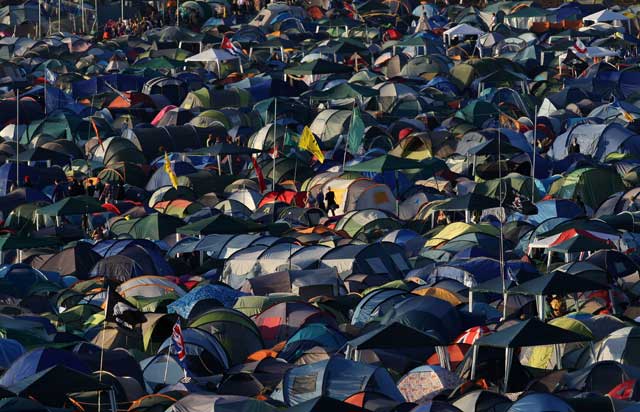
At Glastonbury the majority of tents are now left behind and go straight to landfill, often being used by their owners as last-minute toilets. Matthew de Abaitua's heartfelt history of camping struggles with disillusionment, as he charts the rise and fall of the idealistic movements premised on the communal solidarity of the campfire circle and earthbound habitus of the tent – that thin membrane which barely separates its occupants from the rigours and enchantments of the natural world.
To buy this book online, click here.
For many camping pioneers in the early 20th century, it was only a few sandal-wearing steps from the earth latrine and communal sing-song to world government. From Baden-Powell's Scouts onwards, via the Kibbo Kift, The Order of Woodcraft Chivalry, the Forest School and the Grith Fyrd, most British endeavours intent on re-moralising children and young people through camping and outdoor pursuits were riven by personal and ideological antagonisms. Leading members flirted with paganism, fascism, communism, eugenics, sexual exhibitionism, and dubious varieties of revealed religion, even as the young campers in their charge got on with lighting fires and cheerfully getting wet and dirty.
Having been involved in the Hackney contingent of Flysheet Camps in the 1970s (itself a breakaway from the influential Forest School movement, though one not mentioned by De Abaitua), I can only report that good times were usually had by all. We ended our letters to each other with the flourish: "Blue skies!"
The author does for camping what the late Roger Deakin did for wild swimming, infecting the reader with his enthusiasm, while chastening us with stories of the darker aspects of the back-to-nature movement. The lightweight tent can be the naturalist's best friend, but it has also provided a refuge for the survivalist with the Book of Revelations and an automatic gun. De Abaitua is not afraid to discuss the concentration camp and the labour camp alongside the holiday camp – and sometimes worry about connections between them all. His enthusiastic tone is enlivened by a self-deprecating wit: there is no better account of the rain-soaked family camping holiday than here. The packing-list provided by his wife, Cathy, as an afterword, is equally engaging and full of sage advice.
In the 1930s many teachers and politicians worried about a generation of children growing up "wrapped in cotton wool", for which, it was argued, there was no better corrective than the summer camp. The popular psychological theory of "recapitulation", still in vogue when I trained to be a teacher in the 1960s, insisted that every child had to go through all stages of development - from caveman to hunter-gatherer to model citizen - if they were to gain adulthood successfully. Outdoor living was essential to this process, and camping supplied the missing link.
There is today a great revival of family camping in Britain. In some of the newer campsites, an environmentally-friendly, "big society" ethos now holds sway. The connection between mud and morality still holds. For De Abaitua, striking camp (that is to say, packing up and going home) is ethically more important than setting up: the ideal camper should leave no trace that they were ever there.
Ken Worpole is a contributor to 'Towards Re-enchantment: place and its meanings'
Join our commenting forum
Join thought-provoking conversations, follow other Independent readers and see their replies
Comments