Books

Flurries (AM and PM) 2° London Hi 4°C / Lo -2°C

VERSO £18.99 (372pp) (free p&p) from the Independent Bookshop: 08430 600 030

The Invention of the Jewish People, By Shlomo Sand trans Yael Lotan

Birth of a nation
Reviewed by Stephen Howe

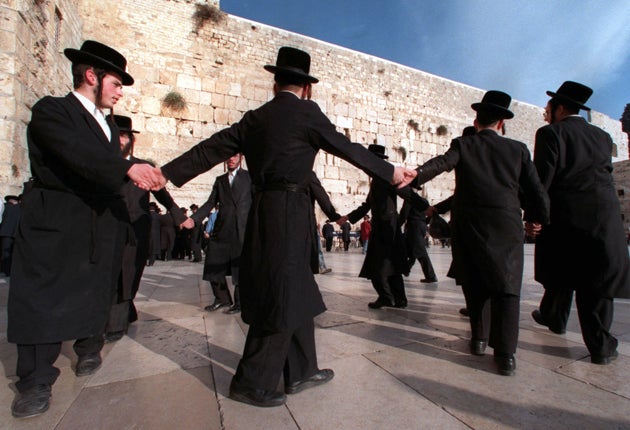
Where history meets tradition and belief: orthodox Jews celebrate at the Western Wall in Jerusalem

REUTERS

Where history meets tradition and belief: orthodox Jews celebrate at the Western Wall in Jerusalem

Shlomo Sand clearly intended his book as an explosive device, a big bang demolishing the myths of Jewishness on which both communal identity and Israeli state policies rest.

His hostile critics react as if it were a deadly bomb, a kind of literary-political terrorist attack. Actually, The Invention of the Jewish People is less a single detonation than a string of firecrackers, erupting or just fizzling in uncertain succession. Ranging across several millennia but with its main aim on Israel's political present, the book has too many diffuse themes and purposes quite to start the kind of fire Sand wants. It doesn't help that a few of his incendiary gadgets almost entirely fail, while others prove to be worn out from previous use.

That sounds harsh: perhaps unduly so. Sand's political purpose is (in my view) an admirable one, and many of his historical claims probably more right than wrong. But at least the mixed response this review will convey might help break away from the pattern of reactions the book is receiving: it has already been published in French and Hebrew. They are starkly divided between uncritical enthusiasm and total condemnation. The blogosphere has been buzzing with wild charges and vulgar abuse against Sand's book – most repeatedly, predictably and depressingly, calling it anti-Semitic.

Almost none of those assailants, naturally, has any discernible expertise in any of the fields Sand touches on. Barely less depressing is the extent to which responses are so utterly predictable according to the critic's political views, so evidently fixed in advance and unaltered by any actual reading.

Conventional ideas about Jewishness hold that Jews are a single ethnic group (or nationality) with substantial shared biological ancestry going back to the biblical kingdom of Judea, from which they were exiled in waves to scatter widely across the Mediterranean world, then far beyond. The core of Sand's historical case is that the whole story is a myth: a very elaborate fiction, supported by hordes of eminent scholars, which became foundational and essential for the state of Israel, but mostly a very recent fabrication without much evidence. Ironically, the idea of the Jews as quintessential people of exile and dispersal was in origin a specifically Christian and even anti-Semitic story: displacement as a punishment for denying Jesus. Yet it was enthusiastically adopted by pioneer 19th-century Jewish historians, partly under the influence of Germanic nationalism, and then by the founders of Zionism.

Sand's counter-story is that very few of those now calling themselves Jews have any connection other than the religious to ancient Levantine Jewish kingdoms. The latter, if they existed at all, were anyway small, disunited and unimportant: the biblical story of a mighty kingdom of David is another groundless myth composed long after the event. Sand argues that the rapid growth of Jewish communities in the Roman Mediterranean world, and later in North Africa, Arabia and south-central Asia, came from mass conversion, not dispersal out of Palestine. Probably the most important wave of conversion was among the Khazars of Russia's Volga-Don steppe. European or Ashkenazi Jews – later the main basis both for America's or Britain's Jewish populations and for Israel's foundation – are mainly descended from them.

Holes can be picked in much of this. For a start, most elements in Sand's counter-narrative are less new than he makes them sound. His key analytical move, to insist on ideas of nationhood as invariably modern, largely top-down inventions rather than ancient ethnic inheritances, is in numerous other contexts not only already old hat but, under the assault of many specialist historians, a slightly battered hat too.

His account of modern arguments over whether ancient Israel ever existed in anything like the biblical stories' depiction is pretty sketchy, and makes those debates sound far simpler than they have really been. He writes as if the sceptical or "minimalist" side has decisively won that intellectual war. A more open-minded reading would suggest, so far, a draw. His arguments about mass conversion, the Khazars and so on, all have many precursors, and equally many long-established critics. Very few serious scholars in recent times have believed in "the Jews" as a single ethno-biological people or "race".

Yet if in intellectual and historical terms, Sand is rehashing some old arguments and even setting up straw men for too-easy demolition, he is surely right that the picture is very different both on more popular level and on that of Israeli politics and law. The very ferocity evident in attacks on the book all too surely proves that point.

In both the opening and the closing pages, Sand presents the political – and indeed ethical – pay-off of his historical claims. Zionism and the Israeli state's most basic founding assumptions depend heavily (though, as he concedes, never exclusively) on the ethno-nationalist pseudo-history he attacks. So long as they remain, Israel can never become a truly democratic society, and never resolve the tensions inherent in calling itself both a democracy and the "state of the Jewish people".

Being "Jewish and democratic" need not be an oxymoron, but can only avoid being so if the idea of Jewishness itself is freed from ethnic, even racialised, myths of origin. Sand seems in two minds over whether that is achievable; and maybe he's right to be so, for the portents are contradictory. On some levels, Israeli-Jewish political culture has become steadily more pluralist and tolerant of dissidence – like, indeed, Sand's own. On others, the centre of political gravity shifts rightward, and the public space for open anti-Arab racism grows bigger.

Here, maybe, the direction of Sand's own polemical fire needs some modification. He notes repeatedly and rightly that the crucial issues all cluster round Israel's treatment of its Arab minority: those who are Israeli citizens (roughly 18 per cent of the total) even more than those of Gaza and the West Bank. But it may be that he still doesn't stress this quite enough. He sees the core of Israel's problems as lying in a "positive" commitment to a mythical idea of Jewishness. It could, though, be argued that still more problematic and pernicious is the "negative" fear, hatred and contempt for Palestinians: that the trouble with Israel is less its character as a "Jewish state" than its being a non-Arab, indeed "anti-Arab" state.

Stephen Howe is professor of history at Bristol University; his books include 'Ireland and Empire' (Oxford)

Mystery or myth: Khazars and Jews

First raised in the 1880s, the theory that Ashkenazi Jews from eastern Europe are largely descendants of the Khazars of central Asia never quite vanished. The rulers of the medieval Khazar empire certainly converted to Judaism in the ninth century. Historians vary in their views of how far mass conversion could have gone. The idea revived in the Arab world as a means of denying legitimacy to Zionist claims, but its most prominent modern outing came in 1976 with 'The Thirteenth Tribe' by Arthur Koestler.

Post a Comment

View all comments that have been posted about this article.

Offensive or abusive comments will be removed and your IP logged and may be used to prevent further submission. In submitting a comment to the site, you agree to be bound by the Independent Minds Terms of Service.

Comments

Response by Kevin Brook, expert on the Khazars and Jewish genetics
[info]khazaria wrote:
Friday, 27 November 2009 at 06:02 am (UTC)
In the letter "Shlomo Sand responds to Simon Schama's review in the Financial Times", dated November 21, Sand claimed "no serious work concerning the origins of the demographic weight of Yiddish-speaking Jews has been carried out" in recent decades. That isn't true because I wrote a study of this very nature titled "The Origins of East European Jews" and it was published in the scholarly journal Russian History/Histoire Russe volume 30 numbers 1-2 (Spring-Summer 2003) on pages 1-22. Was Sand really ignorant of it?

Prof Howe asserts that most of Sand's online critics lack "any discernible expertise in any of the fields Sand touches on." My participation in those blogosphere discussions goes against Howe's assertion.

Sand is familiar with the first edition of my book "The Jews of Khazaria" and cites it in "The Invention of the Jewish People" on page 238. But it is the second edition of my book that carries the full extent of the research on Jewish demographics and origins, with its Chapter 10 (formerly numbered 11) sourcing the new genetic studies as well as the demographic and linguistic research of scholars like Alexander Beider. That's because I expanded upon my journal article when I wrote that chapter. So those are two places where my serious research has been published.

I have also studied worldwide DNA patterns closely for a decade, partnered with Family Tree DNA (a major DNA testing company), and conducted a DNA study of my own (on the Karaites of Europe).

The evidence I collected in my book disproves Sand's book's ideas about the origins of Ashkenazim and Sephardim, showing that the real story is that Ashkenazim and Sephardim have preserved a large amount of ancestry from ancient Israel to the present day.

Ashkenazim do have potential Khazar genetics, though. And many West Bank Palestinians do have Israelite genetics. But Sand exaggerates these two facts. My book "The Jews of Khazaria" presents the middle ground between the extreme views of this debate. - Kevin Brook
Stephen Howe's connections to Sand's publisher
[info]khazaria wrote:
Friday, 27 November 2009 at 06:21 am (UTC)
The author of this review, Stephen Howe, has edited and written books for the same publisher as Sand's book, Verso. Specifically, his book "Afrocentrism" got published by Verso in 1998, and he was the editor of "Lines of Dissent" that Verso published in 1988.

Verso is an avowedly pro-Socialist publishing house. So Prof Howe is not one to talk about how "responses are so utterly predictable according to the critic's political views".
Unintentional Irony
[info]deliotb wrote:
Friday, 27 November 2009 at 09:08 pm (UTC)
Professor Stephen Howe of Bristol University reviewed Shlomo Sand's The Invention of the Jewish People in the Independent. The review itself says nothing of particular interest, and any discussion of the origins of the demographic origins of modern Jews people that doesn't reference the genetic evidence is doomed to be worthless.

But here's the unintentionally ironic part:

The blogosphere has been buzzing with wild charges and vulgar abuse against Sand's book – most repeatedly, predictably and depressingly, calling it anti-Semitic. Almost none of those assailants, naturally, has any discernible expertise in any of the fields Sand touches on.

In fact, much of the criticism I've seen (plus my own), is either by people who do have some demonstrated expertise in the area, or who link to/cite those who do. (For that matter, I haven't seen anyone call Sand anti-Semitic, but many have correctly pointed out that his theory that most Ashkenazic Jews descended from Khazars finds virtually no support among geneticists or linguists, but is quite popular with anti-Semites around the world, who have been basically the only ones keeping the "controversy" alive.) But what of Prof. Howe? From his website:

My main focus has been on British imperial history, including the role of imperial questions in domestic British politics; but my writing also involves a strong comparative element, which embraces a growing interest in ideas about American 'empire' today. Much of my recent and current work engages with the very concept of colonialism and associated terms, including reflection on and probing of the limits, the uses and indeed the abuses of the concept itself. Much, too, addresses broad theoretical and comparative questions about anti- and post-colonialism. I'm currently completing three interrelated books: on the intellectual consequences of decolonisation, on anticolonial intellectuals, and on representations and legacies of late-colonial violence.

Howe's list of over two hundred publications contains not a single one with the words "Jew" or "Jewish" in the title. In other words, he is likely more ignorant about the subject matter at hand than many of the bloggers he excoriates (many of whom have at least a layperson's interest in Jewish history), and there is certainly nothing in his review that suggests otherwise.
zkharya
[info]zkharya wrote:
Tuesday, 1 December 2009 at 01:59 am (UTC)
Part I

I am a PhD student immersed in many of the primary sources to which Shlomo Sand, specialist in modern French history, refers.

The exile is assumed in rabbinic and Talmudic literature, as it is in Christian and Islamic. The Talmud is an expression of the rabbis’ resolve that every scrap of Jewish law, lore, custom and memory be retained in the face of the catastrophic loss of temple, Jerusalem, Judea and state.

In the Bellum Judaeorum. Josephus is too early to realise the loss of temple and Jerusalem is permanent, and he likely hoped for their return to the Jews. But there is no question that he perceives the loss of a Jewish state, of which Jerusalem is the capital.... See More

Soon after Jews fall from favour. We hear no more of Hellenistic Jewish intellectuals, like Philo, whether Roman citizens or no. The destruction of the Alexandrian Jewish communities signals a decline in Hellenistic Jewish civilisation, a decline completed by the Christians. Jews no longer write Greco-Roman historiography. Hellenistic and Roman Jewish works, the provenance, in any case, of an elite, are lost. All Jews, empirewide, are punished for the rebels of Judea by collection of the temple tax. Indeed this likely plays a part in triggering the revolts in Alexandria and Cyrenaica. All Jews are thus identified as “Judeans”, and the Christians continue the policy. But now Jews are not only treated as de facto rebels, or potential rebels, against the Roman state and its gods, they are rebels against their own God, who know favours Greco-Roman gentile Christians, who inherit Jerusalem and Judea, now renamed “Palestine”, from their pagan predecessors, who acted as agents of divine wrath against Israel for rejecting or slaying Christ.

The “myth” of exile arises precisely because it is no longer possible to retain or research information about the past in detail. Except, for Jews, in the Talmud. It is a shorthand that most neatly encapsulates the Jewish experience of dispossession, disfavour, subjugation and displacement. Jews intermingle and intermarry, and the rabbis forge a pan-Jewish identity precisely because they fear Israel will be lost among the nations. Thereafter the tendency is less to convert new as to retain old Jews.

The assumption, indeed the necessity, that Jews are a people dispossessed of temple, city and land for their rejection of Jesus and the prophets only bolsters Jewish self-definition.

And the Christians continue the process of Jewish dispossession of the land of Israel by laws seeking to alienate or marginalise them. Yes, a sizable Jewish community remains in the land, largely in the Galil, whether many Judean refugees likely went.

Shlomo’s assertion that Romans did not exile peoples is idiotic: they certainly carried out tranfer or genocide against Dacia, the only other province, other than Judaea, to be renamed as a consequence.

Cassius Dio says 500 000 Judeans were killed during the suppression of the second Jewish revolt. Exaggeration? Possibly. But ethnic cleansing even by modern standards (and the Palestinian Arab Muslim and Christian experience springs to mind).

Judaea is changed to Syria Palaestina both to likely reflect that “demographic” change and to alienate Jews from the land for ever. It was never complete, sure. But I can tell you that every ancient Christian author, even those living in Palestine, speaks as though Israel has been completely dispossessed from the land, not because it necessarily reflects reality, but because it reflects things as they think they should be.

Which is why Jews have been regarded as a people dispossessed of temple, city and land, in Christendom and Islam, for most of Christian and Islamic history.

Especially Palestinian Christian and Islamic history.

In any case, one consequence of this is that, even in the 19th and 20th centuries, Jews in Europe, North Africa and Asia are regarded as more nationally Judean than, say, European or Arab, and are either killed, or effectively driven out: before 1914, mostly to America, after 1914, mostly to Palestine, or what became Israel.


zkharya
[info]zkharya wrote:
Tuesday, 1 December 2009 at 02:01 am (UTC)
Part II

Which is why the Jewish state of Israel is the second or largest Jewish community today, and certainly the one most identifiably Jewish (hence, unsurprisingly, the especial focus of hatred of antisemites today).

Sand’s holding a post-Revolutionary French notion of nationality as the touch stone of its definition is absurd: the Greeks and the Romans regarded Jews as a distinct ethno-national group, along with Syrians and Egyptians.

But, more to the point, Sand’s criterion proves the very opposite of his thesis: the granting to Jews of French citizenship was significant precisely because it was the first time since antiquity that Jews could transcend their (anciently regarded) Jewish ethno-nationality without having first to convert from Judaism to Christianity.

The intellectuals of the French Republic all assumed the Jews were an ethno-national group historically dispossessed because this was not merely how Jews saw themselves, it had been a datum of European culture for nearly 2000 years.

It was precisely this identity Jews were supposed to surrender in order to become French citizens. That was why orthodox rabbis viewed emancipation with such ambivalence, and why Liberal Judaism evolved as a response.

Conte de Clermont-Tonnerre to the General Assembly of the Republic ‘To the Jews as individuals everything, to the Jews as a nation nothing.’

It goes without saying that this presupposes Jews to have been a national group of some kind, although this was what Jews needed to abandon to become French citizens.

“It is also quite peculiar that a serious historian should assume that in the 9th century B.C there was a “developed nation-state” in the Middle-East. Perhaps we are to imagine the existence of a flourishing print industry, book market and compulsory education during that period, thereby forging ancient Israel into a nation-state?”

This is just moronic.

It sounds as though Sand is saying that, because an ancient Judean state does not match up to the French Republic, ergo it cannot have been a state that originates the traditions that go on to comprise the Tanakh, not to mention the ethnic group that goes on to become the Jews.

Briefly, Sand’s assertion that there could have been no such thing as a state in 9th century Judah only rather shows that specialists in modern French cinema shouldn’t dabble in ancient historiography.

Schama’s asserting Rome extirpated “everything” Jews is a mistake. But Rome did destroy and forbid the temple cultus, various aspects of Judaism at various times, Jewish habitation of Jerusalem, and effected ethnic cleansing from its surroundings and Judea more widely. It was not complete. But then it was not complete for Palestinian Muslims or Christians, either.

They destroyed and depopulated hundreds of Jewish villages, as archeology bears out: most Jewish remains are in the Galil, and date from the third-fourth century. At that time the Roman state seems to have largely left Judeans alone. Then came the Christian state, and that changed.

In any case, as I wrote earlier, Rome, pagan and Christian, punished all Jews as de facto Judean.

Further Sand’s adducing Mishna and Talmud does not help his case: the catalyst for their production is the great national disaster the rabbis perceived had befallen Israel, and their response is, as I write above, the every scrap of Jewish law, lore, custom and memory be retained in the face of the catastrophic loss of temple, Jerusalem, Judea and state.

The Talmuds and Mishna witness to the Jewish experiene of Nakbah.

And these are the very books that assume an exile that Sand claims not to have found.

Perhaps if he looked a little harder?
zkharya
[info]zkharya wrote:
Tuesday, 1 December 2009 at 01:00 pm (UTC)
I would just like to respond to Stephen Howe's assertion that Sand's critics are insufficiently qualified.

a) to call Anita Shapira (http://www.isracampus.org.il/Extra%20Files/Anita%20Shapira%20-%20Shlomo%20Sand%20book%20review.pdf), Hillel Halkin (http://forward.com/articles/108457/?utm_medium=email&utm_source=Email%20marketing%20software&utm_content=70937483&utm_campaign=July+3%2c+2009+_+ijktul&utm_term=Opinion%3a+Jewish+Peoplehood+Denied%2c+While+Israel%E2%80%99s+Foes+Applaud), Israel Bartal (http://www.haaretz.com/hasen/spages/999386.html) insufficiently qualified is ridiculous.

b) for Stephen Howe to profer himself as more the authority in Jewish history than Simon Schama is also ridiculous, especially given Sand's expertise being in modern French, specifically French Cinema, history.

c) Sand's work has hardly been reviewed by his peers in British academic Jewish historiography. Farcical is the fact that, although Sand has twice been hosted at SOAS by groups external to it, not once has any of the staff of the Israel or Jewish Studies departments been informed or invited to respond.

UCL Hebrew and Jewish Studies department is literally a 100 meters away. No one was informed or invited from there either.

The closest scrutiny he received was from Avi Shlaim, Oxford Professor of International Relations, and, surreally, Jaqueline Rose, Professor of English Literature at Queen Mary's.

Dr Catherine Heszer, head of Jewish Studies at SOAS tells me she had no idea that Sand has now spoken twice at SOAS!

Ron
[info]newcentinel wrote:
Saturday, 12 December 2009 at 01:46 pm (UTC)
I believe that Schlomo does raise some major points that need to be addressed, however for ideological reasons they are otherwise ignored by the Zionist establishment.

When the jews left Israel they were exposed to foreign elements and incorporated them into their culture. Thus, we have such traditions and customs that possibly could not have existed in ancient Israel today. The migration of jews into other regions was not the only factor in this however. Many jews themselves today do not even descend from the original Israelites. Judaism was once a proselytizing religion. They incorporated many different peoples from the caucasus to anatolia and ancient Persia. Many Jews entering europe took on European females as wives, a bottleneck was possibly built up over time. Khazaria is quite a particularly interesting story. It is probable that many ashkenazis in particular today descend not from israelites but actually Caucasians. The ashkenazis and chechens (Chechnya was part of Khazaria) apparently have a strong genetic affinity with the kurds and armenians demonstrating a link with the area around the Caucasus. The khazars may be the bulk of jews that you see today.

Article Archive

Day In a Page

Sun | Mon | Tue | Wed | Thu | Fri | Sat

Select date