Vanished Kingdoms: The history of half-forgotten Europe by Norman Davies
In the country of the past
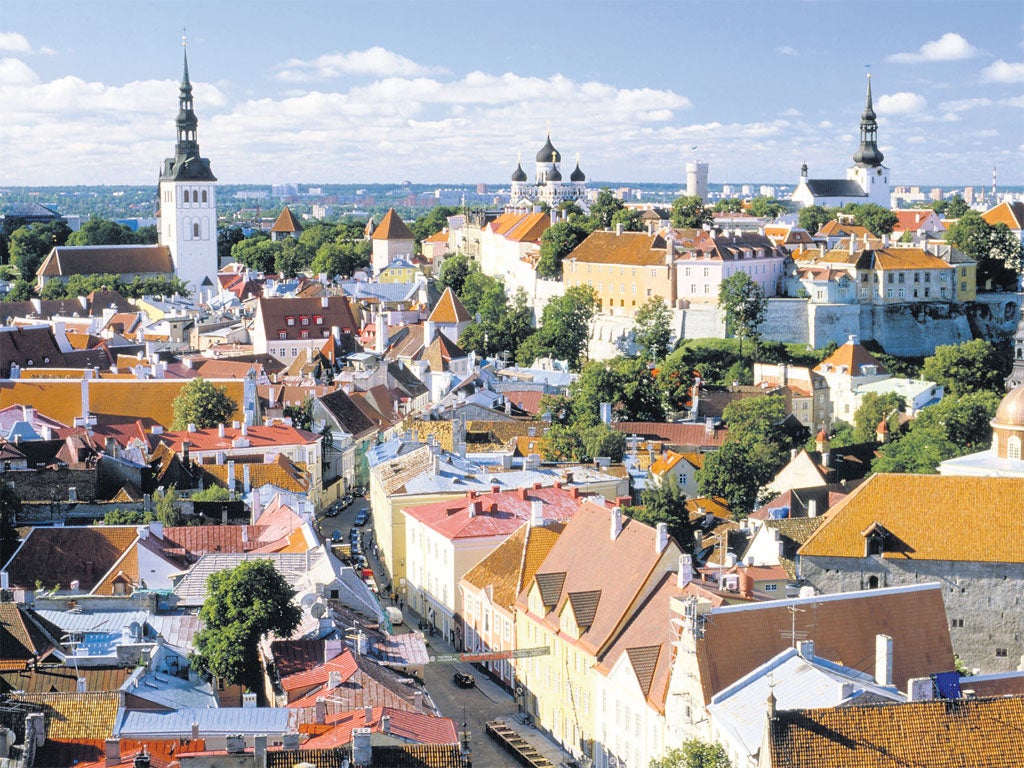
As a child I had assumed that my mother was English. I learned later that she was born in the Baltic seaport of Tallinn, a magical city which is German Lutheran in detail but Tsarist in imagination.
Tallinn is the capital of the Baltic republic of Estonia. For 300 years, Estonia had been part of imperial Russia and served the Tsars as a gateway into Europe and the Nordic lands. My mother had spent a tranquil childhood in Tallinn in the shadow of Alexander Nevsky cathedral. Graham Greene had visited Tallinn in 1934; Arthur Ransome had married Trotsky's private secretary there a few years earlier.
However, the threat of European war was looming. In 1940, Estonia was invaded by Stalin, and the following year by Hitler. The Red Army returned in 1944, and did not leave for half a century. Before they could seize the family property, however, my mother escaped to England. Like many dissidents from the Soviet bloc, she viewed England as a refuge for casualties in a totalitarian age, and became a true Anglophile. She renovated a decayed medieval house in Greenwich where I grew up and where Samuel Pepys had sheltered briefly during the Plague of 1665. To my child's eye, all this restoration looked like a suitably English occupation.
Norman Davies, a distinguished historian of eastern Europe, devotes a fascinating chapter to Estonia in Vanished Kingdoms, his exhaustive account of various "lost" kingdoms, duchies and nation states of Europe from medieval times to the present. Independent Estonia had lasted scarcely two decades from 1918 before it was subsumed into the Soviet empire and effectively disappeared from the map of Europe. Now it is the USSR that has disappeared: Estonia, the "diminutive David", has stood up to and survived the "super-colossal Goliath".
Soviet authority began to unravel after the Berlin Wall came down in November 1989, says Davies. On Christmas Day in that extraordinary year the Romanian dictator Nicolai Ceauçescu and his wife Elena were summarily executed. The Baltic States – Lithuania, Estonia and Latvia - began to agitate for political freedom soon after. Within months, the Soviet empire was a sandpile ready to slide; in 1991, the Russian President Boris Yeltsin officially terminated the USSR's existence when he banned the Communist Party within Russia. Given the magnitude of what had happened, remarkably few people died in the last days of the Cold War. Indeed, the threat posed today by international terrorism and Pentagon intransigence makes the old East-West rivalries look almost manageable.
According to Davies, all nation states and empires, however great, flourish for a season and are replaced. "The paths of glory lead but to the grave": he quotes Gray's "Elegy" on the subject. Rather than offer yet another history of a great power, Davies has chosen to concentrate on half-remembered but no less great nations and the manner of their demise.
As well as a fascinating record, Vanished Kingdoms is intended as a riposte to British deprecations of "Ruritanian" outposts and the perceived inferior cultures of Eastern Europe. The Grand Duchy of Lithuania, far from being a pimple on the edge of the Slav world, was once the largest country in Europe. In 1918 Byelorussia (the birthplace of, among others, Kirk Douglas and Irving Berlin) had been a national republic larger than all three Baltic States put together.
At different times, these great powers had suffered "State Death" (to use a now-accepted English term). Similarly, the Spanish kingdom of Aragon had once dominated the entire western Mediterranean, but is now a "mere ghost" in people's remembrance. The United Kingdom too may collapse one day, says Davies, whether or not a king or queen continues to reign.
If Sparta and Rome perished, what state can hope to endure for ever, Rousseau had asked rhetorically in the Social Contract. The fall of Troy was the first great military defeat of Western civilisation and the prototype for all future national downfalls. No defeat is ever quite straightforward, however, and many Greek heroes who triumphed at Troy were themselves later trounced. By the same token, the losers often turn out to be the winners.
Thus the defeated Trojan leader Aeneas left Troy humiliated, but entered Roman mythology as the heroic founder of Rome. Reborn former Soviet nation states like Estonia have undergone comparably giddy twists of fortune.
In a brilliant chapter, Davies considers the rise and fall of the Byzantine Empire, of which Istanbul was once the capital under the name of Constantinople. Istanbul's end-of-empire atmosphere, with its tottering Armenian and Russian town mansions, radiates hüzün ("sadness" or "melancholy" in Turkish). Handsome homes built on the banks of the Bosphorus by pashas, viziers and other imperial mandarins are now virtually all decayed, or else they burned down in arson attacks during Atatürk's attempted erasure of Islam following the dissolution of the Ottoman Sultanate in 1918.
Atatürk remains the greatest nation-builder of modern times. For all his destruction of Islamic schools and his abolition of the veil as a narrowly Asian trapping, he helped to turn the gaze of Istanbul out across the Bosphorus towards Europe and adopt Western values. In so doing, of course, he left a spiritual and religious void at the heart of modern Istanbul. Islam may yet rise again in formerly Ottoman lands; empires can undergo rebirth as well as death, says Davies.
Kingdoms are often incapable of imagining their defeat, though. In 1946, following the abdication of Italy's pro-Fascist king Victor Emanuel II, the Italian people decided by referendum to become a republic. Europe's oldest ruling royal family, the House of Savoy, was finished. To many Italians, ousting their royal family meant shedding the past and the nationalist myopia of Fascism, the Duce and his cohorts for good. The hopes for a new Italy were boundless but, as Davies relates, the Savoy royal family refused to countenance its constitutional irrelevance. Claimants to the Savoy crown pop up even today, most recently in 2004, when an elder titular Savoyard landed two punches on the nose of a younger one at a royal wedding in Madrid. Having once ruled from the Piedmontese capital of Turin, the Casa Savoia is now reduced to a pantomime monarchy that cleaves to an idea of its past greatness.
In present-day Estonia, meanwhile, the fear is that Russian tanks will once more roll in to the tiny republic and reabsorb it into the "Great Nation" of Russia. The fear is not unrealistic. The absolutism of the Tsarist empire has found a grotesque mirror image in President Putin's own contempt for parliamentary democracy. In a country which has scarcely known Western-style democracy, Putin could hardly be an upright, even-handed parliamentarian. Instead, he sees himself as a man at the helm of a renascent power. Empires have been reborn out of lesser ambitions.
In 1989, I went to Tallinn in search of a long-lost schoolfriend of my mother's. For 11 years Delia had languished in a Siberian gulag as a "bourgeois recidivist". Her father, as head of Tallinn customs, had been shot some time in 1941; her mother had perished somewhere in the Siberian ice-fields. Delia herself had been left with a "spoiled biography" - Soviet-speak for a shameful reactionary past.
To my surprise, she had photographs of my mother. One showed a young girl standing under a Christmas tree – a ritual tolerated in Soviet Tallinn only as a "New Year's Fir". In the course of the encounter, she spoke to me of the Tallinn lawyer Arnold Susi, a key figure in Solzhenitsyn's The Gulag Archipelago. In 1945 Susi had been deported to a camp at Krasnoyarsk, a statistic among the millions of Siberian disappeared. (Fortunately, Davies relates, he was eventually "released".) In the camp there had been unexpected acts of kindness, as well as brutal maimings, murders and torture. "Cruelty is invariably accompanied by sentimentality", Susi had told Solzhenitsyn.
Nevertheless, it is hard for Russians today to conceive that all these political deaths – an estimated 62 million in the 70 years after the 1917 Revolution – were in the name of a great empire. At the war's end, my mother's classmate had returned to Tallinn but, cruelly, Stalin sent the 17-year-old back to the Gulag for a further six years because her character had not yet undergone a full Soviet "reforging" or perekovka. The re-deportation of children within the Soviet empire was a "peculiarly sadistic" feature of Stalin's dictatorship, says Davies, who does not hesitate to condemn the "shameless arrogance" of Soviet conduct towards the lesser nations of Europe. In pages of fact-packed prose, he succeeds in giving voice to nations that have almost "no advocates" today. For that alone, Vanished Kingdoms is a magnificent (if at times slightly wearisome) achievement. Brocaded with scholarship, the book runs to over 800 pages, and is unlikely ever to be equalled.
Ian Thomson's 'The Dead Yard: tales of modern Jamaica' is published by Faber & Faber
Join our commenting forum
Join thought-provoking conversations, follow other Independent readers and see their replies
Comments