A fatal attraction to fallen women
As La Traviata returns to London, Jessica Duchen wonders why opera's routinely punished heroines get such a raw deal
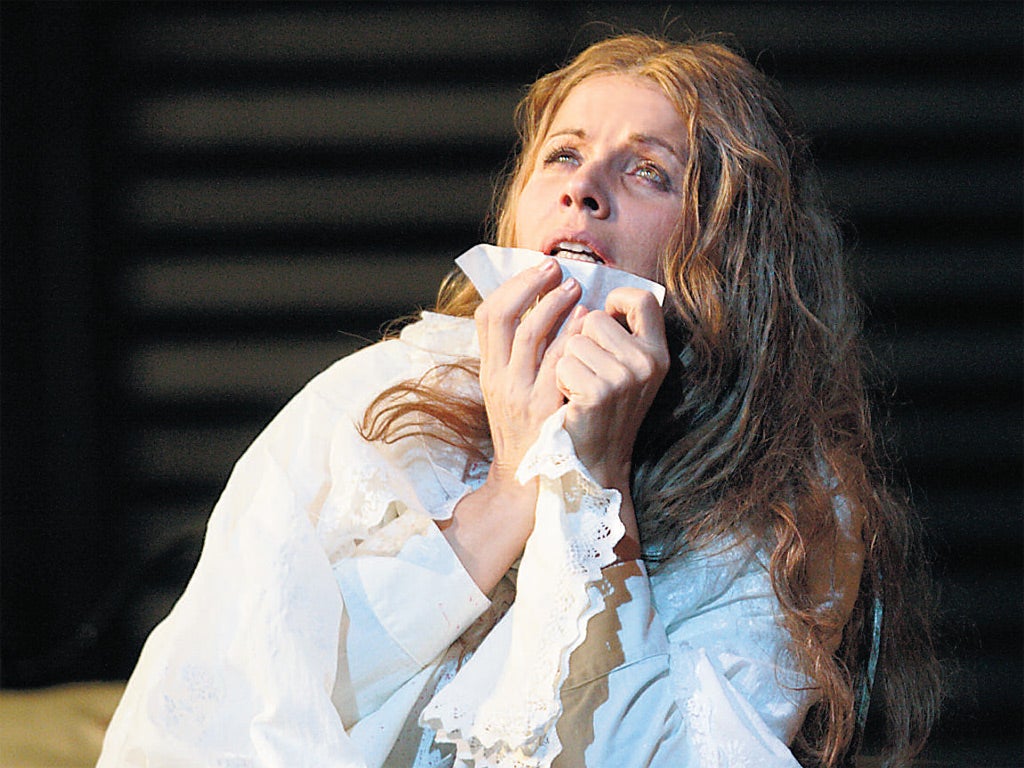
Verdi's La Traviata – literally "The Fallen Woman" – is back at the Royal Opera House. And what a lot of "fallen women" there are in opera. They love, stray and suffer, singing all the while. From La Traviata's heroine, the consumptive courtesan Violetta, to Mark-Anthony Turnage's Anna Nicole, premiered this year, opera itches to punish its heroines. All the art form lacks in its demonisation of passionate women is a boiled bunny.
Mostly, they die. Often, horribly. Largely, they die in the 19th century, but the 20th never quite left them alone. Violetta is the most archetypal. She is the Lady of the Camelias, based on Alexandre Dumas's novella. When she falls in love with Alfredo, his father pressurises her into giving him up to save the family reputation. Eventually he relents, just in time for her to die in Alfredo's arms.
Verdi's operas are peppered with women whose conduct seems to condemn them to terrible ends, voluntarily or not. Rigoletto's daughter, Gilda, lets herself be stabbed to save the odious Duke of Mantua who seduced her. Aida is buried alive; the company in death of her beloved might be small compensation.
Puccini was arguably even better at creating fallen heroines. Madame Butterfly commits suicide when her husband betrays her and tries to take away her child. Suor Angelica swallows poison after learning that the son she bore out of wedlock has died. La Bohème's Mimi, expiring of consumption, may seem innocent – but might the opera's original audience infer that she must be punished for living in sin? It's as if opera possessed an early, inward version of Hollywood's Hays Code, ready to restructure its stories according to its characters' apparent moral failings.
It wasn't always thus: early operas were more ambiguous. Monteverdi's L'incoronazione di Poppea concerns the Emperor Nero's all-consuming love affair with a married woman. The pair stop at nothing, murdering those who obstruct their union – and they get away with it.
Handel's heroines are often faithful, determined spouses, like Rodelinda. Mozart's are human and nuanced, especially when the libretti are by Da Ponte. In Così fan tutte, two sisters are conned into infidelity, yet forgiven (depending on the director); in Don Giovanni, the anti-hero leaves a trail of fallen women in his wake, but it is him, not them, who receives the punishment. Then comes Beethoven's Leonora in Fidelio: the ultimate in marital devotion.
Interestingly, though, Beethoven's story comes in for a lot more criticism than La Traviata. Puccini's La fanciulla del West, which dares to have a happy ending, has never grabbed the hearts of its public like Madame Butterfly or La Bohème.
French opera abounds in capable, faithful heroines – Fauré's Pénélope, Massenet's Charlotte in Werther – but they're not the ones who sell most tickets. Those are Bizet's Carmen, the free spirit whose fate is sealed as soon as she appears; and Gretchen in the Fausts of Berlioz and Gounod, which focus on Faust's affair with Gretchen and its awful consequences.
Wagner's Ring Cycle allows its gods and demigods some brief but extraordinary transgressions. But his preoccupation with the virgin/ whore complex is evident elsewhere. In Tannhäuser, the hero is torn between saintly Elisabeth and Venus herself; Elisabeth goes to heaven to pray for him (she dies). Lohengrin's Elsa is horribly punished for asking her new husband who he really is.
One could blame Romanticism and 19th-century society: many of these stories portrayed the entrapment of women in a hypocritical bourgeoisie. But why are they still popular? Anna Nicole turned its heroine into an archetype just a step away from Violetta, suggesting that our "celebrity" culture is nothing but the same hypocrisy repackaged.
If it's any comfort, if redemption can be found, it is usually granted to the fallen woman, rather than the man who felled her. Gretchen is saved; Suor Angelica dies to the strains of a heavenly choir. As Violetta expires in Alfredo's arms, we could assume, if we so wish, that she will be forgiven in the hereafter.
The bottom line, though, is that there's no arguing with the heart-strings. Opera exists to pull them. And nothing does that job as well as a doomed, passionate heroine who gives all for love, including her life.
'La Traviata', Royal Opera House, London WC2 (020 7304 4000) 3 October to 25 January
Join our commenting forum
Join thought-provoking conversations, follow other Independent readers and see their replies
Comments
Bookmark popover
Removed from bookmarks