Daniel and Michael Barenboim: The family that plays together...
As they prepare for a historic week of Proms, Daniel Barenboim and the leader of his orchestra, his son Michael, talk about discipline and dynasties
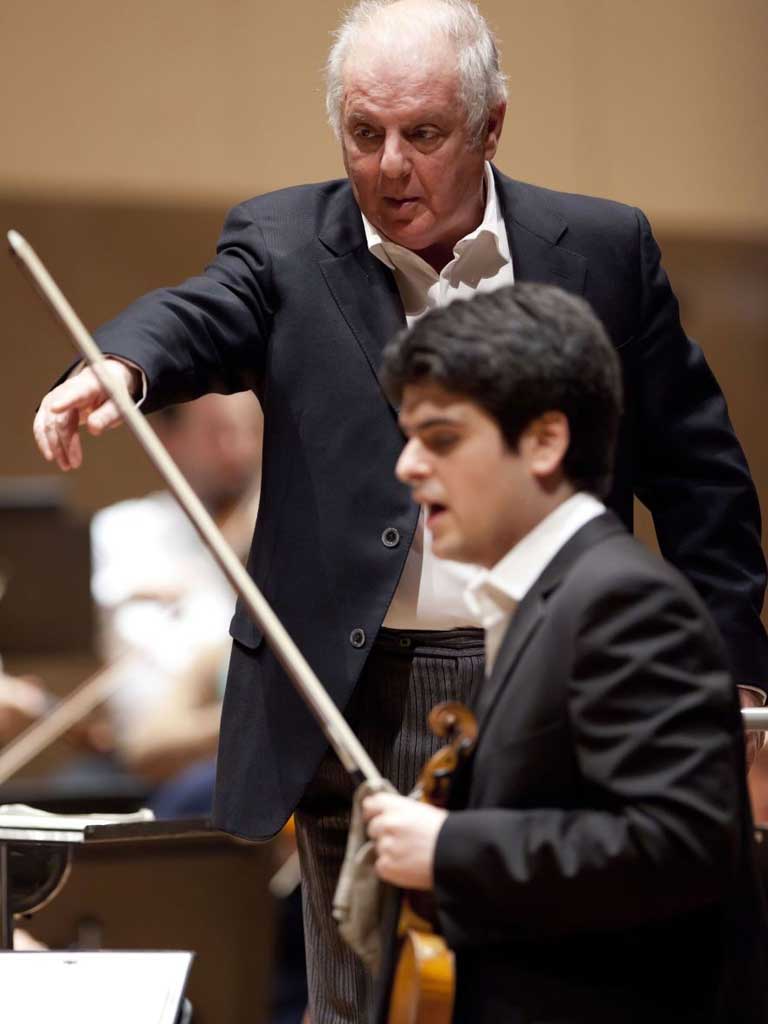
Watch Daniel Barenboim conducting the West-Eastern Divan Orchestra (WEDO) at the Proms this week. Look slightly down to his left. The young man at the front of the first violins is his son. Michael Barenboim, 26, has been concertmaster of the WEDO for nine years. And although he leads the orchestra from just beneath his father's left elbow, it seems he is in no way under his thumb.
It can't be easy to follow in the footsteps of a father – conductor, pianist and deep-thinking idealist – who's widely regarded as a living legend. Compounding the issue, Michael's mother – Daniel's second wife, Elena Bashkirova – is also a well-known pianist, while her father, Dmitri Bashkirov, is a sought-after piano pedagogue. The family rebel is Michael's elder brother, David, who is a rap producer in Berlin.
Such musical dynasties offer their younger members obvious advantages, but often a downside emerges: there's something immense to live up to, both within the family and in the music industry. Michael now has a burgeoning career as a soloist and as first violin of the Erlenbusch String Quartet. Does he feel that his surname is a help or a hindrance?
"It's hard for me to judge," he admits, laughing. "If people talk negatively about me, they'd do so behind my back and I'd never hear about it. But on the positive side I got a great musical education and had opportunities to play for some astonishing people, like Pierre Boulez." The bottom line, he adds, is that when you're a performer you have nowhere to hide. "What counts is how I play. If my performance is good enough, then it is. If it isn't, then no surname can help me."
What about Daniel? Is he is concerned that his son might be judged by his name rather than his playing? "I think he is tough enough to cope with that," declares Barenboim père.
Michael started piano lessons at the age of four, but switched to violin after the Barenboims moved to Berlin in 1992, when Daniel became music director at the Staatsoper. "It wasn't a choice against the piano," Michael says, "but I think it's better to play violin with all these pianists in my family." Daniel himself was the son of two piano teachers: "Music was a totally normal part of my life at home when I was growing up, and of Elena's too. Therefore in many ways it's natural for Michael," he says. He took a reasonably hands-on approach to his son's musical education, helping and advising. "He knows a thing or two", remarks Michael.
Michael joined the WEDO in its second year, when he was a young teenager, and effectively has grown up with the orchestra. "I had most of my musical and human education there," he affirms; and it was here that he got to know his principal teacher, Axel Wilczok, who was coaching the WEDO's violins.
The orchestra itself has matured from a daring, experimental project to a tremendous symbol of Arab and Israeli hopes and dreams. Now it is also a musical powerhouse, ready to take over the Proms with the complete cycle of Beethoven symphonies alongside music by Boulez, culminating with Beethoven's Ninth Symphony next Friday, the opening night of the Olympic Games. Besides leading the orchestra throughout, Michael is the soloist in Boulez's Anthèmes 2.
What does Michael feel he's learned from his father? "To make music successfully you have to combine a rational approach with an emotional approach, and develop a will to do everything 100 per cent," he says. "You can't just play everything with enthusiasm and energy without knowing what you're doing; likewise, you can't just gather information and coldly repeat it. I think that's what all of us in the orchestra have learned from him. He's not only a very energetic person; he also thinks about things in a certain way. This combination makes him what he is."
"When I make music with Michael, I don't think of him as my son," says Daniel. "If I ask him or the first violin section to play something in a certain way, I don't think I'm talking to my son; I think I'm talking to the concertmaster of the orchestra – and I'm very happy we have such a good one. As a musician, Michael has a good balance between the absolutely indispensible sense of rigour in music-making and indispensible fantasy. It's a difficult combination, and most of the time he does it extremely well."
At 18, though, Michael faced a crossroads: should he stick with music full time, or go to the Sorbonne in Paris to study philosophy? "He asked me what I thought," says Daniel. "I said that if you even ask yourself the question, then it's clear you must study philosophy because, as Schoenberg said, one is an artist not because one can be, but because one must be. If you ask the question 'music or something else?' then you must do the something else. In any case, I told him, if you choose the Sorbonne, but one day you decide to go back to music and make that the centre of your life, the philosophy studies will only have been of use to you."
It was an apposite lesson: sure enough, after two years Michael returned to full-time music. "I had to invest more time either in the violin or in my philosophy studies – it was becoming difficult to combine the two in terms of time management," he says. "I took the decision consciously. It wasn't always going to be like this."
In certain ways, he seems a chip off the old block. He's an incisive thinker, clear-headed and pragmatic; and his father's own philosophical bent – evident in his essays and lectures on topics ranging from the links between music and life questions to the attitudes necessary for progress in the Israeli-Palestinian situation – has in recent years become almost as famous as his musicianship.
Time will tell whether Michael's attraction towards philosophy will work its way into writing the way his father's has. But what about conducting? "I'd rather leave that to people who do it better," he says. "The violin is enough for me."
The West-Eastern Divan Orchestra and Daniel Barenboim are at the Proms on 20, 21, 23, 24 and 27 July, televised on either BBC2 or BBC4 and broadcast live on BBC Radio 3. Michael Barenboim plays Boulez's Anthèmes 2 on 24 July (0845 401 5034). WEDO's 'Beethoven for All' CDs are out now on Decca
Join our commenting forum
Join thought-provoking conversations, follow other Independent readers and see their replies
Comments
Bookmark popover
Removed from bookmarks