Gustav Holst - Brought down to earth
Gustav Holst was about much more than the Planets suite, as a new BBC4 documentary reveals. By Jessica Duchen
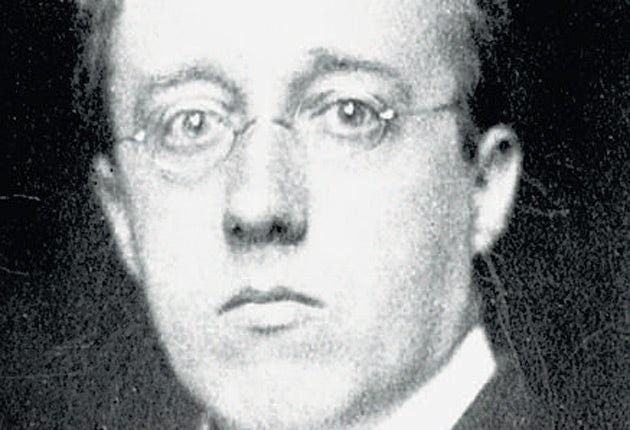
Gustav Holst's The Planets is one of the best-known pieces of classical music written by a British composer. How strange, then, that we know so little of the composer's other music – or, for that matter, of the composer himself. But Tony Palmer's new full-length film about him, In the Bleak Midwinter – due for screening on BBC4 on Easter Sunday – contains more than a few startling revelations about this apparently quiet and enigmatic figure.
First, it turns out that The Planets originally had nothing to do with planets at all. And the composer whose melody (from "Jupiter") became the patriotic hymn "I Vow to Thee, My Country" loathed those words because they were, according to Palmer, "the opposite of what he believed". Holst was a passionate socialist, allying himself during the First World War with a "red priest" in Essex who once pinned to the church door a note announcing "prayers at noon for the victims of Imperial aggression".
Palmer first became interested in Holst when Benjamin Britten told him, during a 1967 interview, that he owed Holst a great deal in terms of influence. And it was in the library of Britten's Aldeburgh home, The Red House, that Palmer eventually viewed letters from Holst that proved his attitude to "I Vow to Thee". Looking at manuscripts of The Planets in the Bodleian Library, Oxford, Palmer was able to see that the title, subtitles and names of planets were afterthoughts to an existing piece. The Planets' first moniker, Palmer says, was simply Seven Large Pieces for Orchestra. Subtitles were added later, and the title "The Bringer of War" only became "Mars" later still. To Holst the "Bringer of War" meant something quite different: Palmer suggests that this extraordinary music depicts the mechanised, industrial capitalism which Holst saw as an impersonal machine threatening to crush humanity, bringing the horror of war as its inevitable companion.
But the central spur of the planned Seven Large Pieces for Orchestra was neither astrological nor political: it was Theosophy. This spirituality, pioneered by Helena Blavatsky, was immensely popular in the late 19th and early 20th centuries, influencing figures as diverse as the Russian composer Alexander Scriabin, the artist Paul Gauguin and the poet WB Yeats. It drew on Eastern philosophies, and Holst was involved in it enough to learn Sanskrit. Many of his works have an intense Eastern flavour, including the three-part suite Beni Mora, his Choral Hymns from the Rig Veda and the operas Savitri and Sita.
The work that became The Planets was conceived as a mystical journey of the evolving spirit: "The Bringer of War" symbolises the lowest level, while "The Mystic", which became "Neptune", is the highest. Holst makes his own place in the journey clear: he worked his name into the music as a driving motif in "The Magician" ("Uranus"). The notes G, S, A, H in German notation (in English notation G, E flat, A, B) stand for "Gustav Holst".
Holst was born in 1874 in Cheltenham to a family of German descent. Sickly and short-sighted, he suffered with neuritis, which affected his right hand and arm so much he could barely hold a pen. In his room at St Paul's Girls' School, where he taught, he would sometimes strap the pen to his finger in order to be able to write. At other times, he enlisted the help of a young teacher and a student. The room was kept as warm as possible, since heat eased the neuritis. This was also why as a young man he lived briefly in Algiers (he rode his bicycle into the Sahara).
But Palmer says it was only when he visited Thaxted in Essex, and saw the church to which Holst gravitated on spotting the red flag inside, that the composer's life began to make sense. "He clearly had very strong socialist sympathies," Palmer says. "He conducted the Hammersmith Socialist Choir, he taught at Morley College, which was set up to bring education to the working classes, and St Paul's Girls' School was doing something similar in a way."
Holst delivered copies of the Socialist Worker from his bicycle around Thaxted, and developed a strong friendship with the Christian Socialist vicar, Conrad Noel. Holst's outlook did not extend to pacifism: he volunteered for army work during the First World War, but was turned down, largely because of his name.
He always remained something of an outsider. He died aged 59; the illness was probably stomach cancer. But The Planets has more than flourished, along with his St Paul's suite and In the Bleak Midwinter.
Why so little else? "Partly it's the overfamiliarity of The Planets," says Palmer. "We know it so well that we think that's what Holst is. But there are other reasons."
Palmer's film tells a moving tale, illustrated with swathes of Holst's startlingly original music. Perhaps it will turn around the fortunes of British music's most unlikely hero.
'Holst: In the Bleak Midwinter' is on BBC4 on Easter Sunday
Join our commenting forum
Join thought-provoking conversations, follow other Independent readers and see their replies
Comments
Bookmark popover
Removed from bookmarks